
TRELLIS 2 ✓
Generate high-fidelity 3D assets from images instantly.
Verdict
A quick read before you dig into the full page.
- Best if
- Generate high-fidelity 3D assets from images instantly
- Skip if
- Complex to implement
- Pick this when
- High fidelity assets
Considering 3D AI Studio instead? Compare side by side
Overview
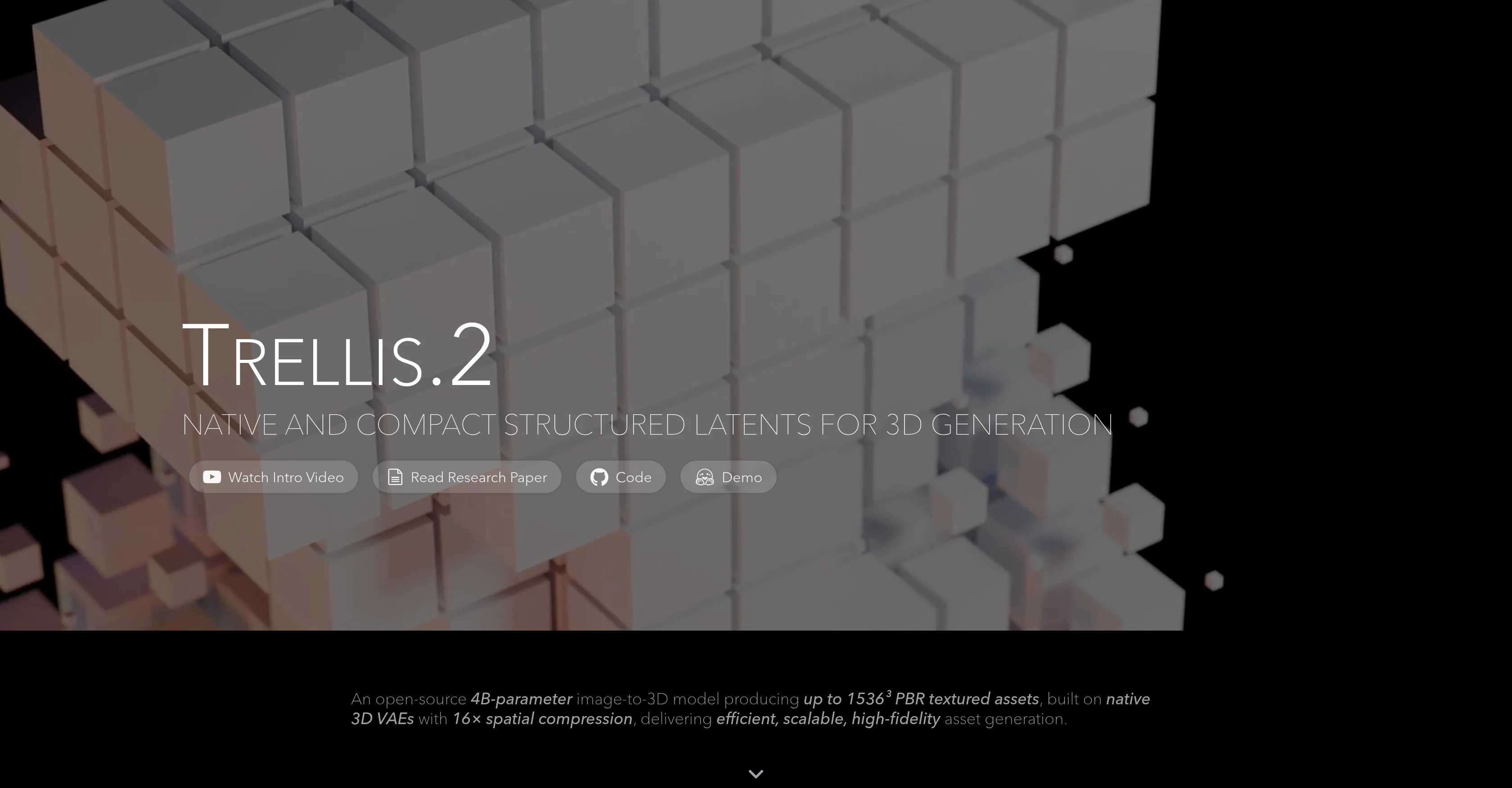
TRELLIS.2 is an open-source image-to-3D model generator, designed to produce high fidelity textured assets using native 3D VAEs. Its core feature makes use of native and compact structured latents, providing both high fidelity and compression capabilities.
The method can handle complex structures, including open surfaces, non-manifold geometry, and enclosed interior structures, thus overcoming the limitations of iso-surface fields.
TRELLIS.2 also has the ability to model arbitrary surface attributes such as Base Color, Roughness, Metallic, and Opacity, thereby facilitating Physically Based Rendering (PBR) and photorealistic relighting.
This tool optimizes the pre- and post-processing of data for training and inference, allowing for quick conversions that are free from rendering and optimization.
It utilizes 'O-Voxel', a novel 'field-free' sparse voxel structure designed to encode detailed geometry and complex appearance simultaneously. A Sparse Compression VAE component is deployed to compress voxel data efficiently, encapsulating fully textured 3D assets into a compact representation with minimal perceptual degradation.
This enables efficient large-scale generative modeling. Its worth noting that TRELLIS.2 is purely a research project with Responsible AI considerations factored into all stages of its development.
Best for
Short scenarios where TRELLIS 2 tends to shine.
-
Generate high-fidelity 3D assets from images instantly.
Example outputs 1
Sample generations and before/after results for TRELLIS 2.
Access & connections
Where you can use TRELLIS 2.
Platforms
Capabilities
What this tool accepts, produces, and is strongest at.
Input
- Image
Output
- 3D
Supported features
- 3D Generation
Pros & cons
Pros
- Open-source
- High fidelity assets
- Handles complex structures
- Models surface attributes
- Supports PBR
- Photorealistic relighting
- Efficient pre-post processing
- O-Voxel encoding
Show 25 more
- Sparse Compression VAE
- Minimal perceptual degradation
- Large-scale generative modeling
- Encodes geometry and appearance
- Handles arbitrary topologies
- Supports full PBR attributes
- Efficient Compression
- Instant image-to-3D conversion
- Flexible Dual Grids representation
- Compact structured latents
- Overcomes iso-surface field limitations
- 1536 PBR textured assets
- Supports Non-manifold geometry
- Handles enclosed interior structures
- Quick data conversions
- Free from rendering optimization
- Handles open surfaces
- 4B-parameter model
- Encapsulates fully textured 3D assets
- Voxel data compression
- Outperforms vanilla DiTs
- Handles Base Color, Roughness, Metallic, Opacity
- Research-focused tool
- Public datasets use
- Minimalistic 3D asset processing
Cons
- Purely a research project
- Requires high-end GPU
- Limited application scope
- Complex to implement
- Potential data biases
- No commercial use intended
- Not user-friendly
- Requires extensive technical knowledge
Show 2 more
- Dependent on NVIDIA H100
- Absolute reliance on O-Voxel
Compare alternatives
Similar tools in the catalog — with a clear reason to open each one.

3D AI Studio ✓
PaidEasily generate free 3D models with our AI-powered 3D AI Studio.
Why look Offers a public API
Full comparison
Mimetic Labs ✓
Free TrialTransform ideas into printable 3D models with AI.
Free + from $9.99
Full comparison
Image3D.io ✓
FreemiumImage to STL and 3D models from any image
Why look Stronger for image work
Full comparison
Hi3D ✓
Free TrialAI-powered 3D model generator with unprecedented precision.
Free + from $17.91/mo
Full comparisonPeople also view
Tools that often show up alongside TRELLIS 2 in collections and comparisons.

Neural4D | Image to 3D ✓
Free TrialTurn photos or prompts into 3D models instantly.
Image3D.io ✓
FreemiumImage to STL and 3D models from any image
Mimetic Labs ✓
Free TrialTransform ideas into printable 3D models with AI.
Hi3D ✓
Free TrialAI-powered 3D model generator with unprecedented precision.

Fast3D ✓
FreemiumTransform text or images into 3D models instantly.
3D AI Studio ✓
PaidEasily generate free 3D models with our AI-powered 3D AI Studio.

Trify3D ✓
Free TrialTurn images and text into 3D models instantly.

Image to STL ✓
PaidTurn 2D images into 3D printable STL files.
Releases 1
FAQ 12
What is TRELLIS.2?
How does TRELLIS.2 generate 3D models from images?
What are the key features of TRELLIS.2?
What kind of structures can TRELLIS.2 handle?
How does TRELLIS.2 handle non-manifold geometry?
What surface attributes can TRELLIS.2 model?
How does TRELLIS.2 facilitate Physically Based Rendering (PBR)?
What is the purpose of the 'O-Voxel' in TRELLIS.2?
How does TRELLIS.2 compress voxel data?
What are the benefits of using the Sparse Compression VAE component in TRELLIS.2?
How efficient is TRELLIS.2 in large-scale generative modeling?
What does it mean that TRELLIS.2 is an open-source project?
Related tools
Recommended

Echoes of History AI ✓
FreeChat with history's greatest minds.

Veo ✓
PaidGenerate high-quality, cinematic videos with AI.

PrompTessor ✓
FreemiumAI Prompt Workspace for Better AI Results

Fliz ✓
Free TrialURLs transformed into captivating videos.

PDF to Video AI ✓
FreeTurn PDFs into professional explainer videos in minutes.

Luma AI ✓
FreeGenerated 3D graphics.
More from this creator

Speech Studio ✓
UnknownCreate stunning AI voices in minutes

Bing Create ✓
FreeCreate stunning images with AI-powered search.

Microsoft Designer ✓
FreemiumCreate stunning designs instantly with AI.

Jarvis/HuggingGPT ✓
FreeBridging LLMs with the ML community

Windows Copilot ✓
FreeUnleash AI-powered productivity on Windows 11

LIDA ✓
FreeGenerate visualizations from data using AI