

3D objects 2026 Rank: #1530
Opolyo ✓
Turn any photo into a full 3D model.
from $16/mo
Verdict
A quick read before you dig into the full page.
- Best if
- Turn any photo into a full 3D model
- Skip if
- Conversion process might be costly
- Pick this when
- Transforms images to 3D models
Considering 3D AI Studio instead? Compare side by side
Overview
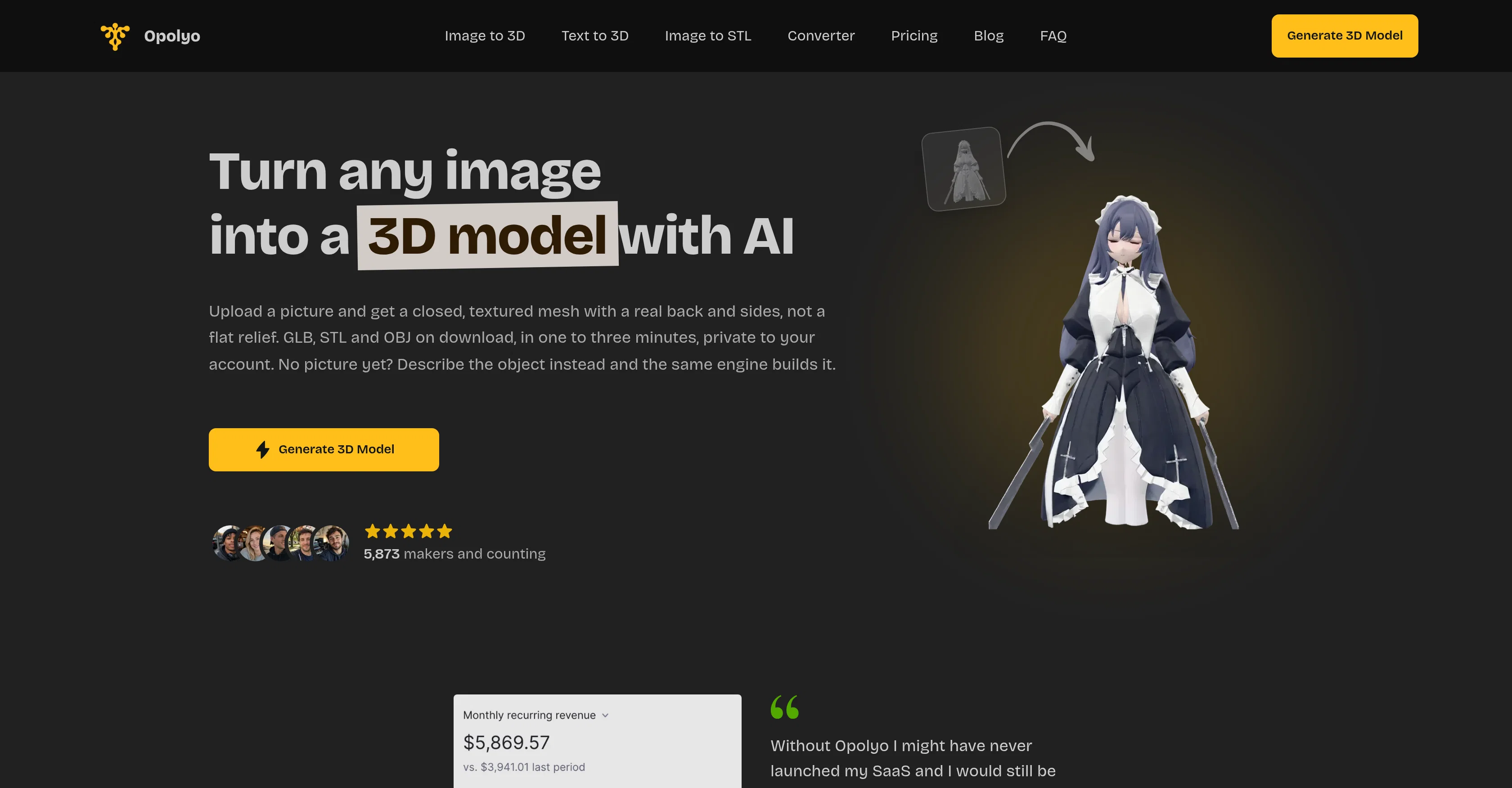
Opolyo is an AI-based tool designed for turning images or text prompts into three-dimensional (3D) models. The tool allows users to upload an image or write a description, which is then processed by an AI to generate a 3D model.
The resulting models feature a closed, textured mesh with a real back and sides, and not a flat relief. The AI tool generates models in various formats including GLB, STL, and OBJ and extends the capability of conversion to FBX and USDZ formats.
Opolyo insures user privacy as every generated model is private to the user's account. They support variety concerning the quality, topology and polygon count of the resulting model, providing users control to set these parameters before generation.
The textures, topology, and faces allow an array of customization, while the diverse formats extend the tools applicability across different applications such as 3D printing to game designing.
Opolyo is useful for various industries such as product design, art and hobby, filmmaking, and gaming where 3D representation is required, providing a quick and efficient way to convert images or textual descriptions into realistic, high-quality 3D models.
Access & connections
Where you can use Opolyo.
Platforms
Capabilities
What this tool accepts, produces, and is strongest at.
Input
- Image
- Text
Output
- 3D
Pros & cons
Pros
- Transforms images to 3D models
- Transforms text prompts to 3D
- Creates closed, textured meshes
- Real back and sides
- Multiple model formats
- Conversion to FBX and USDZ
- User-specific private models
- Quality, topology, polygon control
Show 38 more
- Extensive customization options
- Used across industries
- Efficient conversion process
- High-quality 3D output
- User-friendly tool
- Customizable output
- Supports GLB, STL, OBJ formats
- Privacy Protection
- Realistic 3D models
- Creates 3D for 3D printing
- Generates models for game designing
- Accepts image or text input
- Supports variety of output formats
- Provides quality control
- Supports control of polygon count
- Broad industry applicability
- Enables control of topology setting
- Highly realistic models generated
- Mesh Generation provided
- Textures offer additional customization
- FBX and USDZ conversion
- Quality of output easily adjustable
- User retains full privacy
- Allows per generation quality adjustment
- Enables triangle or quad topology
- Allows face control from 500 to 2,000,000
- Converts images into textured 3D models
- Sets quality, topology, polygon before running
- Works for product design, art
- Useful for filmmaking, gaming
- Efficient model building
- Generator is private to user's account
- Follows the silhouette in pictures
- Works with any uploaded photograph
- Offers commercial license with paid plans
- Refunds failed credits automatically
- Mesh generation comes with back, sides and depth
- Supports both image to 3D and text to 3D conversion
Cons
- No free or trial version
- Requires GPU time
- Credits expiration system
- No public gallery
- Potential interpretation errors for text
- Picture quality impacts result
- Conversion process might be costly
- Constraints on topology and polygons
Show 2 more
- Subscription-based pricing model
- Limitations on file uploading capacity
Compare alternatives
Similar tools in the catalog — with a clear reason to open each one.

3D AI Studio ✓
PaidEasily generate free 3D models with our AI-powered 3D AI Studio.
Why look Offers a public API
Full comparison
Mimetic Labs ✓
Free TrialTransform ideas into printable 3D models with AI.
Why look Typically cheaper
Full comparison
Image3D.io ✓
FreemiumImage to STL and 3D models from any image
Why look Freemium alternative
Full comparison
Hi3D ✓
Free TrialAI-powered 3D model generator with unprecedented precision.
Why look Higher community rating
Full comparison
TRELLIS 2 ✓
UnknownGenerate high-fidelity 3D assets from images instantly.
Why look Higher community rating
Full comparison
Neural4D | Image to 3D ✓
Free TrialTurn photos or prompts into 3D models instantly.
Why look Typically cheaper
Full comparisonReleases 1
FAQ 12
What formats does Opolyo support for 3D model generation?
Does Opolyo maintain user privacy?
Can I customize the quality and topology of the 3D models in Opolyo?
What industries can benefit from using Opolyo?
Can I turn any image into a 3D model using Opolyo?
How does Opolyo handle text prompts?
Can I use Opolyo for 3D printing?
Does Opolyo offer customizable outputs?
How does Opolyo ensure realistic model generation?
Does Opolyo support multiple formats?
How does Opolyo handle mesh generation?
Can I control the polygon count in Opolyo?
Related tools
Recommended

Kick ✓
FreemiumAccounting software that does the work for you

Supernormal App ✓
FreemiumThe AI assistant app that turns meetings into completed work

HappySeeds ✓
FreemiumTurn ideas into AI-powered apps instantly.

AI Effect | AI Video Generator ✓
FreemiumTurn text or images into videos. Pay as you go

SimplePath ✓
Free TrialDescribe your business, get a website instantly.

plori ✓
FreemiumAn AI agent with its own computer.