

Hume AI ✓
Measure and enhance emotional intelligence in AI.
Free + from $0.102
Verdict
A quick read before you dig into the full page.
- Best if
- You are content Creators and need: Generating expressive AI voices for podcasts, voiceovers, and audiobooks
- Skip if
- Limited to specific emotions
- Pick this when
- Empathic Voice Interface
Considering ElevenLabs instead? Compare side by side
Overview
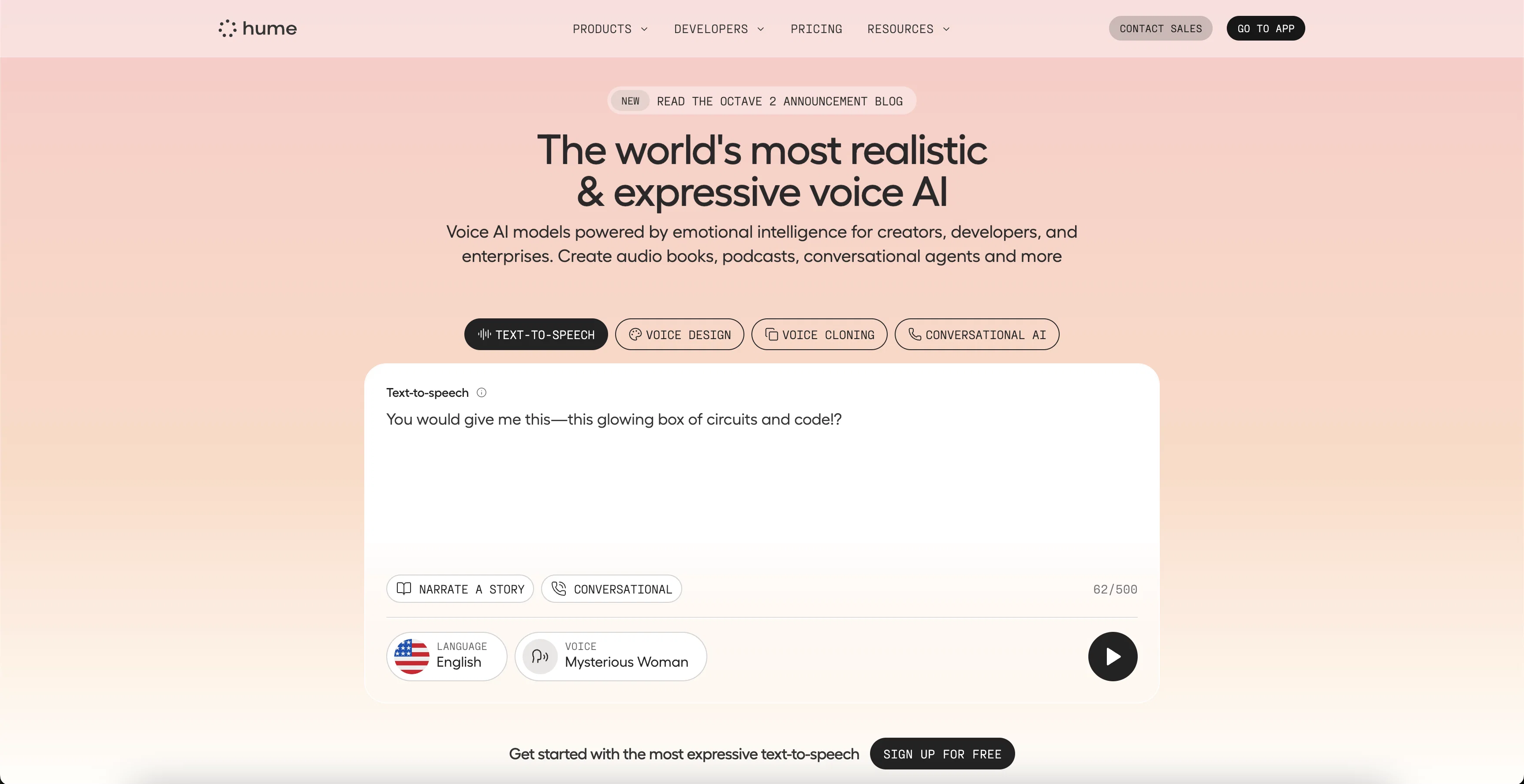
Hume AI is a unique AI suite designed to measure, comprehend, and enhance the influence of technology on human emotions. The platform features several key capabilities, including an Empathic Voice Interface (EVI): a conversation voice API powered by empathic AI.
The EVI is capable of assessing subtle modifications in vocal outputs, steering both language and speech responses. Trained on extensive human interactions, it exemplifies the integration of language modeling and text-to-speech capabilities, supplemented by emotional awareness, prosody, end-of-turn detection, interruptibility, and alignment.Another notable feature of Hume AI is its Expression Measurement API: a tool built on over a decade's worth of research that instantaneously captures the nuances in expressions in audio, video, and images.
This includes a range of expressions such as laughter blending with awkwardness, sighs of relief, nostalgic glances, among others.Hume AI also offers a Custom Model API: a low-code customization ability that provides insights for your application.
This model implemented transfer learning from their high-performance expression measurement models and empathic large language models (eLLMs), and it is capable of predicting almost any outcome more accurately than with language alone.Regardless of the specialization, Hume AI's focus lies with empathic AI with an emphasis on fostering human well-being.
Its commitment to developing empathic technology extends to continuous research in devising foundation models that align with human well-being.
Best for
Short scenarios where Hume AI tends to shine.
-
Generating expressive AI voices for podcasts, voiceovers, and audiobooks.
Best for Content Creators
-
Deploying emotionally intelligent voice agents in any application.
Best for Developers
-
Creating interactive personalities for customer service, virtual assistants, or entertainment.
Best for Businesses
-
Real-time conversational AI for enhanced user experiences.
Best for Researchers
-
Measuring and analyzing emotional expression in various media.
Best for Podcasters
Example outputs 1
Sample generations and before/after results for Hume AI.
Access & connections
Where you can use Hume AI.
Platforms
Capabilities
What this tool accepts, produces, and is strongest at.
Input
- API
Output
- API
Highlights
- SOTA
Supported features
- TTS
- Speech API
Pros & cons
Pros
- Empathic Voice Interface
- Expression Measurement API
- Custom Model API
- Measure subtle vocal outputs
- Steers language and speech
- Language modeling capability
- Integrated text-to-speech
- Emotional awareness feature
Show 39 more
- Prosody detection
- End-of-turn detection feature
- Interruptibility and alignment
- Trained on human interactions
- Interprets nuanced expressions
- Analyzes audio, video, images
- Detects emotion in laughter
- Identifies nostalgic glances
- Low-code customization
- Transfers learning from eLLMs
- Predicts outcomes accurately
- Emphasis on human well-being
- Develops empathic technology
- Researches foundation models
- Interprets vocal and facial expressions
- Instant expression capture
- Captures sighs of relief
- Predicts well-being outcomes
- Single API call responses
- EQ integration
- Alignment with human well-being
- Continuous foundational research
- 10+ years research base
- More accurate than language alone
- Developed for human well-being
- Large language modeling
- Integration of speech analysis
- Trusted by large organizations
- Emphasizes emotional intelligence
- Guides language generation
- Well-being technology integration
- Understands laughter blending awkwardness
- EQ enhancement for text-to-speech
- Audio expression analysis
- Expression measurement models
- State-of-art eLLMs
- Outcome prediction capability
- Unified language modeling
- Broad range of expression capture
Cons
- No multilingual support mentioned
- User privacy concerns
- Complexity in emotion interpretation
- Highly specialized tool
- No offline functionalities
- Continuous internet requirement
- Limited use-cases mentioned
- Limited to specific emotions
Show 2 more
- Potential misinterpretations of emotions
- Dependent on quality of audio/video
Compare alternatives
Similar tools in the catalog — with a clear reason to open each one.

ElevenLabs ✓
FreemiumCreate lifelike AI voices for compelling storytelling.
Why look Offers a public API
Full comparison

VoiSpark ✓
FreemiumCreate human-like voices for content with AI
Why look Better for writing
Full comparison
Free Text-To-Speech ✓
FreeText transformed into customizable spoken output.
Why look Fully free option
Full comparison

People also view
Tools that often show up alongside Hume AI in collections and comparisons.

Replika ✓
FreemiumThe AI companion who cares.
ElevenLabs ✓
FreemiumCreate lifelike AI voices for compelling storytelling.

Notion AI ✓
FreemiumYour all-in-one workspace for notes, docs, and tasks.

Mindsera ✓
FreemiumAI-powered journaling for personal growth and mindset mastery.

Ella ✓
FreemiumMeet Ella, your caring companion.

xpression camera ✓
FreemiumInstantly transform into anyone on video chats and streams.

Motion ✓
Free TrialAI-powered productivity boost for busy people and teams.

Perplexity ✓
FreemiumAI-powered answers to any question, instantly.
Releases 1
In the news
Launch coverage and community mentions for Hume AI.
FAQ 12
What is Hume AI?
What is the Empathic Voice Interface (EVI) in Hume AI?
What is the purpose of the Expression Measurement API in Hume AI?
What does the Custom Model API in Hume AI do?
How does Hume AI use empathic technology to foster human well-being?
How does Hume AI's empathic AI affect language and speech responses?
What kind of expressions can Hume AI's Expression Measurement API capture?
What is the meaning of 'interruptibility' in Hume AI?
What does it mean that Hume AI uses 'empathic large language models (eLLMs)'?
How does Hume AI predict outcomes more accurately with its Custom Model API?
What does the end-of-turn detection feature in Hume AI do?
How is prosody detection used in Hume AI?
Related tools
Recommended
Ella ✓
FreemiumMeet Ella, your caring companion.

Mynd ✓
FreemiumSelf-care app detects patterns & insights in journaling.

PokaMind ✓
FreemiumYour Journey Towards Exceptional Leadership Starts Here

Mindsmith ✓
FreemiumPlatform for building and sharing eLearning content

MindMateGPT: Reflection ✓
FreePersonalized mental health guidance & coping tactics.

My AI Tarot - Free Tarot Card Readings ✓
FreeInsightful guidance tailored to your life's questions.