

Agent management 2026 Rank: #1728
Fly.io ✓
Real computers for AI agents.
Trial; then from $29/mo
Verdict
A quick read before you dig into the full page.
- Best if
- Real computers for AI agents
- Skip if
- Hardware isolation could limit flexibility
- Pick this when
- Hardware-isolated Linux computers
Considering Future AGI instead? Compare side by side
Overview
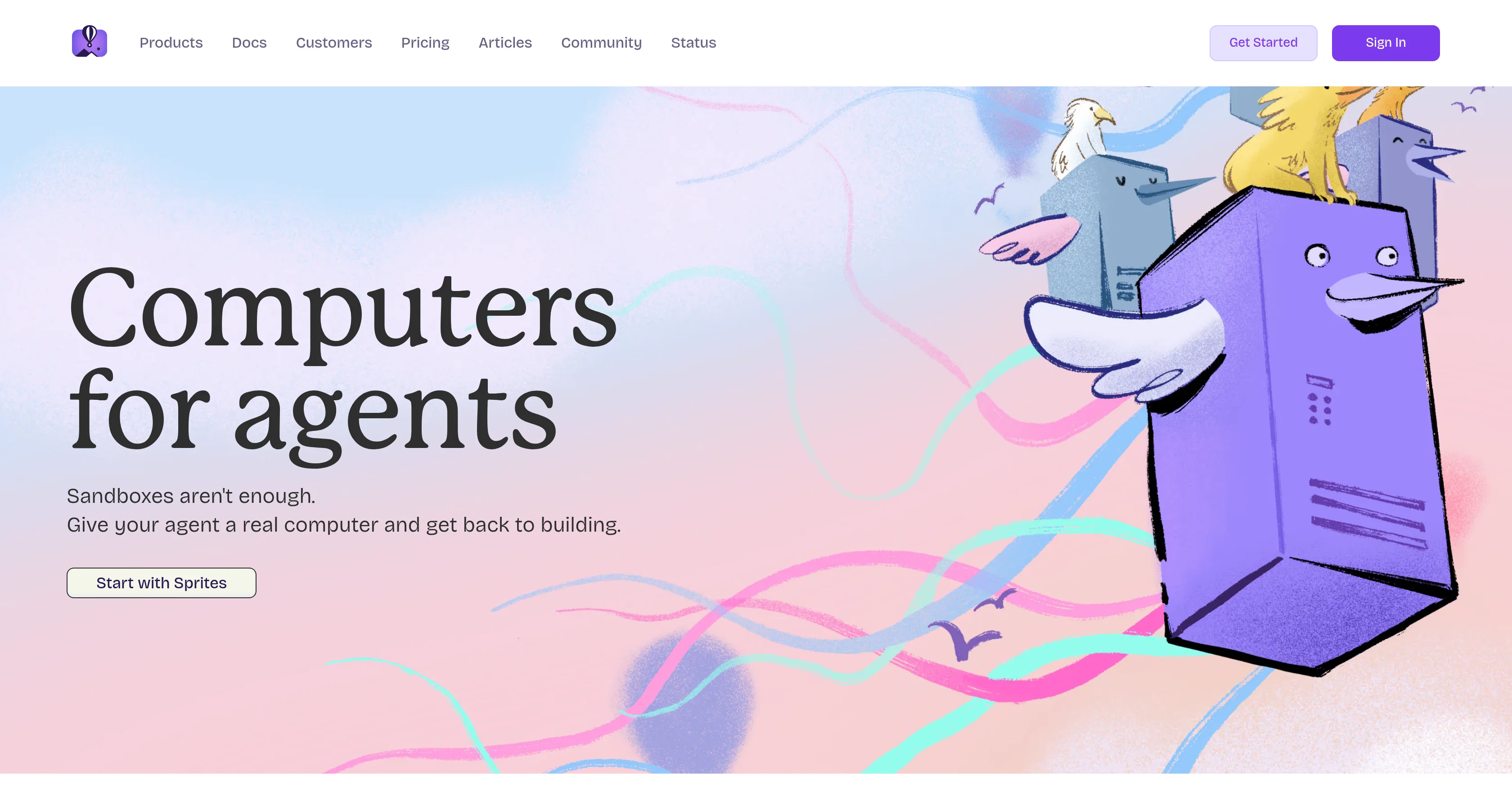
Fly.io is an AI tool designed to facilitate the creation, management, and scaling of digital agents. The core components of the platform are 'Sprites', which are equivalent to real hardware-isolated Linux computers that provide a persistent and secure environment for running agents and applications.
Each Sprite can automatically checkpoint its state while working, resulting in a highly reliable system that always resumes from where it last stopped.
With Fly.io, agents can be assigned their own Sprite that sleeps until needed and wakes up remembering everything. The platform also ensures security and privacy by isolating each machine process and restricting shared state access between users.
Applications built by an agent are delivered through an HTTPS URL, eliminating the need for migration. The service utilises an Object-storage back system that can scale infinitely and allows users to rollback to a previous checkpoint without hassle.
In addition, Fly.io streamlines management tasks for administrators, as the agent handles set up, enabling them to focus on high value tasks. Disk storage scales as per requirement, freeing users from having to size disks upfront.
Another important feature is the Sprites Connector that connects a service once for the entire organization, negating the need to paste a token for each Sprite.
In terms of scalability, Fly.io simplifies the process of moving from a side project to full production without needing to restructure the existing infrastructure.
Overall, it is a tool that offers real computers to AI agents, ensuring greater reliability, efficiency, and scalability for AI projects.
Access & connections
Where you can use Fly.io.
Platforms
Pros & cons
Pros
- Hardware-isolated Linux computers
- Persistent computing environment
- Automatic checkpoint state
- Highly reliable system
- Security and privacy ensured
- Isolated machine processes
- Restricts shared state access
- HTTPS URL application delivery
Show 36 more
- Infinite scaling Object-storage
- Easy checkpoint rollback
- Agent handles setup
- Disk storage scales
- Sprites Connector feature
- Simplifies full production transition
- Applications need not migrate
- Sprite sleeps until needed
- Remembers last state
- User-friendly management tasks
- Efficient infrastructure restructuring
- Granular Routing Monitoring
- Zero Downtime Deploys
- Private Networking
- Full disk capacity utilization
- Autoscaling capabilities
- High value task focus
- User-controlled access settings
- Stateful computation support
- Service connection for organization
- Token pasting not required
- URL retains application
- Egress policy per Sprite
- Untrusted code in VM
- Infinitely scalable object-storage
- Option to rollback checkpoint
- Disk size grows as needed
- Sprite checkpoints itself
- Organizational service connection
- Retains initial API
- Multiple regions available
- Short boot and deploy time
- High uptime SLA
- Granular access permissions
- Automatic key rotation
- Support team with coding experience
Cons
- Hardware isolation could limit flexibility
- Potential for resource underutilization
- Need to handle state management
- Applications anchored to HTTPS URL
- Requires adaptation to Sprites concept
- Autoscaling measures not detailed
- Limited user control over Sprites
- Agent handles setup, less control
Show 2 more
- Disk scaling tied to usage
- Performance depends on agent efficiency
Compare alternatives
Similar tools in the catalog — with a clear reason to open each one.

Future AGI ✓
FreemiumAI Agents hallucinate. Catch it. Fix it fast.
Why look Offers a public API
Full comparison
Plasma AI ✓
UnknownInfrastructure for AI agents at scale.
Why look Higher community rating
Full comparison
Buda AI ✓
FreemiumAI agents that actually run your company.
Why look Typically cheaper
Full comparison
Hermes Agent Helper ✓
PaidDeploy your private AI agent in minutes.
Why look More privacy-focused
Full comparison
Auto Learning Agents ✓
FreeSelf-host your own AI agents in minutes.
Why look Fully free option
Full comparison
Releases 1
FAQ 12
What is the main purpose of Fly.io?
How does Fly.io use 'Sprites'?
How does state checkpointing work in Fly.io?
What security measures does Fly.io have?
How does Fly.io deliver applications built by agents?
Can you describe the Object-storage back system that Fly.io uses?
How does Fly.io handle scalability in terms of infrastructure?
How does Fly.io manage administrative tasks?
How does the Sprites Connector work in Fly.io?
What happens with disk storage on Fly.io?
How does Fly.io handle the process of moving from a side project to full production?
What benefits come with using real computers in Fly.io?
Related tools
Recommended

OlmoEarth by Ai2 ✓
FreeEarth data turned into decision-ready insightsno AI expertise needed.

Visual Studio Code Agents ✓
FreeFrom prompt to finished task, autonomously.

Kick ✓
FreemiumAccounting software that does the work for you

AdControlCenter ✓
Free TrialRun every ad network from one dashboard

Movie Maker Edit ✓
FreeTurn short AI-generated clips into Ads, TV Shows, and Movies in Minutes

AI Book Craft ✓
FreeTurn one sentence into a full story.