

Fabi.ai ✓
AI-powered data analysis: SQL + Python + automation
Free + from $199/mo
Verdict
A quick read before you dig into the full page.
- Best if
- You are data practitioners and need: Ad Hoc Analysis & EDA
- Skip if
- Limited language support (SQL, Python only)
- Pick this when
- SQL and Python integration
Considering Grapha AI instead? Compare side by side
Overview


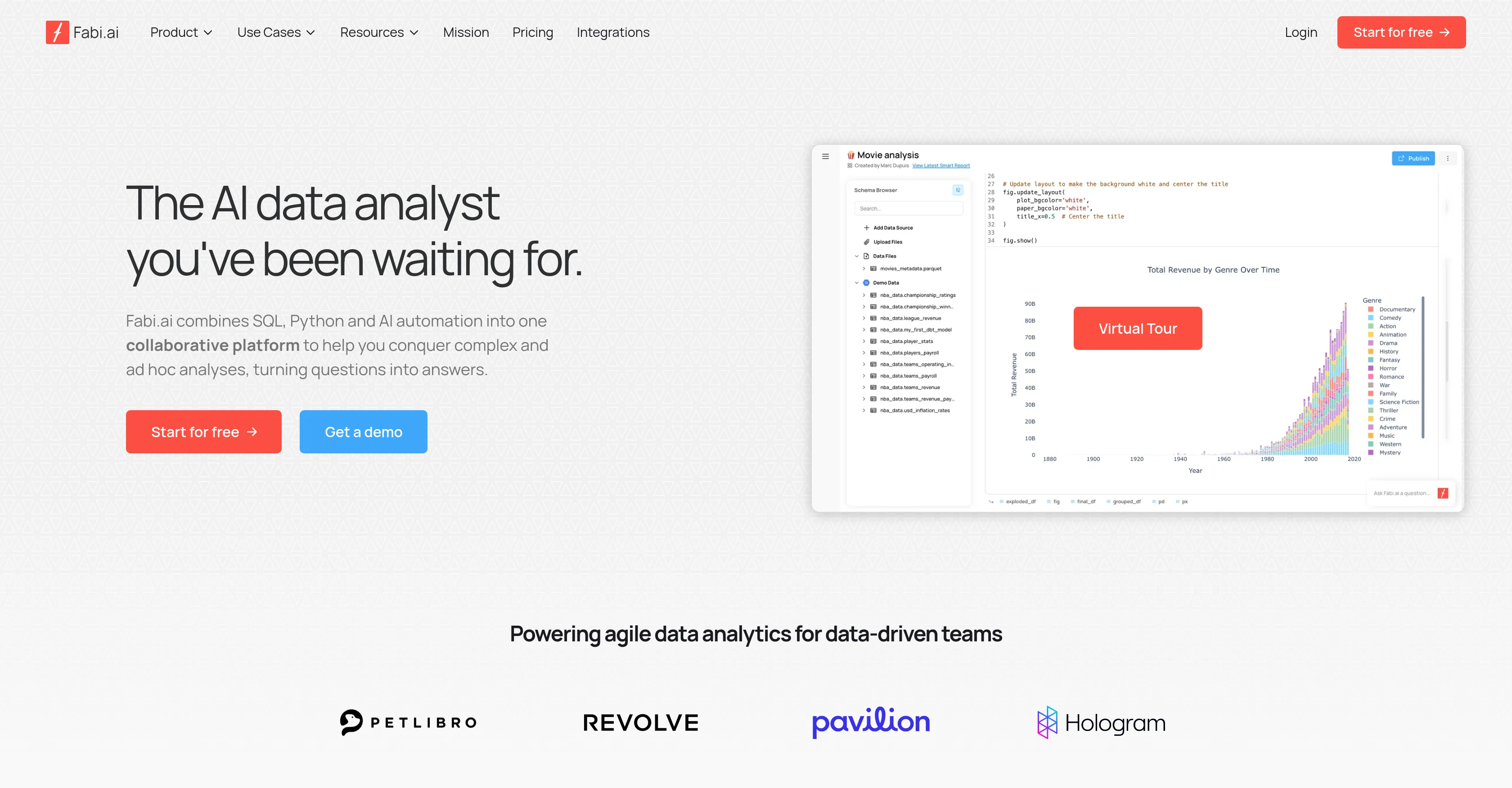
Fabi.ai is an AI-powered data analysis platform that combines SQL, Python, and AI automation into one collaborative environment. This platform helps in conquering complex and ad hoc analyses, transforming queries into answers.
The platform promotes agility in data analytics for data-driven teams by combining the analytical capabilities of SQL and Python in one environment with the added functionality of its AI analyst assistant.
The assistant aids the user in speeding up exploration, coding, and debugging. The platform keeps the entire Python code base in the backend, making it portable, reproducible, and version controlled.
It enables quick ad hoc analytics, where questions can be answered in minutes without having to built new models. Fabi.ai's reactive cells automatically update downstream analyses when upstream data changes, reducing time spent on routine tasks with AI-powered code suggestions.
It also offers automatic reporting, publishing interactive reports with customizable filters on a user-defined schedule. Additionally, it offers advanced statistical modeling and machine learning to power complex business decisions, such as A/B testing analysis, churn prediction, pricing optimization, and sales forecasting.
The platform is designed to be easily integrated with existing data stacks.
Best for
Short scenarios where Fabi.ai tends to shine.
-
Ad Hoc Analysis & EDA
Best for Data practitioners
-
Product Analytics
Best for Data scientists
-
Reporting
Best for Data analysts
-
Collaboration
Best for Product managers
-
Internal Applications
Best for Business analysts
-
GTM Analytics
Best for GTM teams
-
Revenue-generating advanced analysis
Best for Data-driven teams
-
Automatic reporting & storytelling
Best for Data practitioners
Example outputs 1
Sample generations and before/after results for Fabi.ai.
Access & connections
Where you can use Fabi.ai, and what it plugs into.
Platforms
Integrations
Capabilities
What this tool accepts, produces, and is strongest at.
Supported features
- SQL
Pros & cons
Pros
- SQL and Python integration
- Collaborative data analysis
- Speedy exploration, coding, debugging
- Python backend:portability, reproducibility, version-controlled
- Quick ad hoc analytics
- Reactive cells for automatic updates
- Automatic reporting
- Customizable report filters
Show 38 more
- Advanced statistical modeling
- Tailored business decision tools
- Easy data stack integration
- Interactive reports creation
- Real-time data handling
- Centralized data source
- CSV data uploads
- Ad hoc strategic analysis
- Revenue-generating advanced analysis
- Automatic report publishing
- Shareable reports and apps
- In-memory joins for data
- One-click report publishing
- Workflow retained in platform
- Strategic business decision facilitation
- SQL-to-Python seamless workflow
- A/B testing analysis
- Churn prediction analysis
- Pricing optimization tool
- Sales forecasting capabilities
- Existing data stack compatibility
- SOC2 Compliant
- GDPR Ready
- CCPA Ready
- Environment-friendly workflow
- Reduces iteration cycles
- Multiple data source compatibility
- User-friendly interface
- Time efficient
- Better coding experience
- Improved exploratory analysis
- Automated report schedules
- Eliminates manual export/import processes
- Streamlined workflow management
- User-defined customization
- Automatic reactive cell changes
- Efficient ad hoc reporting
- High-level productivity boost
Cons
- Limited language support (SQL, Python only)
- Reactive cells might create dependency
- Non-intuitive for non-coding users
- Lack of detailed customization options
- No offline functionality
- Potential integration issues
- Lack of real-time collaboration features
- Only offers user-defined report schedules
Show 2 more
- Automatic updates may disrupt current analysis
- Features may be overwhelming for beginners
Compare alternatives
Similar tools in the catalog — with a clear reason to open each one.

Grapha AI ✓
PaidUncover hidden trends and patterns in your data effortlessly.
Why look Typically cheaper
Full comparison
DataSquirrel ✓
FreemiumData cleaning & visualization for insights gained.
Why look Typically cheaper
Full comparison
Breadcrumb ✓
FreemiumAutomate data work and reporting with AI Agents. No data|coding skills required.
Why look Typically cheaper
Full comparison
Anomaly AI ✓
FreemiumAI data analysis workspace for business datasets and reports.
Why look Typically cheaper
Full comparison

ChartPixel ✓
FreemiumAI-assisted graphs and insights in 30 seconds!
Why look Typically cheaper
Full comparisonPeople also view
Tools that often show up alongside Fabi.ai in collections and comparisons.
Breadcrumb ✓
FreemiumAutomate data work and reporting with AI Agents. No data|coding skills required.

Seline Analytics ✓
FreemiumSimple, joyful website analytics without cookies.

QuickData.ai ✓
Free TrialExtract T12 and Rent Rolls into Excel with one click.

Overwatch ✓
UnknownReal-time understanding, not noisy intelligence feeds

Mobser ✓
FreemiumAI-powered data analytics for smart reports and visualizations.

Fefi ✓
FreemiumYour AI powered financial dashboard

ExcelDashboard AI ✓
Free TrialTransform Excel files into instant dashboards.

DatumFuse.AI ✓
FreemiumFrom messy spreadsheets to insights in seconds
Releases 1
FAQ 12
What is Fabi.ai?
How does Fabi.ai combine SQL, Python, and AI automation in data analysis?
What is the role of the AI analyst assistant in Fabi.ai?
How does Fabi.ai keep the entire Python code base in the backend?
How does Fabi.ai enable quick ad hoc analytics?
How do Fabi.ai's reactive cells work?
What kind of AI-powered code suggestions does Fabi.ai offer?
How does Fabi.ai offer automatic reporting?
What sort of customization is offered for Fabi.ai’s interactive reports?
What kind of statistical modeling and machine learning does Fabi.ai provide?
How can Fabi.ai help with A/B testing analysis and sales forecasting?
How easily can Fabi.ai be integrated with existing data stacks?
Related tools
Recommended

ANDRE ✓
FreemiumPersonal Synthetic Data Analyst – Available 24/7

Eliza - Your AI Data Copilot ✓
FreemiumAsk data questions, get instant insights, SQL, and charts — all powered

FetchFox ✓
FreemiumScrape any data from any website, with AI

Lido Document Processing ✓
FreemiumAutomate PDF data extraction with AI

VenturusAI ✓
FreemiumBusiness idea analysis and reporting.

Thea ✓
FreemiumAI study tools to master material, not just memorize it.