
AI visibility 2026 Rank: #3018
VisibilityRadar ✓
Find out who AI recommends instead of you.
Verdict
A quick read before you dig into the full page.
- Best if
- Find out who AI recommends instead of you
- Skip if
- No mobile application
- Pick this when
- Multi-model visibility assessment
Considering Loamly instead? Compare side by side
Overview
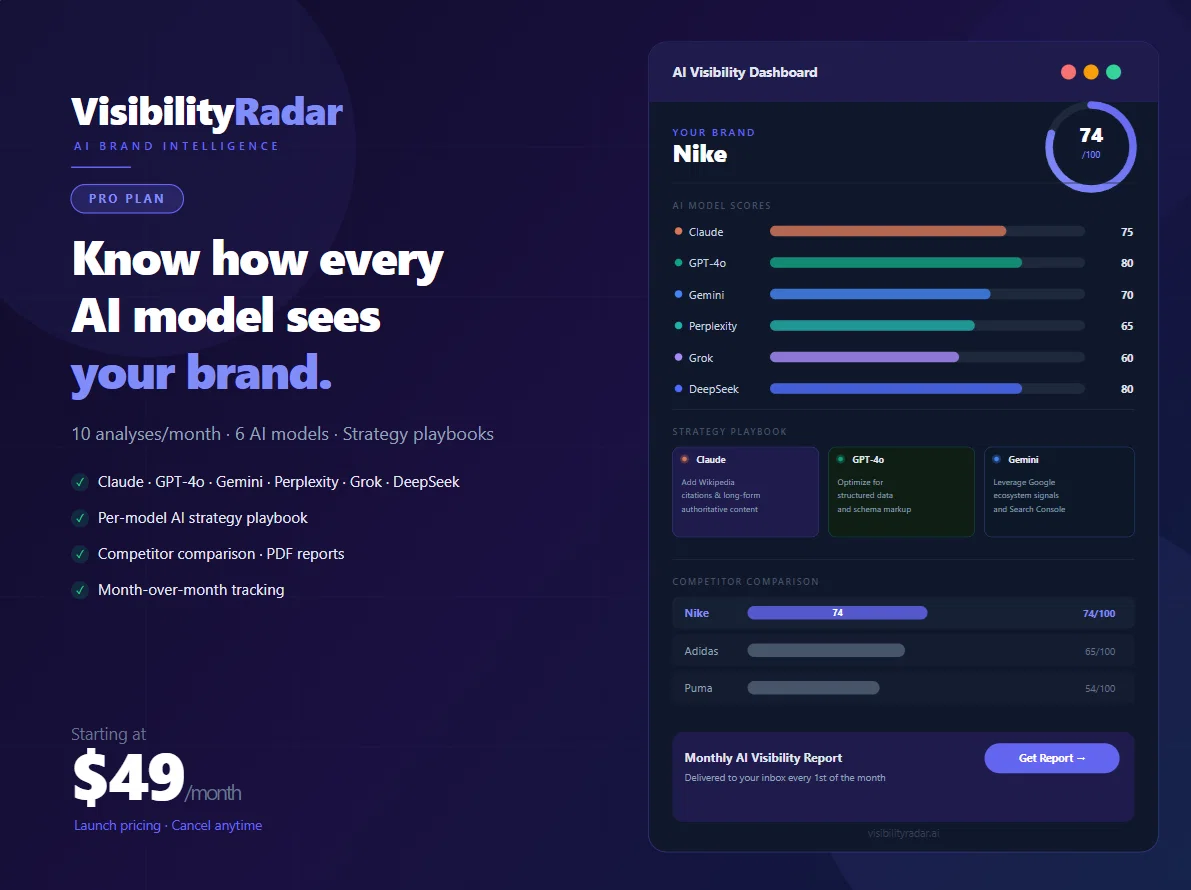
VisibilityRadar is an AI Brand Visibility & GEO Intelligence tool. This tool measures the visibility of brands across AI modes like Claude, GPT-4o, Gemini, Perplexity, Grok, and DeepSeek.
It delivers scores indicating the brand's visibility within each model, and provides a comparative analysis in relation to competitors. The VisibleRadar uses AI strategies to provide recommendations that are designed to increase brand visibility, according to the specific requirements of each AI model.
The report generated by VisibilityRadar includes live AI response analysis, per-model visibility scores, brand comparisons and sentiment analysis. In addition, this tool provides real-time AI strategy insights.
The strategies are designed for different AI models based on what those AI models prioritize for information sourcing. For instance, Claude learns from Wikipedia and long-form articles, Gemini feeds from Google's ecosystem, and Grok focuses on live Twitter feeds.
Therefore, the strategies provided are custom tailored to optimize visibility across all these various models. The tool can also generate custom strategies for each brand after a single analysis.
Finally, VisibilityRadar also factors in trending mentions, influencer content, review volume, and other parameters to ensure a comprehensive analysis of brand visibility.
Access & connections
Where you can use VisibilityRadar, and what it plugs into.
Platforms
Integrations
Capabilities
What this tool accepts, produces, and is strongest at.
Input
- API
- Text
Output
- Tabular
- API
Highlights
- Agents
- API
- MCP
Supported features
- Agents
- API
- MCP
- SEO
- Brand Strategy
- Deep Research
- Search
- Social Media
- Automation
Pros & cons
Pros
- Multi-model visibility assessment
- Per-model visibility scores
- Brand competitor analysis
- Real-time strategy insights
- Trending mentions monitoring
- Influencer content analysis
- Review volume analysis
- Sentiment analysis
Show 26 more
- Custom strategy generation
- Free visibility score
- Brand monitoring capability
- Product or company recommendations
- Visibility score metric
- Brand sentiment gauging
- Strategy playbook provided
- Per-model strategy insights
- Wikipedia presence for Claude
- Google footprint for Gemini
- Twitter live feed for Grok
- Claude, GPT-4o, Gemini, Perplexity, Grok, DeepSeek support
- Real-time web search for Perplexity
- Monitor multiple brands
- Technical documentation for DeepSeek
- Adaptable real-time brand tracking
- Demo without signup
- Single analysis custom strategy
- Covers Gemini's Google ecosystem needs
- Factors trending mentions
- Considers influencer content
- Accounts for review volumes
- Claude's Wikipedia and long-form feeds
- Benchmark against competitors
- Radar intelligence for brand
- Positive/negative brand sentiment analysis
Cons
- No mobile application
- Not open-source
- No API for integration
- Single data point analysis
- No free version available
- Requires high technical knowledge
- No offline mode
- No real-time collaboration
Show 1 more
- Unclear data protection policy
Compare alternatives
Similar tools in the catalog — with a clear reason to open each one.

Loamly ✓
Free TrialSee the visitors ChatGPT sends you — they convert 4x
Why look Typically cheaper
Full comparison
Genrank ✓
Free TrialThe AI Search Platform for marketing teams.
Why look Higher community rating
Full comparison
Lucid Engine ✓
Free TrialTrack Your AI Search Presence in Real Time
Why look Typically cheaper
Full comparison
Trustable ✓
FreemiumSEO Is Dead. What's Next? Rank Higher In ChatGPT Today
Why look Higher community rating
Full comparison
Releases 1
Imported reviews 1
Splitting the advice per model is the sensible part - what sits behind Gemini and what sits behind Grok have almost nothing in common, and generic improve-your-content advice ignores that entirely. The thing I keep running into is lag: a fix aimed at one model can take months to surface in another because the underlying sources refresh at different speeds. Does the report give any sense of that, or is it left to the reader to work out?
FAQ 12
What is VisibilityRadar?
How does VisibilityRadar measure brand visibility?
Can VisibilityRadar analyze competitor's AI visibility score?
How does VisibilityRadar deliver visibility scores?
Can VisibilityRadar produce a custom strategy for each brand?
How does VisibilityRadar generate its analysis and recommendations?
Does VisibilityRadar support real-time AI strategy insights?
What AI models does VisibilityRadar work with?
Does VisibilityRadar provide per-model visibility scores?
What information is included in the report generated by VisibilityRadar?
In which AI model VisibilityRadar factors trending mentions, influencer content, review volume?
What are the parameters that VisibilityRadar use to ensure a comprehensive analysis of brand visibility?
Related tools
Recommended
Pallix ✓
Free TrialTrack how your brand appears in AI answers.

Trovance AI ✓
Free TrialThe growth engine for the agentic web.

Sited ✓
FreemiumSee if AI can find your brand.

RankSurf ✓
Free TrialGet recommended by AI before your competitor does.
VisibAI ✓
Free TrialFind out if AI knows your business exists.

RankBits ✓
FreemiumSee how your brand ranks across AI answers.