

AI visibility 2026 Rank: #2237
Pallix ✓
Track how your brand appears in AI answers.
Verdict
A quick read before you dig into the full page.
- Best if
- Track how your brand appears in AI answers
- Skip if
- Limited platform language options
- Pick this when
- Tracks brand across ChatGPT
Considering Loamly instead? Compare side by side
Overview


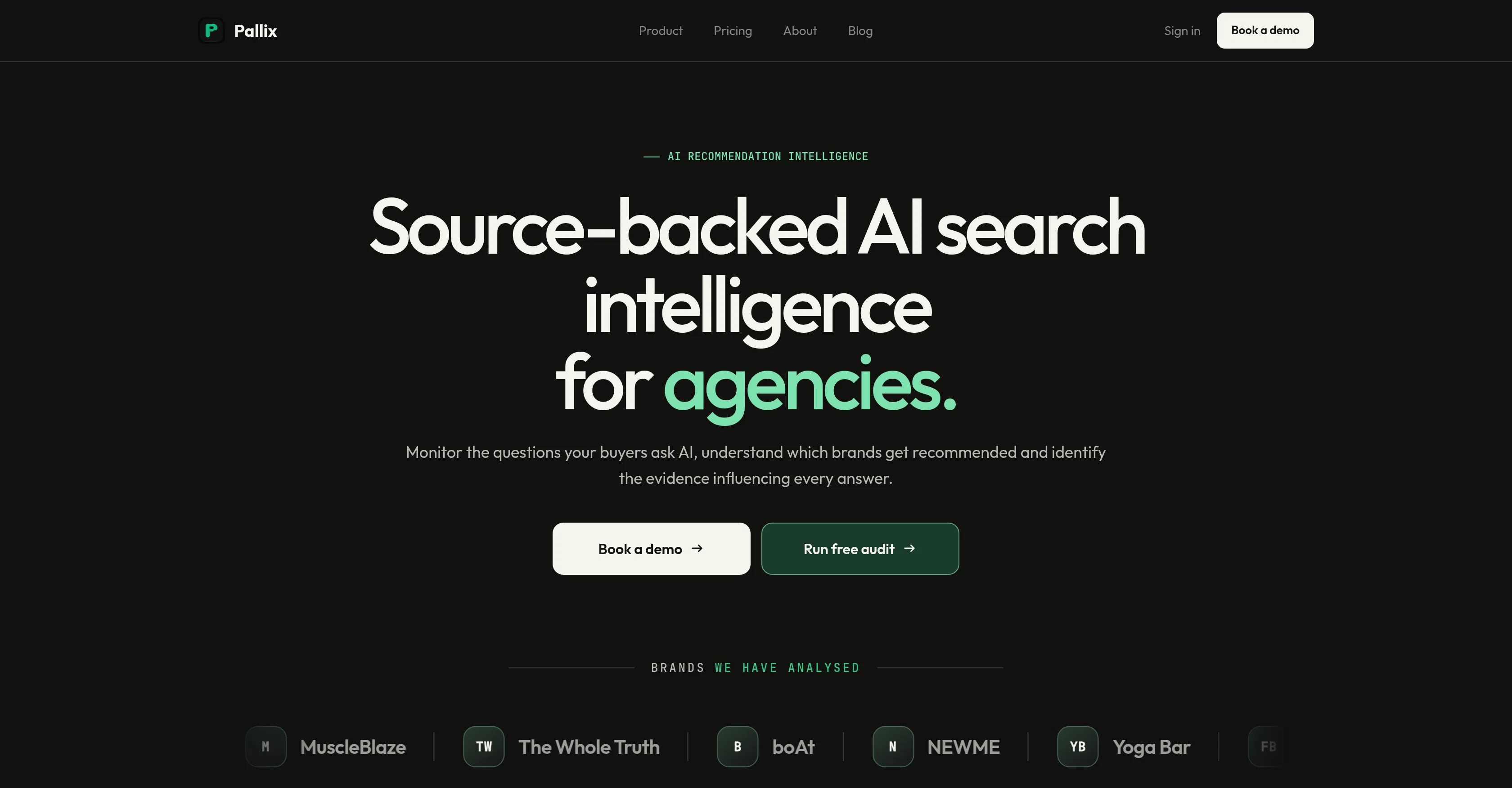
Pallix is a tool powered by artificial intelligence to provide visibility and citation intelligence. It enables users to track the appearance and representation of their brand across various artificial intelligence engines including ChatGPT, Perplexity, Gemini, Google AI and Copilot.
The tool is particularly useful for marketing teams, enterprises, brands, agencies, founders, and freelancers to monitor questions posed by consumers to AI, understand which brands get recommended, and identify the evidence influencing these recommendations.
Inside the Pallix workspace, users can analyze their brand's sentiment, competitors, market intelligence, citation performance, AI sourcing, source gaps and recommended fixes.
It has a function to track AI visibility, AI sourcing, citation intelligence, market intel, prioritized action and impact tracking. Pallix also helps in mapping the exact domains, URLs and communities that are shaping each recommendation.
Furthermore, it provides an option to measure reputation, Reddit, YouTube, marketplaces and editorial signals all in a single evidence view. It offers prioritized recommendation on various actions by ranking content, authority, and technical actions based on expected impact, effort, and the evidence behind them.
- Citation Source Tracking
- Chatgpt Visibility Tracking
- Perplexity Visibility Tracking
- Google Ai Overviews Tracking
- Gemini Visibility Tracking
- Competitor Share Of Voice
- Prompt-level Monitoring
- Brand Sentiment In Ai Answers
- Prioritized Fix Recommendations
- Free Ai Visibility Audit
- Visibility Change Alerts
- Exportable Reports
Access & connections
Where you can use Pallix, and what it plugs into.
Platforms
Integrations
Capabilities
What this tool accepts, produces, and is strongest at.
Input
- Text
Output
- Tabular
- Text
- Image
Highlights
- SOTA
- No Signup
Supported features
- No Signup
Pros & cons
Pros
- Tracks brand across ChatGPT
- Gathers citation intelligence
- Analyzes brand sentiment
- Performs competitor analysis
- Market intelligence offerings
- Highlights source gaps
- Provides recommended fixes
- Domain Mapping capability
Show 23 more
- URL Tracking feature
- Comprehensive community analysis
- Reputation measurement
- Reddit analysis included
- YouTube analysis incorporated
- Marketplace evaluation offered
- Single evidence view
- Prioritized action recommendations
- Impact tracking feature
- Content ranking process
- Cross-platform analytics
- Authority scoring technique
- Technical action ranking
- Offers marketing automation
- SEO related features
- Brand management functionalities
- Mapping communities influencing recommendations
- Editorial signals measurement
- Country-specific execution
- Local buyer language analysis
- Market-native sources tracking
- Category-specific prompts monitoring
- Action prioritization based on impact
Cons
- No mobile app
- Limited platform language options
- No offline functionality
- No multi-user access
- No real-time updates
- No security features listed
- No open API provided
- No training resources available
Show 1 more
- Undisclosed pricing structure
Compare alternatives
Similar tools in the catalog — with a clear reason to open each one.

Loamly ✓
Free TrialSee the visitors ChatGPT sends you — they convert 4x
Why look Higher community rating
Full comparison
Genrank ✓
Free TrialThe AI Search Platform for marketing teams.
Why look Offers a public API
Full comparison
Lucid Engine ✓
Free TrialTrack Your AI Search Presence in Real Time
Why look Typically cheaper
Full comparison
Trustable ✓
FreemiumSEO Is Dead. What's Next? Rank Higher In ChatGPT Today
Why look Offers a public API
Full comparison
Are you found by AI? ✓
FreemiumFree scan: Make AI recommend your business
Why look Offers a public API
Full comparison
Releases 1
Imported reviews 2
Source gaps is the part I would build the whole workflow around. Most teams can see that they are missing; far fewer can see that the engines are leaning on two industry directories nobody in the company has ever heard of. Do you rank those gaps by how reachable they are? A trade association page and a major publisher are worlds apart in effort, and a flat priority list hides that.
AI recommendations often depend on sources most brands don’t know they’re being judged by. Does Pallix show which specific pages, Reddit discussions, videos or other sources are influencing an AI engine’s recommendation so teams know exactly where to focus their efforts?
FAQ 12
How does Pallix monitor brand representation across different AI engines?
Can Pallix analyze a brand's sentiment, competitors, and market intelligence?
What are the key features of the Pallix workspace?
How does Pallix contribute to AI sourcing and citation intelligence?
How does the impact tracking feature on Pallix work?
Does Pallix provide a map for domains, URLs and communities influencing recommendations?
Can Pallix measure reputation across Reddit, YouTube, and other marketplaces?
What is the function of the single evidence view in Pallix?
How does Pallix prioritize recommendations?
Can I track how my brand appears in AI answers with Pallix?
What are the benefits of Pallix's AI monitoring and brand management features?
Does Pallix offer analysis of competitor's brand visibility and citation performance?
Related tools
Recommended

Gandr ✓
Free TrialUnlimited text-to-speech for AI voice agents.

GetLogit ✓
FreemiumArtificial intelligence, available for everyone.

ChatGPT ✓
FreemiumAsk anything, create anything, and move from idea to action.

Notis ✓
Free TrialThe first WhatsApp assistant that runs on your ChatGPT and Claude subscriptions
freebeat AI ✓
FreemiumTurn Music & Ideas into Viral Videos In One Click

Jason AI ✓
PaidAI-powered assistant for B2B sales outreach