
Business intelligence v1.1.1 2026 Rank: #530
Mel by Skymel- Persistent Open-Web intelligence Infr... ✓
Open-source intelligence infrastructure for teams and agents
Trial; then from $150/mo
Verdict
A quick read before you dig into the full page.
- Best if
- You are individuals seeking personal assistance and need: Best for Individuals seeking personal assistance
- Skip if
- You are not ready to evaluate a time boxed trial
- Pick this when
- Free Trial · Trial; then from $150/mo
Considering Columns instead? Compare side by side
Overview


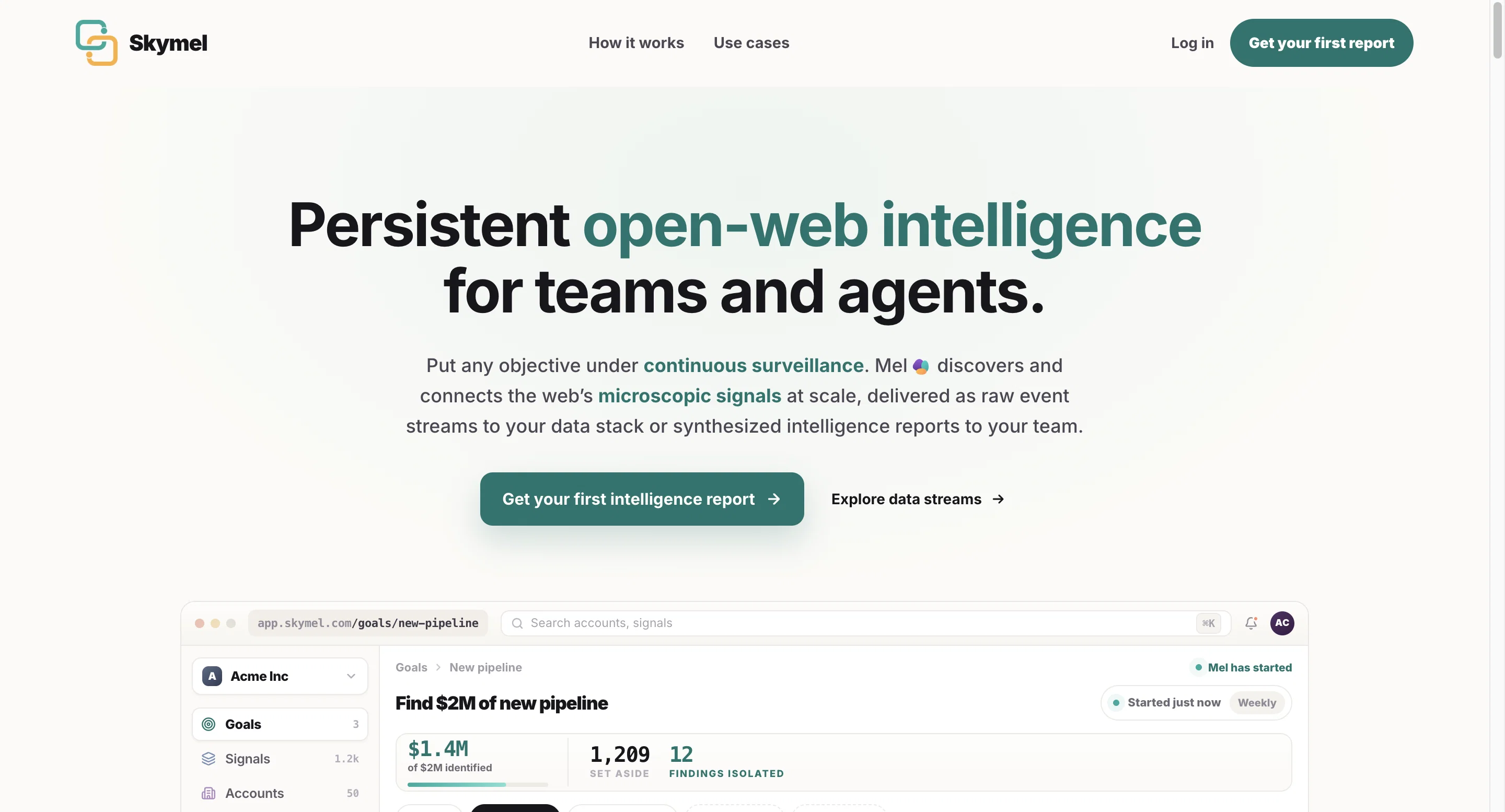
Open Source Intelligence (OSINT) is the discipline of tracking massive volumes of fragmented public information to anticipate a target’s next move. For decades it was restricted to defense agencies and enterprise risk teams backed by armies of analysts.
Mel automates that discipline for everyone else.
Tell Mel what kind of data or intelligence you need from the open web. That becomes the objective.
Mel figures out where to look, discovers the relevant sources, collects the signals, resolves the entities behind them, and keeps connecting what it finds as new information appears.
Want the data? Signal Mode streams it into your agents, models, or systems.
Want the answer? Intelligence Mode turns it into a report on what it means for your objective and what to do next.
First report is free.
- Web Search
- Osint
- Web Scraping
- Open Source Intelligence
- Data For Agents
Best for
Short scenarios where Mel by Skymel- Persistent Open-Web intelligence Infr... tends to shine.
-
Best for Individuals seeking personal assistance
Best for Individuals seeking personal assistance
-
Best for Families needing planning tools
Best for Families needing planning tools
-
Best for Homeowners requiring problem-solving guidance
Best for Homeowners requiring problem-solving guidance
-
Best for Shoppers looking for gift ideas
Best for Shoppers looking for gift ideas
-
Best for Parents/Guardians for storytelling
Best for Parents/Guardians for storytelling
-
Best for Business professionals for analysis and reporting
Best for Business professionals for analysis and reporting
Example outputs 1
Sample generations and before/after results for Mel by Skymel- Persistent Open-Web intelligence Infr....
Access & connections
Where you can use Mel by Skymel- Persistent Open-Web intelligence Infr..., and what it plugs into.
Platforms
Capabilities
What this tool accepts, produces, and is strongest at.
Input
- Text
- Image
- Audio
- API
Output
- Text
- Image
- Audio
- API
Highlights
- SOTA
- Agents
- API
- MCP
- No Signup
Supported features
- Agents
- API
- MCP
- No Signup
- Data Analysis
Models
Text
Image
Audio
Coding
Compare alternatives
Similar tools in the catalog — with a clear reason to open each one.

Analytify - A GenBI Platform ✓
Free TrialAI-powered analytics that unlock smarter business insights.
Why look Typically cheaper
Full comparison
Vizologi ✓
Free TrialAI to boost your business strategy.
Why look Typically cheaper
Full comparison
Springboard ✓
FreeKickstart workshops with instant market insights.
Why look Fully free option
Full comparison
Jeda AI ✓
FreemiumAI workspace canvas for instant productivity.
Why look Typically cheaper
Full comparisonPeople also view
Tools that often show up alongside Mel by Skymel- Persistent Open-Web intelligence Infr... in collections and comparisons.
Vizologi ✓
Free TrialAI to boost your business strategy.
Springboard ✓
FreeKickstart workshops with instant market insights.
Jeda AI ✓
FreemiumAI workspace canvas for instant productivity.

Columns ✓
FreemiumAutomate clear insights from any data
Analytify - A GenBI Platform ✓
Free TrialAI-powered analytics that unlock smarter business insights.

KnowInsideIQ ✓
FreemiumKnow every market signal. Decide better.

DealNavigator.Ai ✓
FreemiumAI-powered deal intelligence for smarter negotiations.

Cube ✓
FreemiumAI analytics your team and customers can trust.
Releases 3
Get the public-web data or intelligence you need at a microscopic contextual depth that ordinary search, feeds, and one-off research can’t reach.
Meet Mel — open-source intelligence infrastructure for teams and agents.
Open Source Intelligence (OSINT) is the discipline of tracking massive volumes of fragmented public information to anticipate a target’s next move. For decades it was restricted to defense agencies and enterprise risk teams backed by armies of analysts.
Mel automates that discipline for everyone else.
Tell Mel what kind of data or intelligence you need from the open web. That becomes the objective.
Mel figures out where to look, discovers the relevant sources, collects the signals, resolves the entities behind them, and keeps connecting what it finds as new information appears.
Want the data? Signal Mode streams it into your agents, models, or systems.
Want the answer? Intelligence Mode turns it into a report on what it means for your objective and what to do next.
First report is free.
Skymel LEGATO turns your goal into a tested agent workflow, then ships the passing version as an API.
It builds the workflow, chooses the right runtime for each step, tests normal and edge cases, fixes what breaks, and deploys the version that passed.
Long description:
Skymel LEGATO is an Autonomous Agent Design & Deployment Kit for teams building reliable production agents.
Most agents rely on one LLM looping through a task. LEGATO takes a different approach.
Give it a goal. LEGATO builds a bespoke agent workflow, connects the steps, and chooses the right runtime for each part: TOOL, LLM, Code-Gen, or ML coming soon.
Then it tests the workflow against normal, edge, and failure cases. When something breaks, LEGATO applies fixes. When the workflow passes, LEGATO freezes that version and ships it as an API.
What you test is what deploys.
Try the Playground or Book a Demo
FAQ 12
What exactly is Skymel LEGATO?
🛠️ 2
tools
🙏 20
karma
wrote:
Skymel LEGATO is an Autonomous Agent Design and Deployment Kit. It allows you to go from a single prompt to a production-ready agent in hours rather than months. It automates the massive manual effort typically required to plan, test, and harden an AI agent for real world use.
Can I not just build production agents with existing tools?
🛠️ 2
tools
🙏 20
karma
wrote:
You can, but the process is a massive manual grind. Most tools help you get a "skeleton" demo working quickly, but they leave the hard work to you. You are stuck manually wiring tools, testing for edge cases, validating outputs, and patching failures. LEGATO is different because it builds the "muscles" too. It automates the entire planning and validation phase so you can ship a reliable agent behind an API instead of a fragile prototype.
Why does moving from demo to production take 1,000+ engineering hours?
🛠️ 2
tools
🙏 20
karma
wrote:
The first demo is cheap because it only has to work on few test cases and expectation from it is low. Production agents have to work every time. Without LEGATO, engineers burn over 1,000 hours manually creating test inputs, finding where the logic breaks, tweaking prompts, and re-validating the entire workflow. LEGATO compresses this by auto-generating test runs and self-correcting the plan until every edge case passes.
Does LEGATO actually handle the testing and fixing for me?
🛠️ 2
tools
🙏 20
karma
wrote:
Yes. LEGATO generates a near-correct plan on the first shot and assigns the best resource (Code, ML, or LLM) to each task. It then runs simulated and live execution tests. If a node fails, the framework identifies the failure mode and fixes the logic automatically. You only deploy the version that has already proven it can handle the pressure.
If the agent workflow is "frozen," can it still adapt in the wild?
🛠️ 2
tools
🙏 20
karma
wrote:
Freezing the workflow ensures that your core logic and costs stay predictable and auditable. However, the execution engine is highly intelligent. It has smart retries and fallbacks baked into every node based on real execution data. This means your agent stays within its engineered boundaries while still being smart enough to adapt to messy, real-world inputs.
How does LEGATO choose between Code, ML, and LLM calls?
🛠️ 2
tools
🙏 20
karma
wrote:
Most agents use an LLM for everything, which is slow and expensive. The LEGATO framework analyzes each task in your goal and picks the right resource for the job. If a task requires a deterministic calculation, it uses Code. If it needs pattern recognition, it uses an ML model. It only uses LLM calls where reasoning is actually required.
Where do these agents run once deployed?
🛠️ 2
tools
🙏 20
karma
wrote:
You have complete control over deployment. You can run your workflows on the Skymel managed cloud for zero-infra scaling, or deploy on-prem within your own network. We also support edge deployment for latency-sensitive tasks and offer privacy-first configurations where no data is used for model training.
What is the pricing for running these agents?
🛠️ 2
tools
🙏 20
karma
wrote:
We believe in a "pay for what you build" model. You pay a monthly base plus metered usage while you are in the planning and testing phase. Once you deploy your agent as an API, there are no additional platform fees. You only pay for the raw infrastructure and token costs of your execution.
How does Skymel OA make AI task automation and workflows future-proof?
What is the effort required to integrate Skymel OA?
How does Skymel OA choose the optimal model for each request?
What balance does Skymel OA aim for between privacy and performance?
Related tools
Recommended

Thea ✓
FreemiumAI study tools to master material, not just memorize it.

Recall ✓
FreemiumSummarize Anything, Forget Nothing!

Younet ✓
Free TrialAI Agent Orchestration and Automation. Build your agentic business.

Automateed ✓
Free TrialCreate eBooks effortlessly with Automateed, the AI-powered writing tool.

remio: Your Personal ChatGPT ✓
FreemiumGet Tailored Answer with Your Personal ChatGPT

SachaSoft ✓
FreemiumAI LinkedIn post generator trained on top creators.