

Business intelligence 2026 Rank: #1741
Cube ✓
AI analytics your team and customers can trust.
Free + from $40/mo
Verdict
A quick read before you dig into the full page.
- Best if
- AI analytics your team and customers can trust
- Skip if
- API may be complex
- Pick this when
- Semantic layer architecture
Considering Columns instead? Compare side by side
Overview
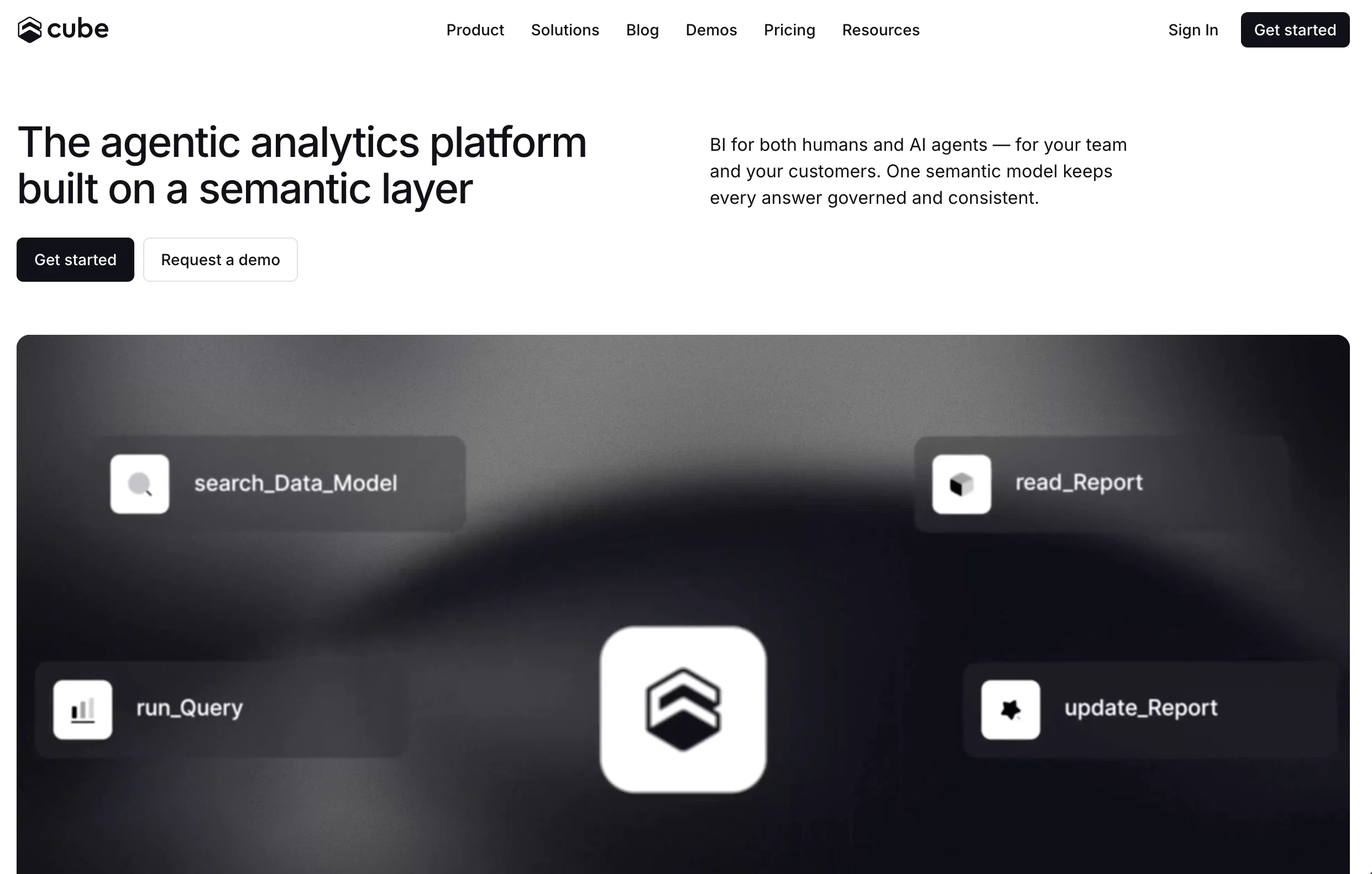
Cube is an analytics platform constructed on a semantic layer, offering AI-native business intelligence and embedded analytics. The platform focuses on providing consistent and trustworthy answers for both team and customer queries.
Cube's functionality is rooted in the semantic model that it's built on, managing data and analytics from end to end. The platform aids in grounding the Analytics Chat, workbooks, and dashboards on a single governed model ensuring all answers are consistent with the same data.
Cube's embedded analytics platform presents an AI-driven service that multiple SaaS companies trust to deliver customer-facing analytics. It also allows for the creation of a tailor-made AI analytics experience through its Analytics Chat API.
Additionally, Cube includes a feature called Creator Mode, which lets consumers construct their own workbooks and dashboards. An important characteristic of Cube is its commitment to consistent definitions across all its surfaces.
This extends to its AI-driven tools, enabling natural language analytics, allowing queries to be asked in plain English, and answers directly tied to the semantic model.
This contributes to accuracy and consistency of responses, regardless of the questioner. Known for its semantic layer, Cube can effectively scale AI utility, while ensuring a consistent, understandable, and correct answer.
Businesses use Cube as a primary source for metric definitions, powering customer-facing dashboards and AI-driven business reviews. It reduces the complexities involved in accessing and managing various data, thereby saving teams valuable hours.
Access & connections
Where you can use Cube.
Platforms
Capabilities
What this tool accepts, produces, and is strongest at.
Input
- API
Output
- API
Pros & cons
Pros
- Semantic layer architecture
- Consistent, trustworthy analytics
- Analytics Chat API
- Offers Creator Mode
- Natural language analytics
- Same answers regardless of questioner
- Powers customer-facing dashboards
- Reduced data management complexities
Show 24 more
- Trusted by multiple SaaS companies
- Analytics grounded in semantic model
- Consistency across all surfaces
- Metric definitions source
- Data accessibility
- Embedded analytics in SaaS
- UI control with Core Data APIs
- Customized analytics UI branding
- Multi-tenant architecture
- End-to-end governance
- Plain English query capability
- Analytics for data team
- BI for everyone in team
- Claude, ChatGPT, Slack compatibility
- Analytics Chat builds queries
- Semantic definitions for accurate answers
- Eliminates multiple same-metric queries
- Saves team hours
- Analytics chat and Dashboard iframes
- Customer can build their own workbooks, dashboards
- Embedding ability inside the app
- Is part of the agentic analytics ecosystem
- Provides accurate, contextualized answers
- Single source of truth for metrics
Cons
- Requires semantic layer understanding
- Limited customization
- API may be complex
- No mention of offline use
- Creator Mode may confuse users
- No explicit multi-language support
- Possible steep learning curve
- No explicit real-time analytics
Show 1 more
- Memory and CPU intense
Compare alternatives
Similar tools in the catalog — with a clear reason to open each one.


Analytify - A GenBI Platform ✓
Free TrialAI-powered analytics that unlock smarter business insights.
Why look Typically cheaper
Full comparison
Vizologi ✓
Free TrialAI to boost your business strategy.
Why look Typically cheaper
Full comparison
Springboard ✓
FreeKickstart workshops with instant market insights.
Why look Fully free option
Full comparison
Jeda AI ✓
FreemiumAI workspace canvas for instant productivity.
Why look Typically cheaper
Full comparisonReleases 1
FAQ 12
What is the main functionality of Cube?
How does Cube's semantic model contribute to its performance?
Can Cube manage data and analytics from end to end?
What is the purpose of Cube's Analytics Chat?
Does Cube offer a custom AI analytics experience and how?
What is Creator Mode in Cube?
How does Cube ensure consistency across all its surfaces?
What are the benefits of Cube's natural language analytics?
How does Cube scale AI utility?
Can businesses use Cube for metric definitions?
How does Cube contribute to customer-facing dashboards and AI-driven business reviews?
Does Cube help in managing and accessing various data?
Related tools
Recommended

freebeat AI ✓
FreemiumTurn Music & Ideas into Viral Videos In One Click

Whacka ✓
Free TrialTurn ideas into real apps from your phone.

Kinovi - AI Video Generator ✓
Free TrialAI video generator powered by Seedance 2.0

Movie Maker Studio ✓
FreeTurn Ideas into finished Ad, TV show, or short movie in Minutes

Playground AI - AI Video Generation ✓
FreemiumGenerate cinematic AI videos from text or images.

PhotoGPT's AI Product Photography ✓
Free TrialStudio-quality product photos, instantly.