

Nomic Atlas ✓
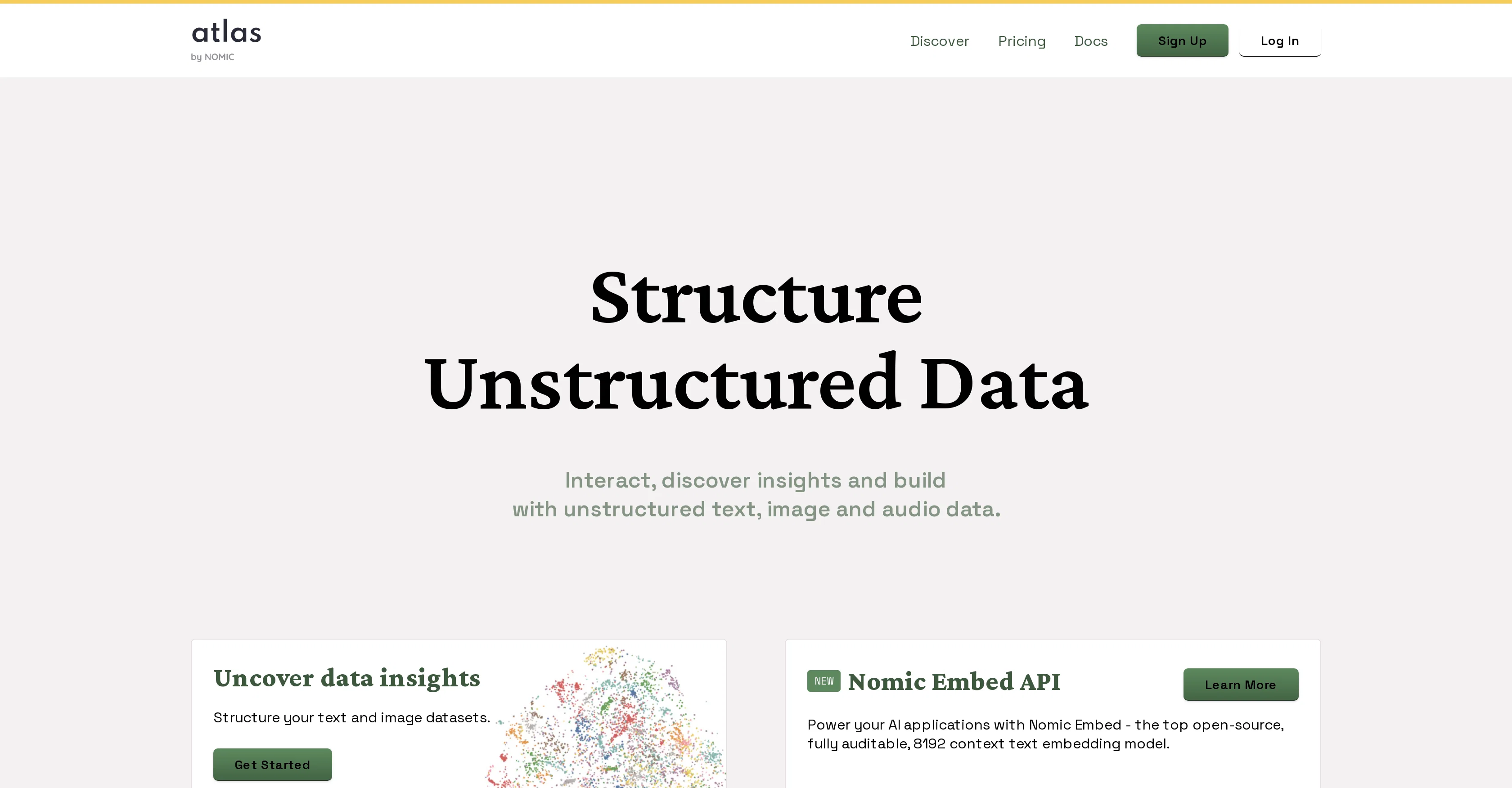
Structure unstructured data across media types.
Free + from $0.05
Verdict
A quick read before you dig into the full page.
- Best if
- Structure unstructured data across media types
- Skip if
- Capabilities vary by data type
- Pick this when
- Structures unstructured datasets
Considering BlazorData instead? Compare side by side
Overview
Nomic Atlas is an AI tool primarily focused on the structuring of unstructured datasets. It encompasses an array of media types, including text, images, embeddings, audio, and video.
The tool is designed to assist with organizing these types of data, which are often unmanageable due to their lack of a predefined model or form. By creating structure, the tool aids in making sense of the unstructured data, facilitating better analysis and understanding.
The tool's capabilities extend to various fields that deal heavily with data such as artificial intelligence, machine learning, data analysis, and more.
It is particularly useful for tackling large volumes of data, enabling users to classify, sort, search, and analyze information efficiently. With Nomic Atlas, organizations can augment their expertise in understanding and utilizing diverse unstructured data resources.
This contributes to enhancing strategic decision-making, improving operational efficiency, identifying trends and patterns, and deriving valuable insights from complex, raw data sources.
However, while Nomic Atlas offers considerable benefits in data structuring, its exact capabilities may vary based on the specific type of data and user requirements, and thus potential users are encouraged to thoroughly explore its functionalities pertaining to their specific use-case.
Access & connections
Where you can use Nomic Atlas.
Platforms
Capabilities
What this tool accepts, produces, and is strongest at.
Input
- Image
- Text
- Video
- Audio
Output
- Audio
- Video
- Text
- Image
Pros & cons
Pros
- Structures unstructured datasets
- Supports various media types
- Organizes complex data types
- Facilitates better data analysis
- Useful for large datasets
- Enables data classification
- Enables data sorting
- Enables data searching
Show 7 more
- Aids in trend identification
- Enhances strategic decision-making
- Improves operational efficiency
- Derives valuable insights
- Tailored to user requirements
- Augments data understanding
- Useful across different fields
Cons
- Capabilities vary by data type
- Unpredictable efficiency with large datasets
- Lack of predefined data models
- Requires extensive user exploration
- Inconsistent functionality for use-cases
- Unclear ease of organizing data
- Lacks clear user requirements definition
- Unspecified operational efficiency improvement
Show 2 more
- Unclear trend and pattern identification
- Unspecified data sorting/searching mechanisms
Compare alternatives
Similar tools in the catalog — with a clear reason to open each one.

BlazorData ✓
FreeBuild your personal data warehouse with Blazor
Why look Fully free option
Full comparison


Aboard ✓
FreemiumAI-powered data management to simplify your digital life.
Why look Higher community rating
Full comparison

Gentables ✓
FreemiumTransform unstructured data into organized tables.
Free + from $9.99/mo
Full comparisonReleases 1
FAQ 12
What is Nomic Atlas?
What types of data does Nomic Atlas handle?
How does Nomic Atlas help to structure unstructured data?
What are the fields that can benefit from using Nomic Atlas?
Can Nomic Atlas aid in dealing with large volumes of data?
How does Nomic Atlas support data classification?
What functionalities does Nomic Atlas provide for data searching?
How can Nomic Atlas help in identifying data trends?
Does Nomic Atlas contribute to strategic decision-making?
Can Nomic Atlas help in improving operational efficiency?
How can Nomic Atlas contribute to deriving insights from raw data?
Does the performance of Nomic Atlas vary with the type of data?
Related tools
Recommended

vizGPT ✓
Free TrialTurn complex data into clear insights with AI.

GPTExcel ✓
FreemiumGenerate spreadsheet formulas with AI

Recall ✓
FreemiumSummarize Anything, Forget Nothing!
Ask Your PDF ✓
FreemiumChat with your PDFs and extract valuable insights

SWOT Analysis ✓
Free TrialInstantly generate a SWOT Analysis with AI

What-A-Prompt ✓
FreeSupercharge your ChatGPT prompts for better results.