
OCR vv3
Mistral AI - OCR ✓
Turn documents into structured knowledge with high-accuracy OCR
Verdict
A quick read before you dig into the full page.
- Best if
- Turn documents into structured knowledge with high-accuracy OCR
- Skip if
- Possibly limited OCR capabilities
- Pick this when
- User-friendly Interface
Considering DeepRead.Tech instead? Compare side by side
Overview
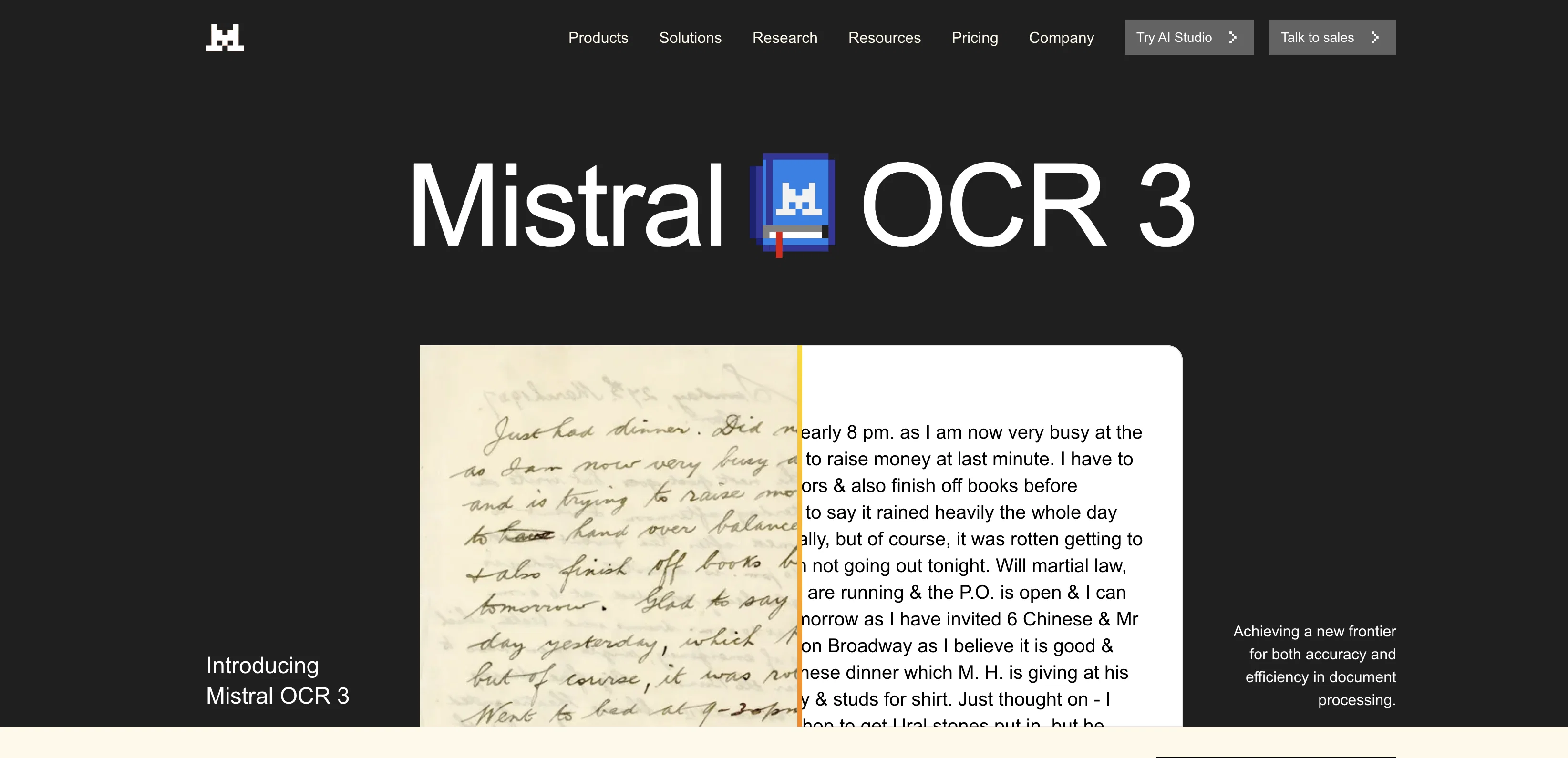
Built to handle real-world complexity, Mistral OCR accurately interprets cursive handwriting, mixed printed and handwritten content, and low-quality or distorted scans. It is highly robust to common document issues such as compression artifacts, skew, low DPI, and background noise, making it well suited for both enterprise and everyday use cases.
A key strength of Mistral OCR is its ability to preserve document structure. It reconstructs complex tables with headers, merged cells, and hierarchical layouts, outputting clean markdown enriched with HTML table elements. This allows downstream systems to understand not just extracted text, but also the relationships and layout within the original document.
Mistral OCR is available through both an API and a user-friendly document interface, enabling seamless integration into automated pipelines or interactive workflows. Users can instantly convert PDFs and images into clean text or structured JSON for use in search, analytics, knowledge systems, and AI-driven applications.
Designed for efficiency as well as accuracy, Mistral OCR offers high performance at a competitive cost and supports a wide range of languages and document formats. It is ideal for document digitization, form processing, archive modernization, and any workflow where reliable document-to-knowledge transformation is essential.
Access & connections
Where you can use Mistral AI - OCR.
Platforms
Capabilities
What this tool accepts, produces, and is strongest at.
Highlights
- API
Supported features
- API
- Docs
- Image Understanding
Pros & cons
Pros
- User-friendly Interface
- Data Analysis capability
- Complex Task solution
- High Security measures
- Data Privacy respectfulness
- Login Feature
- Password Recovery option
- Cloud-Based Platform
Show 7 more
- Cross-Platform Access
- OCR feature
- Considers Terms Of Service
- Efficient for Big Data
- User Convenience centered
- Easy Account Creation
- Effective Data Manipulation
Cons
- Requires user login/signup
- Undefined specific functionalities
- Possibly limited OCR capabilities
- Unclear account creation options
- Functionality requires initial login
- No offline mode
- Undefined data manipulation tools
- Terms of service review necessary
Show 2 more
- Ambiguous feature set
- Lack of transparent pricing
Compare alternatives
Similar tools in the catalog.

DeepRead.Tech ✓
FreemiumAI-native OCR platform, 95%+ accuracy, zero prompt engineering, flags uncertain fields.
Free + from $99/mo
Full comparison

Note This Down ✓
Free TrialTransform handwritten notes into digital text instantly.
Free + from $8/mo
Full comparison


Releases 3
Achieves a 74% overall win rate compared to other leading OCR solutions on complex document types, including scanned pages and handwritten content. 
Better interpretation of forms, complex layouts, tables, and diverse document structures, surpassing traditional OCR limitations. 
Improved handling of cursive and mixed handwritten text layered over printed forms, increasing reliability on real-world documents where handwritten annotations are common. 
Reconstructs complex tables with merged cells and hierarchical headers, preserving structure and enabling richer downstream analysis. 
Designed to excel across a broad spectrum of documents including invoices, receipts, compliance forms, and government paperwork, with improved resilience to skew, distortion, and noise. 
Positioned as a cost-effective solution (~$2 per 1,000 pages) with scalability for enterprise pipelines and high-volume workflows. 
Available via API and integrated into user-friendly developer tools like the Document AI Playground (drag-and-drop parsing interface), enabling both automated and interactive use. 
AI-Driven Document Understanding: Designed as more than traditional OCR, it integrates deep learning to not only recognize text but also understand document structure, layout, and context, improving accuracy on complex documents.

Structured Output Capability: Outputs recognized content in structured formats (e.g., interleaved text and images) making it immediately useful for downstream workflows and AI systems. 
Multimodal Support: Processes images, scanned PDFs, complex layouts, and even mathematical content, going beyond mere text extraction. 
Mltilingual Recognition: Built to support a wide range of languages and scripts, making it suitable for global use cases. 
High Performance: Capable of processing documents at very high speeds (~2000 pages per minute on optimized infrastructure), enabling scalable enterprise workflows. 
Competitive Accuracy: Internal benchmarks reported accuracy scores around ~94–95% against major competitors, demonstrating significant improvements over legacy OCR systems in both fidelity and robustness. 
API & Tools: Available via API through Mistral’s developer platform, with integration support for structured outputs like JSON/Markdown. 
Flexible Deployment: Designed for integration into both automated processing pipelines and interactive tools, enabling document workflows across industries.
FAQ 12
What is Mistral AI?
What functionalities does Mistral AI offer?
How does Mistral AI ensure user data privacy?
How can I sign up for Mistral AI?
Does Mistral AI offer account recovery?
Can I log in to Mistral AI using my Google account?
Can Mistral AI handle big data analysis?
How user-friendly is the interface of Mistral AI?
Does Mistral AI provide data manipulation tools?
How can Mistral AI help with complex tasks?
Does Mistral AI require an account creation?
Does Mistral AI offer cross-platform access?
Related tools
Recommended

DeepSeek ✓
FreeUnravel the mystery of AGI with curiosity

bolt.new ✓
FreemiumBuild web apps with AI prompts

Cora Intelligence ✓
PaidThe AI SDR that fills your pipeline.
VentureVault ✓
FreeDiscover validated startup ideas with AI-powered market analysis.

BeatViz AI Music Video Generator ✓
FreemiumTransform your music into stunning visual experiences with AI

Audio Converter AI ✓
FreemiumAI turns your audio into accurate text instantly.