

Product development 2026 Rank: #2145
Mimir ✓
Turn customer feedback into shippable product features.
Verdict
A quick read before you dig into the full page.
- Best if
- Turn customer feedback into shippable product features
- Skip if
- Limited third-party integrations
- Pick this when
- Transforms feedback into decisions
Considering Archie instead? Compare side by side
Overview
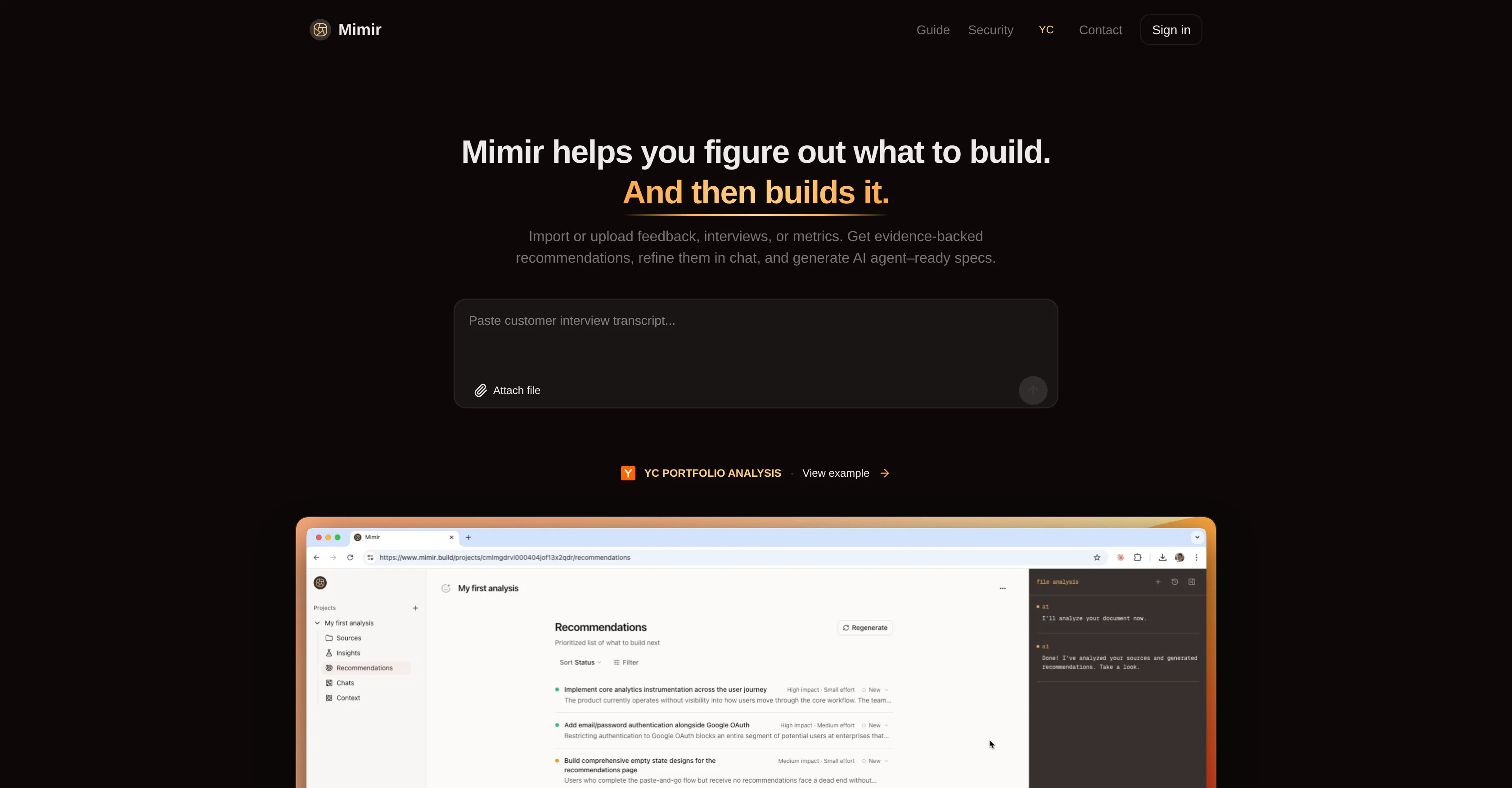
Mimir is an AI-native product management tool designed to help users make more informed, evidence-based product decisions. It does this by transforming user feedback, customer interviews, and usage data into actionable product insights.
Users can import or upload their metrics or feedback, and Mimir will analyze this data to provide evidence-backed recommendations. Users can also refine these recommendations through the built-in chat feature.
Mimir stands out from other AI tools in that it doesn't merely relay user feedback to a language model. Instead, it uses a specially designed pipeline to extract structured data and insights, group them into themes, and produce prioritized product recommendations.
This process is grounded in best practice, incorporating key aspects of effective product management. Each piece of data analyzed by Mimir, whether it be customer pain points, feature requests, metrics or other insights, gets categorized and weighted based on relevance and importance.
Mimir also links each piece back to its original source. The tool also employs hierarchical analysis to cluster these pieces into themes, working at a large scale to identify patterns, the most severe or recurring problems, and how they interrelate.Once the data synthesis is complete, Mimir generates ranked product development recommendations.
Each recommendation includes impact projections, effort estimates, and a clear rationale that maps back to the original data. As Mimir becomes more familiar with your business context and receives more data, its recommendations become increasingly attuned to your specific business considerations and needs.In addition, Mimir also features full integration with GitHub.
It can transform recommendations into complete specs and GitHub issues, thus enabling users to develop new product features rapidly with various AI coding agents.
Access & connections
Where you can use Mimir, and what it plugs into.
Platforms
Capabilities
What this tool accepts, produces, and is strongest at.
Input
- Tabular
- Text
Output
- Code
- Text
Supported features
- Deep Research
- Memory
- Assistant
- Integrations
Pros & cons
Pros
- Transforms feedback into decisions
- Generates evidence-supported recommendations
- Built-in interactive chat
- Automates detailed specifications creation
- Integrates with GitHub
- Facilitates efficient feature development
- Draws structured insights
- Categorizes important data points
Show 19 more
- Clusters data into themes
- Identifies severe and recurrent problems
- Generates ranked recommendations
- Considers business context and best practices
- Projections of impact included
- Effort estimates included
- Clear rationale for recommendations
- Adaptive learning feature
- Aligns to business-specific context
- Turns metrics into actionable insights
- Built-in refinement features for recommendations
- Extracts structured data from user feedback
- Groups insights into prioritized themes
- Weights data based on relevance
- Sources are linked back to data
- Analyzes large-scale data patterns
- Complete specs and GitHub issues
- Facilitates rapid feature development
- Adapts recommendations to specific needs
Cons
- Limited third-party integrations
- Relies heavily on good data
- Closed proprietary algorithm
- No real-time analysis
- Possible bias in hierarchical analysis
- No manual data categorization
- No user customization
- Dependency on GitHub for tasks
Show 1 more
- No direct customer interaction
Compare alternatives
Similar tools in the catalog — with a clear reason to open each one.

Archie ✓
FreemiumThe platform to architect, build, and run production-grade applications.
Why look Offers a public API
Full comparison

Devplan ✓
Free TrialAI-Native Product Development for Modern Teams
Why look Offers a public API
Full comparison
UX Design GPT ✓
FreeYour AI-powered UX design sidekick.
Why look Stronger for image work
Full comparison
PRDKit ✓
Free TrialAI-powered product requirements and GTM content in minutes.
Why look Better for writing
Full comparison
Releases 1
Imported reviews 1
So fast, so good.
FAQ 12
What is Mimir?
How does Mimir use AI in product management?
What input data does Mimir require?
How does Mimir process customer feedback and usage data?
How does Mimir integrate with GitHub?
How does Mimir's interactive chat work?
How does Mimir automate the creation of specifications and tasks for implementation?
How does Mimir extract and categorize data?
What is the hierarchical analysis feature in Mimir?
How does Mimir identify severe and recurrent problems?
How does Mimir formulate its recommendations?
What is the learning function of Mimir?
Related tools
Recommended

PDF to Video AI ✓
FreeTurn PDFs into professional explainer videos in minutes.

Mindsmith ✓
FreemiumPlatform for building and sharing eLearning content

Midjourney ✓
PaidExpand human imagination through AI-powered visuals.

Elicit ✓
Free TrialAI-powered research assistant for literature reviews and analysis.

Showspace ✓
FreeCreate an AI-powered portfolio to outshine top candidates

Jason AI ✓
PaidAI-powered assistant for B2B sales outreach