
LLaMA ✓
Open-source AI models for customization and deployment.
Verdict
A quick read before you dig into the full page.
- Best if
- Open-source AI models for customization and deployment
- Skip if
- Complex customization process
- Pick this when
- High customizability
Considering Claude instead? Compare side by side
Overview
LLaMA is an open source Artificial Intelligence (AI) model designed with flexibility and versatility in mind. Developed to provide users with the capability to fine-tune its underlying algorithms to better align with their requirements, this tool stands out due to its customizability.
Additionally, it is equipped with distillation functionality that enables users to simplify complex AI models into more manageably sized forms, thereby improving efficiency and performance.Available in different variants, it offers users a range of functionalities in terms of capacity and complexity depending on their specific needs and system capabilities.
Regardless of the version chosen, it's devised to be portable and easily deployable across various environments, ensuring seamless integration with existing systems.As an open-source tool, LLaMA promotes transparency and extends the opportunity for AI enthusiasts, professionals, and organizations to explore, modify, and improve its algorithms.
This openness fosters a collaborative approach towards the development of AI tools, contributing to the overall advancement and resourcefulness in the AI field.
Overall, LLaMA proves to be an adaptable and scalable solution for those seeking to incorporate customized AI models into their systems, with the added benefits of distillation and portability presented in an open-source framework.
Best for
Short scenarios where LLaMA tends to shine.
-
Open-source AI models for customization and deployment.
Example outputs 1
Sample generations and before/after results for LLaMA.
Access & connections
Where you can use LLaMA.
Platforms
Capabilities
What this tool accepts, produces, and is strongest at.
Highlights
- API
Supported features
- API
Pros & cons
Pros
- High customizability
- In-built model distillation
- Improved efficiency and performance
- Offers various capacity variants
- Portable across environments
- Seamless system integration
- Open to modifications
- Versatile usage
Show 9 more
- Scalability in performance
- Tuned for user needs
- Different complexity levels
- Open source transparency
- Model variants 8B, 70B, 405B
- Flexibility in design
- Options for fine-tuning algorithms
- Aligns with users' requirements
- Can be deployed anywhere
Cons
- Complex customization process
- Difficult distillation functionality
- Various versions add confusion
- High system capabilities required
- Collaborative approach can be chaotic
- Transparency leads to security concerns
- Scalability may affect performance
- Variants could have compatibility issues
Compare alternatives
Similar tools in the catalog — with a clear reason to open each one.



Ollama ✓
FreemiumRun powerful AI models locally on your machine.
Why look Higher community rating
Full comparison
Subquadratic ✓
UnknownFirst sub-quadratic LLM for 12M-token reasoning tasks.
Why look Higher community rating
Full comparison
People also view
Tools that often show up alongside LLaMA in collections and comparisons.

DeepSeek ✓
FreeUnravel the mystery of AGI with curiosity

Mistral AI ✓
FreemiumFrontier AI in your hands

Veo ✓
PaidGenerate high-quality, cinematic videos with AI.

NotebookLM ✓
FreemiumAI-powered note-taking and research assistant

Lovable ✓
Free TrialBuild software products using chat

Kin - Personal AI Advisors ✓
FreePrivacy-first & designed your for mind, and life at work

Grok ✓
FreemiumConversational AI for understanding the universe.

bolt.new ✓
FreemiumBuild web apps with AI prompts
Releases 6
Model Sizes:
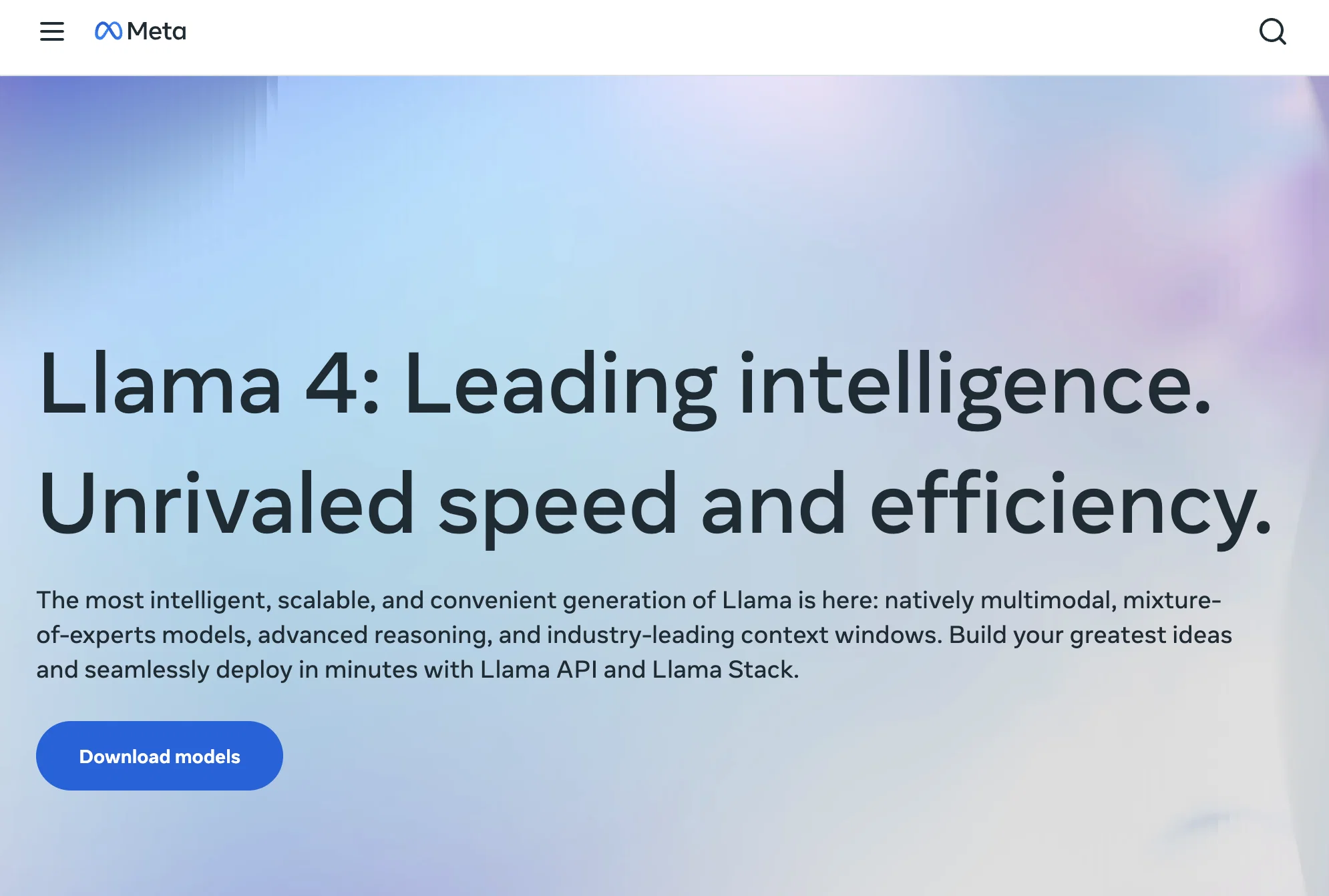
- Scout: 109B parameters (17B active via MoE)
- Maverick: 400B parameters
- Behemoth: In training
Multimodal Capabilities: Processes text, images, and videos.
Architecture: Introduced Mixture-of-Experts (MoE) for computational efficiency.
Performance Enhancements:
Improved coding, reasoning, and multilingual tasks.
Optimized for long-context processing.
Applications: General assistant tasks, creative writing, document summarization, and advanced visual comprehension.
Licensing: Stricter terms, especially in the EU; special approval required for enterprises with >700M MAUs.
Llama 3.2 builds upon Llama 3.1 by introducing new model sizes—1B, 3B, 11B, and 90B parameters—allowing deployment on devices ranging from mobile to servers.
The 11B and 90B models add multimodal capabilities, processing both text and images for tasks like visual reasoning, which Llama 3.1 lacks.
Developer experience is enhanced with Llama Stack, offering streamlined development, better tool integration, and flexible deployment options across various programming languages.
Overall, Llama 3.2 offers more versatility, multimodal support, and improved developer tools compared to Llama 3.1.
LLaMA 3.1 is an updated version of LLaMA 3, bringing several key enhancements in performance, efficiency, and functionality. It offers improved accuracy and contextual relevance in responses, with better handling of complex queries and specialized tasks compared to LLaMA 3.
Safety features in LLaMA 3.1 have been further advanced, incorporating enhanced mechanisms to minimize the risk of generating harmful or biased content. The model aligns more closely with ethical standards, ensuring that its outputs are even more reliable and responsible.
LLaMA 3.1 benefits from an upgraded training dataset, providing access to a broader and more current range of information. This results in more precise and relevant answers, improving the quality of interactions and content creation beyond what was achieved with LLaMA 3.
The user experience is smoother with LLaMA 3.1, featuring more natural conversation patterns and improved engagement. Enhanced support for diverse applications, including more sophisticated multimodal tasks, makes it a more versatile tool compared to LLaMA 3.
Overall, LLaMA 3.1 builds on the foundation of LLaMA 3 with significant improvements in accuracy, safety, and usability, making it a more advanced and effective AI model.
LLaMA 3 is a significant upgrade over LLaMA 2, offering notable improvements in performance, efficiency, and versatility. It provides more accurate and contextually nuanced responses, with enhanced capabilities in handling complex tasks and specialized domains compared to LLaMA 2.
Safety features in LLaMA 3 have been further refined, reducing the risk of generating harmful or biased content. The model is better aligned with ethical standards and incorporates advanced mechanisms to ensure that its outputs are both reliable and responsible.
LLaMA 3 benefits from an even more updated training dataset, which allows it to draw from a wider and more current range of information. This results in more precise, relevant, and up-to-date answers, significantly enhancing the overall quality of interactions and content generation.
The user experience with LLaMA 3 is markedly improved, featuring smoother and more natural conversation patterns along with greater engagement. The model offers enhanced support for diverse applications, including more advanced multimodal tasks and integration with other data types.
Overall, LLaMA 3 builds on the advancements of LLaMA 2 with substantial enhancements in accuracy, safety, and usability, making it a more advanced and capable AI tool for a wide range of applications.
LLaMA 2 is an enhanced version of LLaMA 1, bringing notable improvements in performance, versatility, and safety. It delivers more accurate and contextually relevant responses, with enhanced capabilities in handling complex tasks and specialized domains compared to LLaMA 1.
Safety features in LLaMA 2 are further refined, reducing the risk of generating harmful or biased content. The model is better aligned with ethical standards, ensuring that its outputs are more reliable and responsible.
LLaMA 2 benefits from an updated training dataset, which allows it to draw from a broader and more current range of information. This results in more precise and relevant answers, improving the overall quality of interactions and content generation.
The user experience is notably enhanced with LLaMA 2, featuring more natural conversation patterns and improved engagement. It also offers better support for diverse applications, making it more adaptable for various use cases compared to LLaMA 1.
Overall, LLaMA 2 builds on the foundation of LLaMA 1 with significant advancements in accuracy, safety, and usability, making it a more powerful and refined AI tool.
In the news
Launch coverage and community mentions for LLaMA.
Imported reviews 1
A huge disappointment. It fails standard tasks that Sonnet 3.5 completes with no issue. I’ll be skipping this version.
FAQ 12
What is Llama 3.1?
How customizable is Llama 3.1?
What is the significance of distillation in Llama 3.1?
What types of functionalities does Llama 3.1 offer?
How does Llama 3.1 enhance AI efficiency and performance?
How portable is Llama 3.1?
Can Llama 3.1 be easily deployed across different environments?
How can Llama 3.1 be integrated into existing systems?
As an open-source tool, how can users modify the algorithms of Llama 3.1?
How does Llama 3.1 promote AI transparency?
How can Llama 3.1 foster collaborative development of AI tools?
How scalable is Llama 3.1?
Related tools
Recommended

Perplexity ✓
FreemiumAI-powered answers to any question, instantly.

ChatGPT ✓
FreemiumAsk anything, create anything, and move from idea to action.
NotebookLM ✓
FreemiumAI-powered note-taking and research assistant
Veo ✓
PaidGenerate high-quality, cinematic videos with AI.

Recall ✓
FreemiumSummarize Anything, Forget Nothing!

Suno ✓
FreemiumMake music at the speed of your ideas.
More from this creator

AnimatedDrawings by Meta ✓
FreeBring children's drawings to life through animation.

AI Sandbox ✓
UnknownHarness AI to supercharge your ad performance

Voicebox by Meta ✓
FreeGenerate versatile speech with state-of-the-art AI

GenAI by Meta ✓
FreeAI-powered tools to connect, create, and explore

Meta AI Studio ✓
UnknownCreate and chat with AI characters and extensions

Manus ✓
FreemiumTurn your thoughts into actions with AI