
Productivity vv3 2026 Rank: #175
Kimi AI ✓
Visual coding meets agent swarm for complex tasks.
Verdict
A quick read before you dig into the full page.
- Best if
- Visual coding meets agent swarm for complex tasks
- Skip if
- May over-simplify complex tasks
- Pick this when
- Open-source model
Considering TheLibrarian.io instead? Compare side by side
Overview
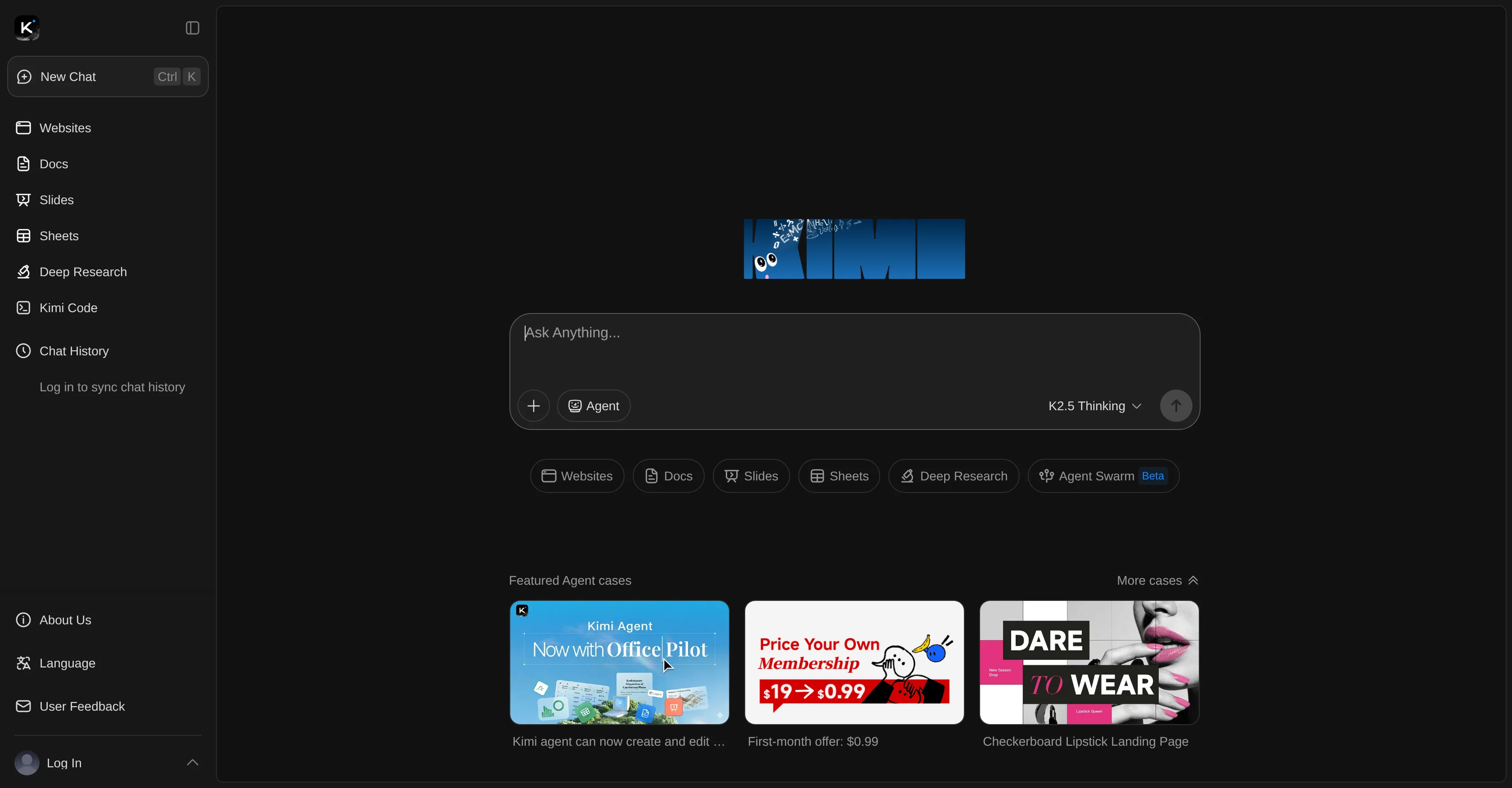
Kimi AI with K2.5 is an open-source model designed to enhance visual coding processes. As part of its core functionalities, it offers a feature known as 'Agent Swarm', provisioned to handle substantial tasks effectively.
Kimi AI's strength lies in its ability to simplify complicated office tasks, improving precision and efficiency within such workflows. The platform includes a new chat control Kimi code feature, which further expands its array of interactive capabilities to engage with users.
Users can initiate conversations, ask queries, and receive insights, making the tool interactive and user-friendly. Furthermore, Kimi AI's adaptability is shown in its compatibility with multiple interfaces such as websites, documentations, slides, and sheets.
These features allow users to tap into deep research mechanisms, enhancing productivity and providing thorough analytical capabilities. The platform is also available on mobile applications, extending its accessibility for users on the go.
Currently, the Agent Swarm feature is under Beta testing, which may iterate improvements and enhancements in handling and executing larger tasks. Kimi AI with K2.5 continues to pioneer in the blend of visual coding and swarm technology, offering a robust platform for managing complex tasks with ease.
Access & connections
Where you can use Kimi AI.
Platforms
Capabilities
What this tool accepts, produces, and is strongest at.
Highlights
- SOTA
Supported features
- Writing
- Docs
- Web browsing
- Assistant
- Search
- Deep Research
- Translation
- Video Understanding
- Computer Use
Pros & cons
Pros
- Open-source model
- Enhances visual coding
- Agent Swarm feature
- Simplifies complex tasks
- Improves office task precision
- Workflow efficiency
- Interactive chat code feature
- Facilitates user engagement
Show 16 more
- Initiates user conversations
- Query capabilities
- Insight provision
- User-friendly
- Multi-interface compatibility
- Works with websites
- Works with documentations
- Works with slides
- Works with sheets
- Supports deep research
- Analytical capabilities
- Boosts productivity
- Available on mobile
- Agent Swarm in Beta
- Promotes complex task management
- Visual coding with swarm technology
Cons
- Agent Swarm still in Beta
- Limited to visual coding tasks
- May over-simplify complex tasks
- No stated support for non-mobile platforms
- Relies on interface compatibility
- User interaction primarily through chat
- Unspecified execution time for tasks
- No stated offline capabilities
Compare alternatives
Similar tools in the catalog — with a clear reason to open each one.

TheLibrarian.io ✓
Free TrialYour WhatsApp AI assistant for instant productivity.
Why look Higher community rating
Full comparison
Supernormal App ✓
FreemiumThe AI assistant app that turns meetings into completed work
Free + from $25.90/mo
Full comparison

MiroAI ✓
FreemiumUnlock creative power with AI-driven collaboration.
Free + from $8
Full comparison
Collate ✓
FreeUnlimited free and private summaries and chat with PDF
Why look More privacy-focused
Full comparison
Releases 5
Stronger long-horizon coding sustains extended engineering tasks, navigates massive repositories, and coordinates terminal tools with minimal supervision.
Native visual reasoning combines screenshots, images, and video with coding for frontend development, game creation, CAD, and iterative visual refinement.
A 1-million-token context window enables much larger codebases, documents, and persistent agent workflows within a single working context.
More capable knowledge-work agents handle research, analysis, spreadsheets, reports, visualizations, and other production-oriented workflows end to end.
New KDA, Attention Residuals, and highly sparse MoE architecture deliver roughly 2.5x better scaling efficiency than K2 while reaching 2.8 trillion parameters.
Stronger coding turns simple prompts into polished interfaces, full-stack websites, authentication flows, interactions, and database-backed applications.
More reliable long-horizon execution stays aligned across complex multi-step tasks, makes fewer unnecessary changes, and corrects mistakes during execution.
Upgraded agent coordination lets specialized agents work in parallel across research, analysis, writing, websites, documents, slides, and spreadsheets.
Reusable skills can be extracted from high-quality documents and applied to future tasks for more consistent, scalable outputs.
Improved presentation generation produces editable, professional decks from prompts, screenshots, templates, and mixed-format source material.
Major improvements in agentic intelligence, enabling more autonomous task execution.
Further enhancements to reasoning depth, planning, and multi-step problem solving.
Optimized performance for complex workflows and large-scale context handling.
Added multimodal capabilities, enabling understanding of text, images, and code.
Significantly improved reasoning, mathematics, and coding performance.
Enhanced long-context comprehension and response consistency.
Imported reviews 2
(API user) really decent on coding tasks, price is affordable. On par with other frontier models for small to medium refactors.
The K2.5 Agent mode itself is giving up on a particular small task
FAQ 12
What does Kimi AI with K2.5 do?
Can you explain the Agent Swarm feature in Kimi AI K2.5?
How does Kimi AI enhance office task automation?
What is the new chat control Kimi code feature?
In what ways can Kimi AI engage with users?
How is Kimi AI compatible with multiple interfaces?
How does Kimi AI allow users to conduct deep research?
Is Kimi AI available as a mobile application?
How does Kimi AI contribute in managing complex tasks?
How does Kimi AI K2.5 use swarm technology?
Why is Kimi AI considered a pioneer in visual coding and swarm technology?
How user-friendly is Kimi AI?
Related tools
Recommended

DeepSeek ✓
FreeUnravel the mystery of AGI with curiosity

Qwen ✓
UnknownAI assistant with visual, search and tool capabilities

Claude ✓
FreemiumBuilding reliable, interpretable AI systems

Cursor ✓
FreemiumAI-powered IDE for faster coding

Google CC ✓
FreeYour AI productivity agent for a smarter morning

Kin - Personal AI Advisors ✓
FreePrivacy-first & designed your for mind, and life at work