

AI cost management 2026 Rank: #1976
Headroom ✓
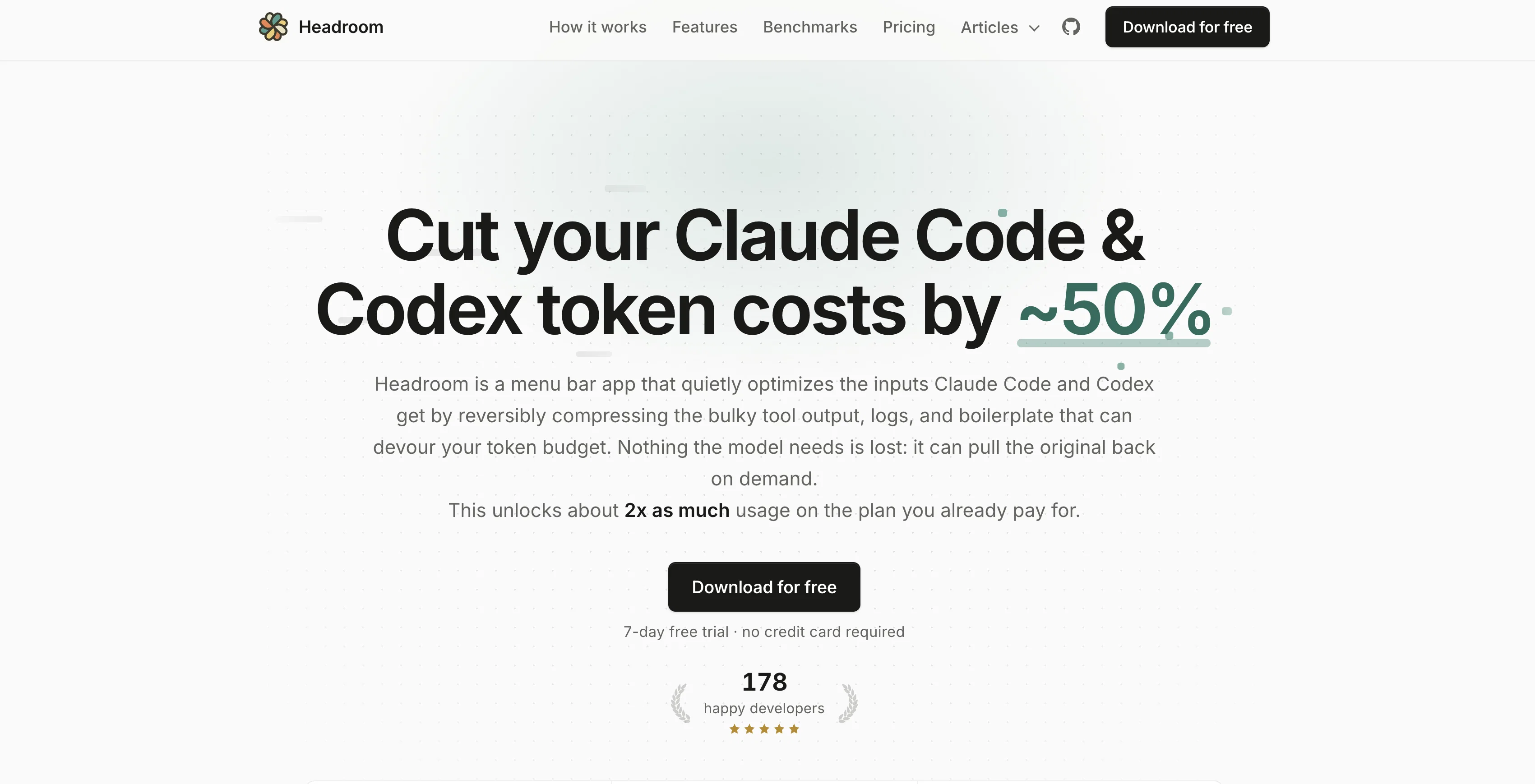
Cut Claude Code & Codex costs by 50%.
Verdict
A quick read before you dig into the full page.
- Best if
- Cut Claude Code & Codex costs by 50%
- Skip if
- Operates locally, may limit integration
- Pick this when
- Reduces token expenditure
Considering AICosts.ai instead? Compare side by side
Overview
Headroom is an AI optimization tool designed to reduce token expenditure of Claude Code and Codex. The app operates in the menu bar to decrease prompt bloat before it reaches Claude Code and Codex, hence reducing token spend and increasing the usage of the existing plan, in theory, making it last about double its regular duration.
Headroom preserves the original data that the AI models need by reversibly compressing the data. The algorithm used to compress the data inputs ensures that the quality of the output is not compromised.
The tool's optimization completely runs locally, ensuring the privacy and security of code and prompts. By lessening the 'noise' pumped in with every prompt, Headroom is enabling developers to stretch their usage limit and avoid unnecessary expenditure.
Headroom interacts with Claude Code or Codex as a local proxy, compressing logs, boilerplates, and replicating contexts that could otherwise unnecessarily inflate the data sent to the AI, this is done in a reversible manner to allow retrieval of the original data when it's needed.
Access & connections
Where you can use Headroom.
Platforms
Capabilities
What this tool accepts, produces, and is strongest at.
Input
- Tabular
Output
- Code
Pros & cons
Pros
- Reduces token expenditure
- Increases plan duration
- Preserves original data
- Quality uncompromised by compression
- Runs locally for privacy
- Lessens prompt 'noise'
- Compresses logs and boilerplates
- Acts as local proxy
Show 40 more
- Reversible compression allows data retrieval
- Supports Claude Code and Codex
- Manageable from menu bar
- Negates need for plan upgrade
- Free 7-day trial
- Privacy first - no data leakage
- Keeps runtime clean
- Menu-bar User Interface
- Reversible 'noise' compression
- Streamlines token efficiency
- Automates prompt bloat reduction
- Savings dashboard visualisation
- Compresses HTML and JSON
- Utilised by established companies
- Worldwide user base
- Positive user reviews
- Compatible with MacOs
- Multiple payment plans
- Uncompromised output quality
- No additional installation requirements
- Monthly savings history
- Automatic updates
- Open-source CLI version
- Learnable token-saving patterns
- Guides to reduce costs
- No credit card required for trial
- Compatible in different scenarios
- Quality preserved ROI calculator
- Increased usage per plan
- Flat monthly fee
- Retain output quality
- Discount on annual plan
- Email-based support
- Shared controls for teams
- Single use or multiple-device tracking
- No interference with project dependencies
- Trackable daily token savings
- Priority support for Max x20
- Private deployment options
- Strips noise, not signal
Cons
- Only supports Claude Code, Codex
- Operates as a local proxy
- May slow down performance
- Runs only within menu bar
- Dependent on Claude Code, Codex updates
- Operates locally, may limit integration
- Lacks diverse platform support
- Potential data retrieval issues
Show 1 more
- Only compresses specific data types
Compare alternatives
Similar tools in the catalog — with a clear reason to open each one.


Run BiOS ✓
Free TrialOne API for the best AI models. Zero logs, upto 70% less
Why look Offers a public API
Full comparison
Caddi ✓
PaidAutomate professional services workflows without changing your tools.
from $100.00/mo
Full comparison
CloudByte PMS ✓
FreemiumGovernance, Security & Cost Tracking for AI Coding Agents
Why look Better fit for coding
Full comparison
Motiofy ✓
Free TrialCreate Product and Social Videos Without Filming a Thing
Why look Stronger for image work
Full comparison
Releases 1
FAQ 12
What is Headroom?
How does Headroom optimize Claude Code and Codex?
How does Headroom contribute to data compression and decompression?
What's the advantage of Headroom running locally?
What is the impact of Headroom on prompt bloat management?
How does Headroom ensure privacy and security?
How can Headroom reduce operational costs?
How is the original data preserved in Headroom?
How does Headroom manage to avoid compromising the quality of output?
Is there an impact on the usage limit when using Headroom?
How does Headroom interact with Claude Code or Codex as a local proxy?
What specific tasks does Headroom perform in its role as a local proxy?
Related tools
Recommended

Acade ✓
FreemiumYour all-in-one AI research assistant for academics.

Rest — AI Sleep Coach ✓
FreemiumA voice AI sleep coach built on CBT-I

PageVero ✓
FreemiumTurn webpages into a structured, source-linked knowledge base.

UGCVideo.ai ✓
Free TrialTurn product links into viral video ads instantly.

GetLogit ✓
FreemiumArtificial intelligence, available for everyone.

ChatGPT ✓
FreemiumAsk anything, create anything, and move from idea to action.