

Goodlookup ✓
Smart, intuitive spreadsheet matching with AI precision.
from $15/yr
Verdict
A quick read before you dig into the full page.
- Best if
- Smart, intuitive spreadsheet matching with AI precision
- Skip if
- No alternatives to yearly subscription
- Pick this when
- Designed for spreadsheet users
Considering SheetAI App - AI For Sheets instead? Compare side by side
Overview
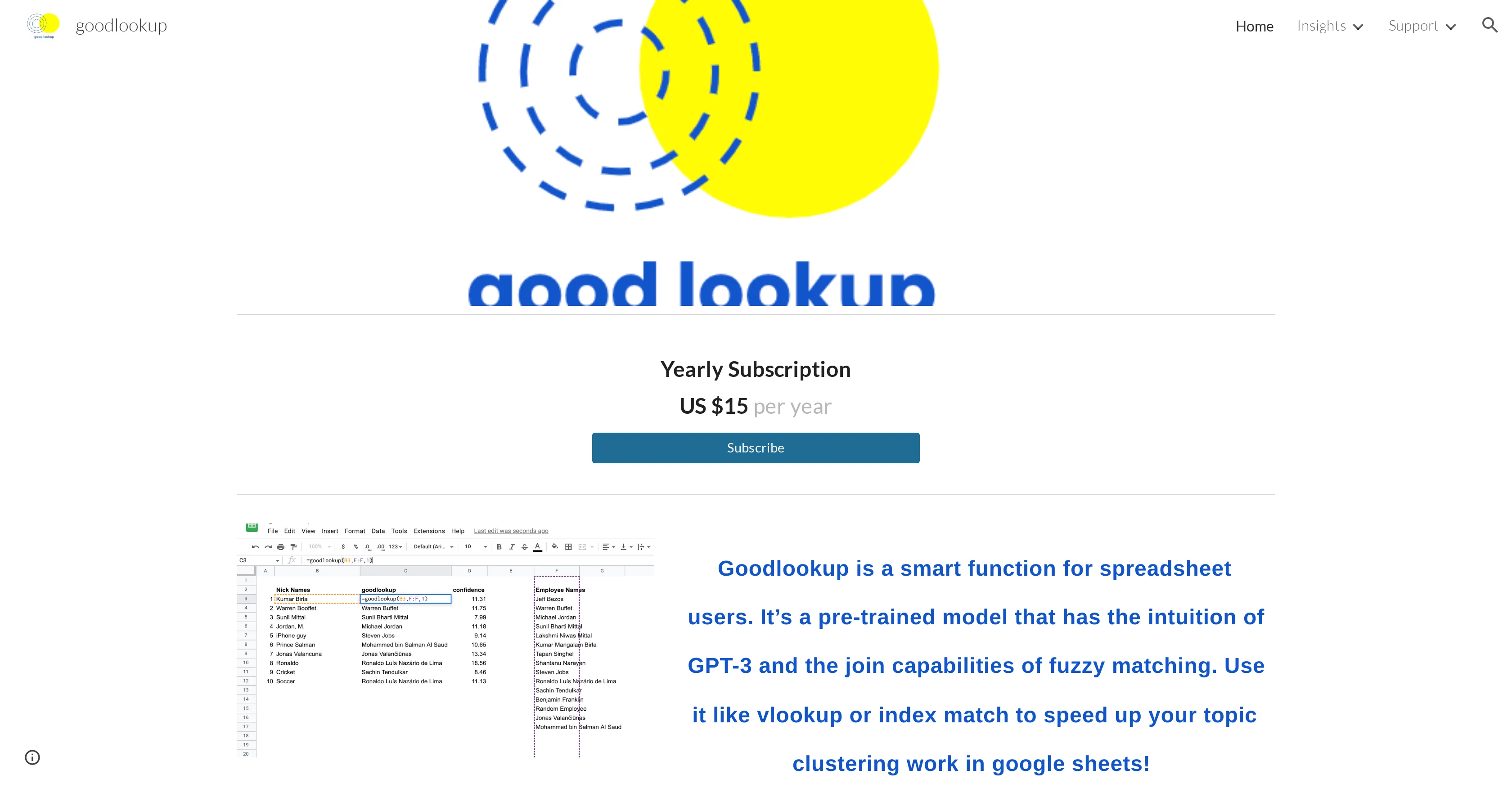
goodlookup is a smart, pre-trained AI model designed to deliver advanced lookup functionality for spreadsheet users, particularly in Google Sheets. Its primary feature is the ability to perform fuzzy matching that goes beyond traditional approaches by delivering similarity-based results that rely not only on exact string matching, but also on semantic and cultural relationships between text strings.
This feature enables users to match similar text in a way that a human would understand. Furthermore, the tool successfully addresses the join problem most modern spreadsheet users face, revolving around managing data scattered in several locations and differing naming conventions.
By providing solutions for text-to-text record linking issues, goodlookup fosters clarity and unity in data viewing. Pertaining to its application, it is proficient in identifying synonyms, cultural similarities and semantic relations between text strings.
For instance, it can match 'Ronaldo' to 'Ronaldo Lus Nazrio de Lima' or 'soccer'. It does not aim to replace fuzzy matching but to enhance it, providing an additional, superior tool for your data operations toolkit.
The utility of each match is represented by a score indicating the intensity of neighboring words in the vector space, with the highest scores assigned to longer strings matching identically to other long strings.
Access & connections
Where you can use Goodlookup, and what it plugs into.
Platforms
Integrations
Capabilities
What this tool accepts, produces, and is strongest at.
Input
- Tabular
Output
- Tabular
Supported features
- Spreadsheets
Pros & cons
Pros
- Designed for spreadsheet users
- Combines GPT-3 and fuzzy matching
- Speeds up topic clustering
- Cost-effective yearly subscription
- Matches similarities beyond strings
- Semantic understanding of data
- Matches text like humans
- Recognizes cultural similarities in text
Show 12 more
- Facilitates data unification
- Solves record linking problems
- Identifies synonyms in text
- Specifically designed for Google Sheets
- Doesn't replace, but enhances fuzzy matching
- Utility score for matches
- Matches based on semantic relationships
- Installs from Google Workspace Marketplace
- Matches longer strings with high score
- Addresses join problem in data management
- Identifies cultural references
- Allows clear and unified data view
Cons
- Only for Google Sheets
- Subscription-based model
- No multiple platform support
- Limited cultural understanding
- Dependent on GPT-3 accuracy
- No API integration
- Limited versatility beyond lookup
- No alternatives to yearly subscription
Show 2 more
- Challenges with unique naming conventions
- No local hosting option
Compare alternatives
Similar tools in the catalog — with a clear reason to open each one.

SheetAI App - AI For Sheets ✓
FreemiumAI with brain power inside Google Sheets
Why look Freemium alternative
Full comparison
Sourcetable — AI spreadsheet & data analyst ✓
FreemiumAI spreadsheet & data analyst. 10x your productivity.
Why look Freemium alternative
Full comparison
TabTabTab ✓
FreemiumTurn Google Sheets into your personal research assistant.
Why look Freemium alternative
Full comparison
Grist ✓
FreemiumBuild complex spreadsheet workflows with AI in minutes.
Why look Freemium alternative
Full comparison
ChatGPT in Google Sheets ✓
Free TrialChatGPT in Google Sheets: Automate insights from your data.
Why look Typically cheaper
Full comparison
Numerous ✓
Free TrialAI-powered plugin to automate spreadsheet tasks
Why look Typically cheaper
Full comparisonReleases 1
FAQ 12
What is Goodlookup?
How does Goodlookup use GPT-3?
What exactly is fuzzy matching in Goodlookup?
How is Goodlookup beneficial for Google Sheets users?
How does Goodlookup assist in topic clustering work?
What is the cost of a yearly subscription for Goodlookup?
In what way does Goodlookup improve the limitations of traditional fuzzy matching?
What exactly does Goodlookup mean by 'matching similar text the way a human would'?
How does Goodlookup help in data unification for spreadsheet users?
Can Goodlookup replace the traditional fuzzy matching method?
How does Goodlookup identify synonyms and cultural similarities?
How can Goodlookup assist with text-to-text record linking problems?
Related tools
Recommended

TutorAI ✓
FreemiumInstant knowledge on any topic

GPTinf ✓
PaidBypass AI detectors with one-click rephrasing.

Codeium ✓
FreemiumAI-powered code completion for 20+ languages

GeniePM ✓
Free TrialAI-powered product requirements magic

LearningStudioAI ✓
Free TrialAI-powered authoring tool for effortless online course creation.

VenturusAI ✓
FreemiumBusiness idea analysis and reporting.