

Images 2026 Rank: #1199
GLM Image | z.AI ✓
Generate high-fidelity images with autoregressive AI.
Verdict
A quick read before you dig into the full page.
- Best if
- Generate high-fidelity images with autoregressive AI
- Skip if
- Limited inference optimizations
- Pick this when
- Hybrid autoregressive architecture
Considering Photo AI instead? Compare side by side
Overview
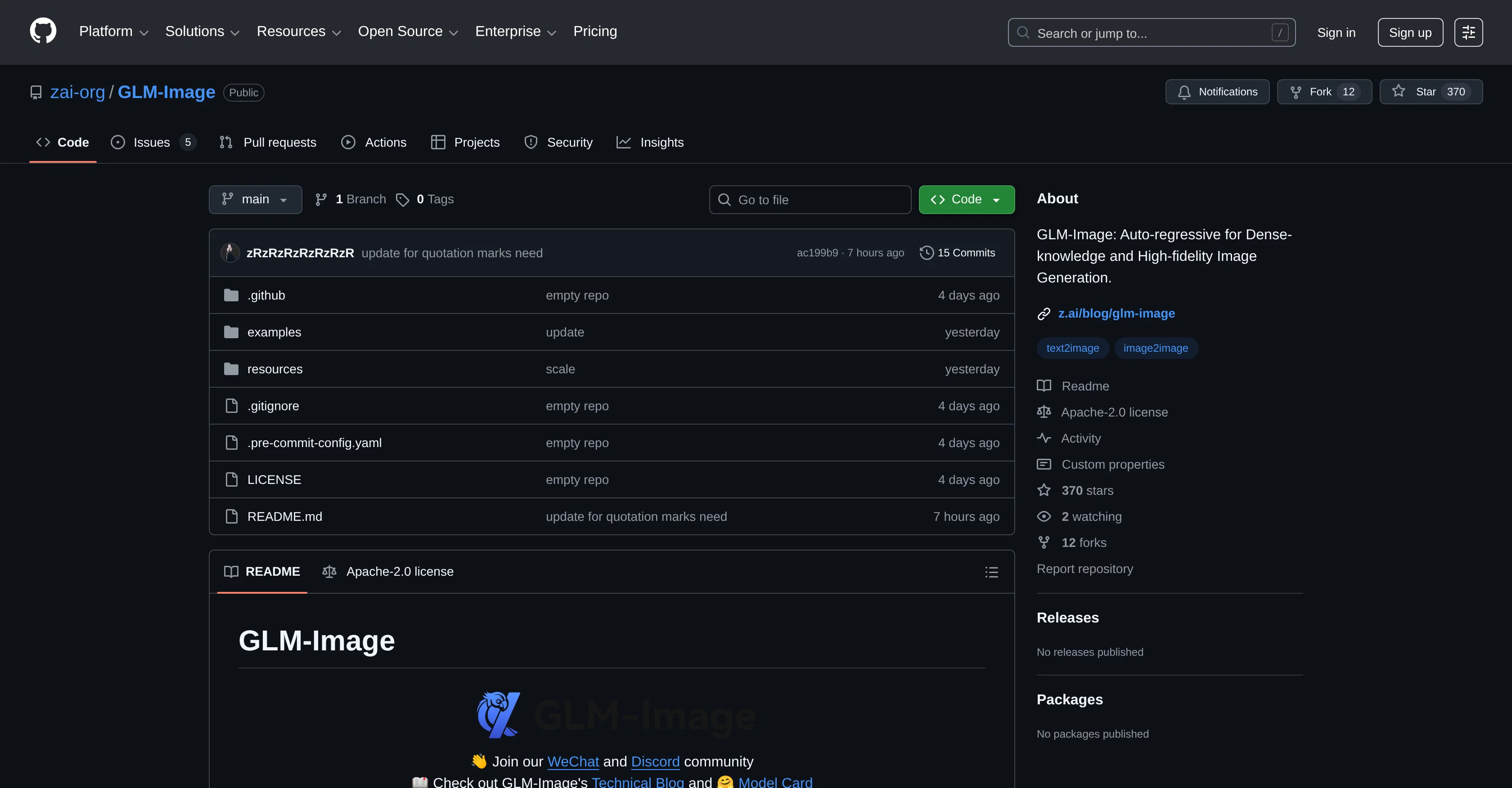
GLM-Image is an AI-powered image generation model developed by zai-org that adopts a hybrid autoregressive and diffusion decoder architecture. Positioned in line with mainstream latent diffusion approaches in general image generation quality, the tool offers notable benefits in scenarios necessitating text-rendering and knowledge-intensive generation.
It demonstrates impressive performance in tasks that require robust semantic understanding and intricate information expression, while ensuring high-fidelity and detailed image generation.
The architecture involves a 9B-parameter autoregressive generator, initializing from GLM-4-9B-0414 with additional visual tokens, a diffusion decoder, and a post-training system with the reinforcement learning algorithm GRPO to augment both semantic understanding and visual detail quality.
GLM-Image is equipped to handle both text-to-image and image-to-image generation. It offers capabilities to generate high-detail images from textual descriptions, and supports a wide array of image-to-image tasks including image editing, style transfer, consistent generation of multiple subjects, and identity-preserving generation.
Access & connections
Where you can use GLM Image | z.AI.
Platforms
Capabilities
What this tool accepts, produces, and is strongest at.
Input
- API
- Image
- Text
Output
- API
- Image
Highlights
- API
- Open Source
- Local
Supported features
- API
- Image Edit
- Image Generation
- Open Source
- Runs Locally
- Styling
Pros & cons
Pros
- Hybrid autoregressive architecture
- Diffusion decoder
- Text-rendering capabilities
- Knowledge-intensive generation
- High-fidelity image generation
- Detailed image generation
- 9B-parameter autoregressive generator
- Additional visual tokens
Show 14 more
- Reinforcement learning algorithm GRPO
- Supports text-to-image generation
- Supports image-to-image generation
- Supports various image-to-image tasks
- Image editing
- Style transfer
- Consistent generation of subjects
- Identity-preserving generation
- High-detail images from textual descriptions
- Quality aligns with latent diffusion
- Post-training system
- Robust semantic understanding
- Accurate in tasks requiring intricate information
- Enhances visual detail
Cons
- Requires GPU with 80GB+ memory
- Image resolution must be divisible by 32
- High runtime cost
- AR model configured with do_sample=True
- Limited inference optimizations
Compare alternatives
Similar tools in the catalog — with a clear reason to open each one.


Stockimg AI ✓
PaidGenerated images and text for design ease.
Why look Stronger for image work
Full comparison


Releases 1
Imported reviews 1
messed around with this for some 3D character concepts and the results are wild. hit or miss but when it works it WORKS. saved a few that are going straight into my portfolio
FAQ 12
What is the architecture of GLM-Image?
How does GLM-Image handle text-to-image generation tasks?
How does GLM-Image handle image-to-image generation tasks?
What is the role of the 9B-parameter autoregressive generator in GLM-Image?
How does reinforcement learning algorithm GRPO enhance GLM-Image?
What is the quality of images generated by GLM-Image?
What does the term 'latent diffusion' mean in the context of GLM-Image?
What are the benefits of the hybrid architecture adopted by GLM-Image?
How does GLM-Image enhance visual detail quality?
How does GLM-Image perform in tasks necessitating robust semantic understanding?
What does 'knowledge-intensive generation' mean in GLM-Image's context?
What functionalities does GLM-Image provide for image editing and style transfer?
Related tools
Recommended

AI Image Editor ✓
FreemiumImage editing

EzEditor AI Magic Editor ✓
Free TrialEdit photos instantly with text prompts.

ChatGPT ✓
FreemiumAsk anything, create anything, and move from idea to action.

Automateed ✓
Free TrialCreate eBooks effortlessly with Automateed, the AI-powered writing tool.

Claude ✓
FreemiumBuilding reliable, interpretable AI systems

Clever AI Humanizer ✓
FreeMake AI text undetectable and human-like.


