

Agent management 2026 Rank: #2381
DeerFlow ✓
An open-source SuperAgent that researches, codes, and creates.
Verdict
A quick read before you dig into the full page.
- Best if
- An open-source SuperAgent that researches, codes, and creates
- Skip if
- Overly complex task management
- Pick this when
- Open-source platform
Considering Future AGI instead? Compare side by side
Overview
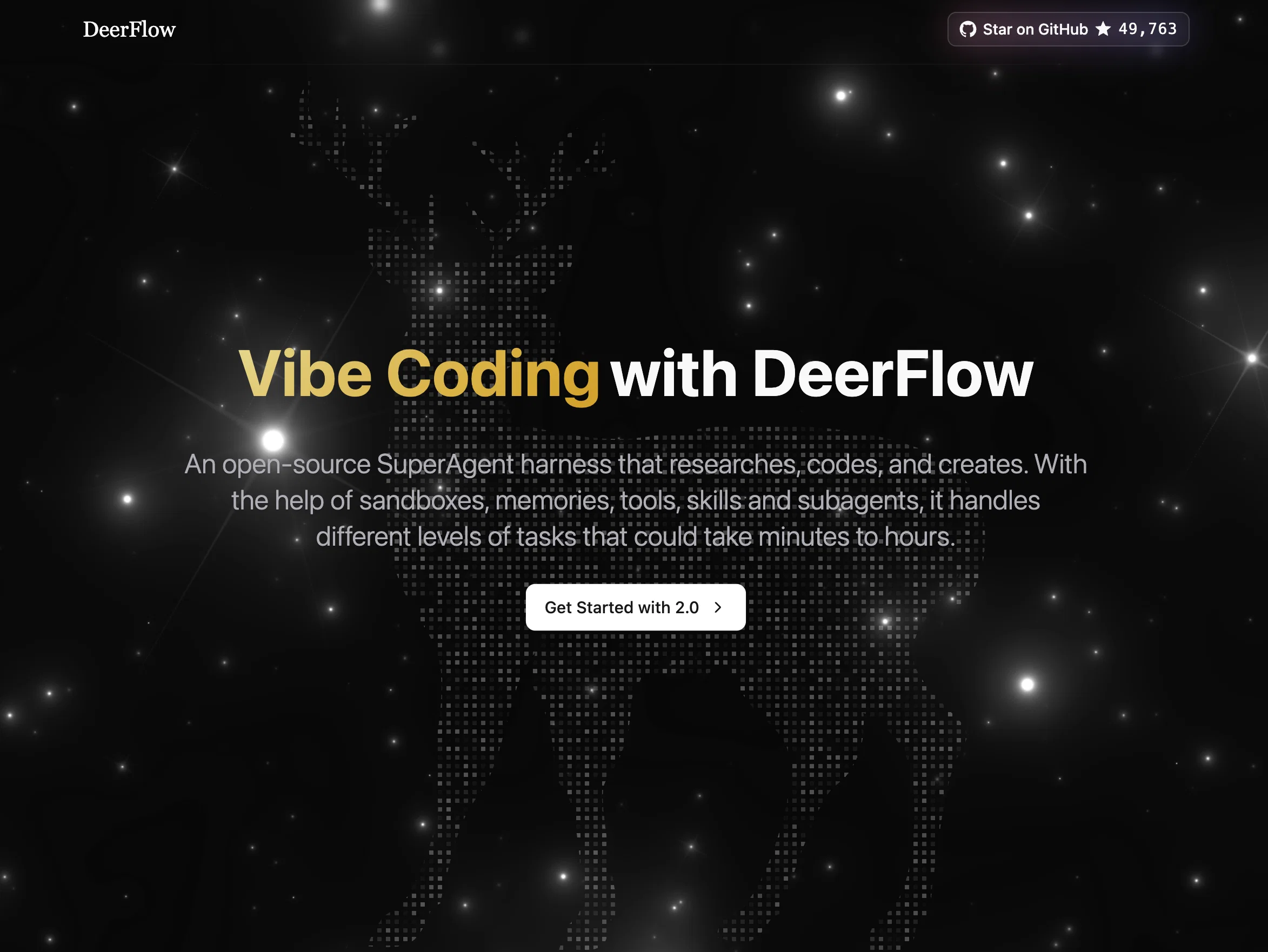
DeerFlow is an open-source, LangChain-based framework designed to build SuperAgents. It serves as a harness that enables the research, coding, and creation of tasks of varying complexity.
It utilizes sandboxes, which provide a secure, isolated environment for performing tasks, and memories to manage tasks that could range from minutes to hours.
The system uses subagents and tools to extend its functionalities. This agent framework can be employed in various practical applications including creating webpages, generating videos from novel scenes, explaining complex concepts through comic strips, data analysis, and summarizing podcasts.
DeerFlow loads agent skills progressively based on need, allowing for the extension of functionalities with user-specific skill files or with its built-in library.
It is also capable of long task running planning and sub-tasking, a feature that allows it to anticipate, reason through complexity and execute either sequentially or parallel.
This full-stack Super Agent is designed to offer flexibility and control to the user. It also supports a multi-model framework and presents an option to use a Persistent Sandbox with File System, thus allowing a user to read, write, and run commands just like on a real computer.
The community-driven framework encourages users to contribute innovative ideas to shape DeerFlow's future.
Access & connections
Where you can use DeerFlow.
Platforms
Capabilities
What this tool accepts, produces, and is strongest at.
Input
- Tabular
- Text
Output
- Video
- Tabular
- Text
- Image
Highlights
- Agents
- API
- Local
- Open Source
Supported features
- Agents
- API
- Runs Locally
- Open Source
- Deep Research
- Memory
- Code Assistant
Pros & cons
Pros
- Open-source platform
- LangChain-based framework
- Secured sandbox environment
- Task management capabilities
- Subagents extension
- Versatile functionalities
- Webpage creation capability
- Video Generation
Show 37 more
- Comic Strip Production feature
- Data Analysis feature
- Podcast Summarizing capability
- Dynamic skill loading
- User control and flexibility
- Long task planning
- Sub-tasking feature
- Parallel execution feature
- Multi-model system compatibility
- Built-in library availability
- Persistent Sandbox with File System
- Community-driven platform
- Anticipates and reasons complexity
- Adaptable to user-specific skills
- Supports different task complexities
- User-directed function extension
- Case studies availability
- Solves complex practical applications
- Secure Docker-based sandbox
- Agent skills extendable and progressive
- Full-stack SuperAgent
- Different execution models
- Modular capability loading
- Real computer-like functionalities
- MIT License
- Self-hosted tool
- Community collaborative opportunities
- Future-shaping innovative ideas
- Read, write, run commands
- Handles different levels of tasks
- Visualizations and insights
- Comprehensive report creation
- Multi-model support
- Extensible skills and tools
- Built-in tools customization
- Isolated Safe Persistent Mountable FS
- Environment for agent runtime
Cons
- Requires user-specific skill files
- Overly complex task management
- Sub-task operation unclear
- Flexible, yet overwhelming control
- Long task planning issues
- Community-driven can be disorganized
- Limited built-in library
- Potential security issues sandbox
Show 2 more
- Only web-based functionality
- Non-intuitive interface
Compare alternatives
Similar tools in the catalog — with a clear reason to open each one.

Future AGI ✓
FreemiumAI Agents hallucinate. Catch it. Fix it fast.
Free + from $250/mo
Full comparison


Hermes Agent Helper ✓
PaidDeploy your private AI agent in minutes.
Why look More privacy-focused
Full comparison
Auto Learning Agents ✓
FreeSelf-host your own AI agents in minutes.
Why look More privacy-focused
Full comparison
Releases 1
FAQ 12
What is DeerFlow?
How does DeerFlow use the LangChain-based framework?
What are the main tasks DeerFlow can handle?
Can DeerFlow function in secure and isolated environments?
How does DeerFlow manage tasks?
Can DeerFlow generate videos and create comic strips?
How does DeerFlow assist in data analysis?
What does it mean to load agent skills progressively in DeerFlow?
How can I add user-specific skill files to DeerFlow?
Can DeerFlow execute tasks sequentially or in parallel?
How do Persistent Sandbox and File System benefit me as a user of DeerFlow?
How does DeerFlow encourage community contribution?
Related tools
Recommended

MagicSlides.app AI PPT Maker ✓
FreemiumCreate Stunning PPTs in Seconds with the AI PPT Maker

ChatGPT ✓
FreemiumAsk anything, create anything, and move from idea to action.

TheLibrarian.io ✓
Free TrialYour WhatsApp AI assistant for instant productivity.

Suno ✓
FreemiumMake music at the speed of your ideas.

Sensay ✓
Free TrialAI Offboarding that keeps knowledge inside your company.

CodeRabbit ✓
Free TrialEnhanced code review for improved workflow and quality.
More from this creator

CapCut Online Creative Suite ✓
FreemiumUnleash creativity with CapCut's all-in-one online suite

Seedream ✓
UnknownTurn words into stunning 4K images instantly.

Seedance ✓
FreemiumMulti-shot video generation from text and image.

Seed by ByteDance ✓
UnknownAdvancing intelligence to serve humanity.

Dreamina ✓
FreeCapCut’s AI studio for generating images, videos, and avatars

BytePlus ✓
PaidAI-Native Cloud for Enterprise Growth