

Benchling AI ✓
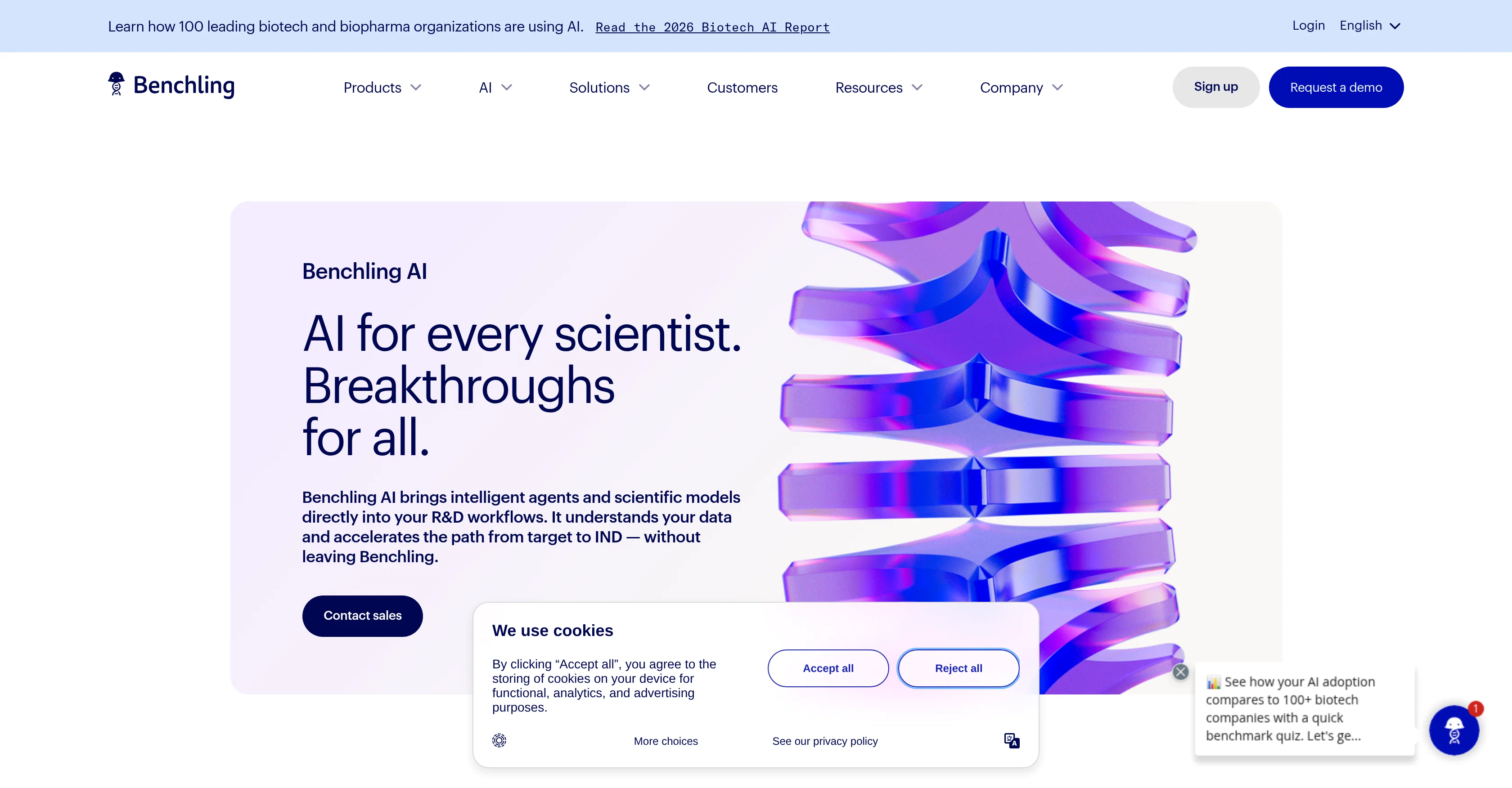
AI for every scientist. Breakthroughs for all.
Verdict
A quick read before you dig into the full page.
- Best if
- AI for every scientist. Breakthroughs for all
- Skip if
- Complex for non-advanced users
- Pick this when
- Seamlessly integrates with R&D processes
Considering Vicena instead? Compare side by side
Overview
Benchling AI is an intelligent tool designed to seamlessly integrate artificial intelligence into research and development (R&D) processes. It aims to revolutionize biotechnology and pharmacy industries by automating manual work, enabling faster data analyses, and facilitating discovery breakthroughs.
By harnessing AI, Benchling AI is designed to understand and process data, accelerate the path from target to Investigational New Drug (IND) application, all within the Benchling environment.
Benchling AI deploys intelligent agents and scientific models in your R&D workflows, directly addressing the tasks that were previously unreachable.The tool also features AI-ready data, thereby removing the need for data wrangling or building pipelines.
It offers effective R&D agents for productive workflows that understand your science. It facilitates easy access to pioneering models without any vendor lock-in or integration burden, which helps scientists stay abreast of rapid AI advancements.Furthermore, Benchling AI Agents autonomously navigate your data, utilize suitable models, and conduct intricate scientific work.
They help in locating experiments, compiling results, and finding samples instantly with natural language prompts. The tool also allows for automatic data extraction and structuring from Contract Research Organization (CRO) reports, legacy systems, and spreadsheets.Designed for an open ecosystem, Benchling AI connects your complete R&D stack using open standards, providing flexibility and insights without vendor lock-in.
The tool also offers access to frontier models from leading corporations directly in Benchling. The software is based on the trust principles that safeguard your R&D data, ensuring data security.
Ultimately, Benchling AI serves as a comprehensive solution for scientists seeking to blend traditional research methods with advanced AI models to expedite scientific R&D.
Access & connections
Where you can use Benchling AI.
Platforms
Capabilities
What this tool accepts, produces, and is strongest at.
Input
- Tabular
Output
- Text
- Tabular
Pros & cons
Pros
- Seamlessly integrates with R&D processes
- Automates manual work
- Enables faster data analyses
- Facilitates discovery breakthroughs
- Accelerates path to IND application
- Deploys intelligent agents in R&D
- No need for data wrangling
- Offers productive R&D agents
Show 37 more
- Easy access to pioneering models
- No vendor lock-in
- Integration burden-free
- Utilizes suitable models for work
- Conducts intricate scientific work
- Locates experiments and samples instantly
- Automatic data extraction and structuring
- Extracts data from CRO reports
- Legacy systems compatibility
- Spreadsheet automation
- Open ecosystem design
- Connects complete R&D stack
- Uses open standards
- Offers flexibility and insights
- Access to frontier models
- Models from leading corporations available
- R&D Data security
- Comprehensive solution for scientific R&D
- Natural language processing for prompts
- Supports all research methods
- Expedite scientific R&D processes
- Immediate experiment tracking
- Instant result compilation
- Automatic data structuring
- Open standard for ecosystem
- Access to corporate models
- Optimized for biotechnology R&D
- Advanced scientific models integration
- Autonomous complex scientific work completion
- Natural language based sample search
- 75% faster comprehensive reports generation
- Saving transcription hours
- Domain-specific models running capability
- Model predictions feed into experimental design
- Feed models without computational expertise
- Automatic availability of new models
- Insights without vendor lock-in
Cons
- Complex for non-advanced users
- Possible over-reliance on automation
- Privacy concerns with open ecosystem
- Dependent on pre-structured data
- Limited to R&D processes
- May not integrate with non-standard systems
- Accuracy dependent on model choice
- Potential delay in updating models
Show 1 more
- May overlook non-quantitative data
Compare alternatives
Similar tools in the catalog — with a clear reason to open each one.


Otio ✓
FreemiumFastest Way To Read & Write - Your Research Focused AI Workspace
Why look Better for writing
Full comparison
Paperguide ✓
FreemiumAI Research Platform for scientific research workflows
Why look Offers a public API
Full comparison

Releases 1
FAQ 12
What is Benchling AI?
How does Benchling AI integrate AI into the R&D process?
What industries does Benchling AI aim to revolutionize?
How does Benchling AI accelerate the path from target to IND application?
What are Benchling AI Agents and how do they aid the R&D workflows?
What kind of data does Benchling AI work with?
How does Benchling AI handle data wrangling and building pipelines?
Does Benchling AI work with pioneering models from other companies?
How do Benchling AI agents navigate my data?
Can Benchling AI agents conduct scientific work?
How does Benchling AI extract and structure data from CRO reports, legacy systems and spreadsheets?
Does Benchling AI provide access to models from leading corporations?
Related tools
Recommended

IllumiChat ✓
FreemiumFrom Ticket Backlog to Instant Answers Powered by AI

Scispace ✓
FreemiumPlatform for exploring and publishing research papers.

Notis ✓
Free TrialThe first WhatsApp assistant that runs on your ChatGPT and Claude subscriptions

Revmo AI ✓
Free TrialConversational AI that remembers every customer and completes every workflow

Findsight ✓
FreeCompare non-fiction ideas from multiple sources.

ZenCall ✓
Free TrialAI Answers Your Calls