

Scientific research 2026 Rank: #1449
BioSkepsis ✓
AI research assistant with cited answers from 40M+ papers
Verdict
A quick read before you dig into the full page.
- Best if
- AI research assistant with cited answers from 40M+ papers
- Skip if
- Limited to preexisting databases
- Pick this when
- Semantic search functionality
Considering Vicena instead? Compare side by side
Overview


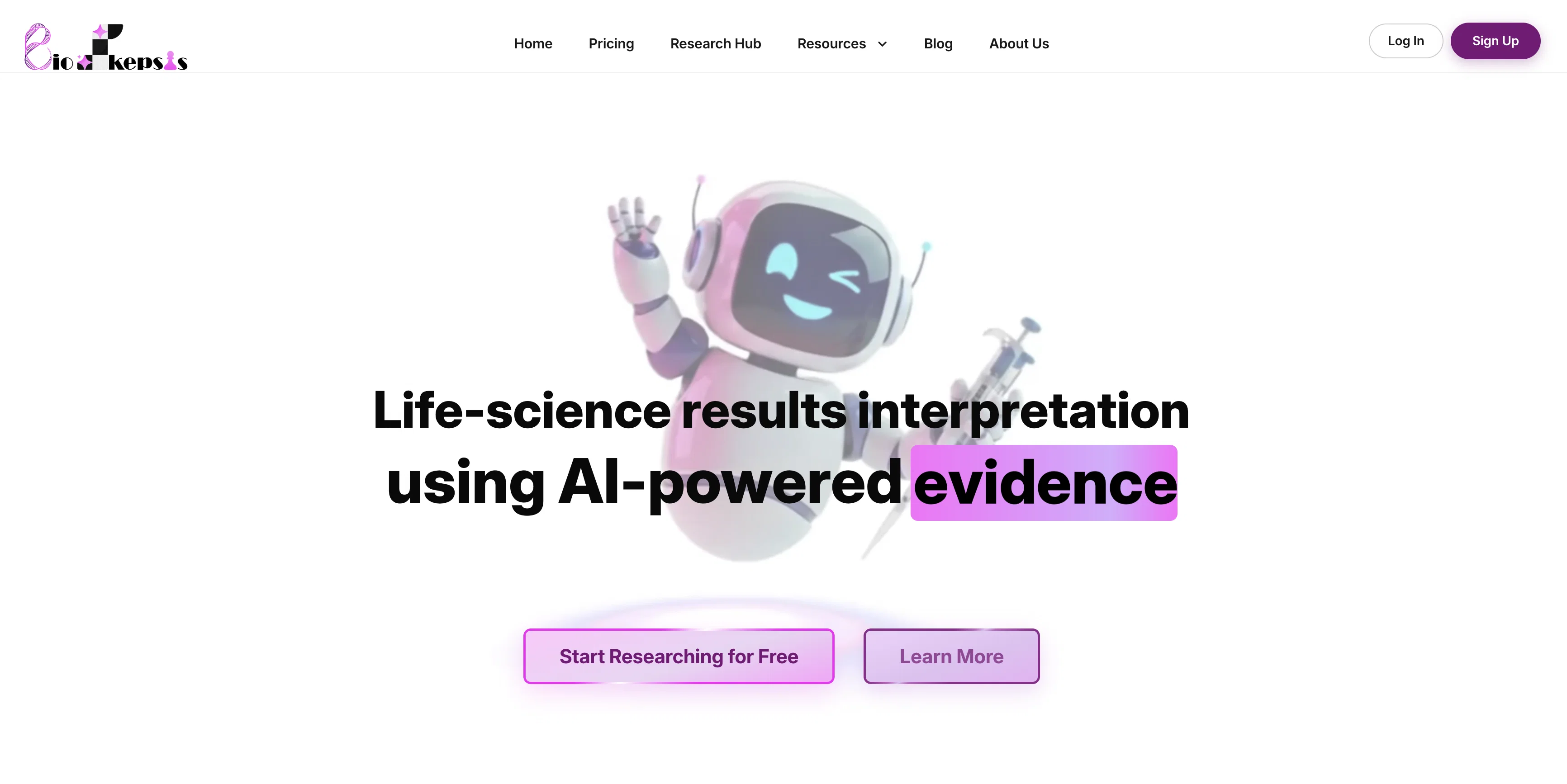
BioSkepsis is an AI-powered tool designed specifically for life-sciences research. It offers the ability to search millions of biomedical papers swiftly and efficiently, improving research workflows.
Researchers can analyze results, write papers, prepare proposals and create lectures more effectively by saving hours of manual searching. BioSkepsis applies semantic search strategies to a wide range of papers across Biology, Medicine, Agricultural & Food Sciences, and Environmental science sectors.The platform features AI-powered cluster analysis, trend detection, and traceable citations.
It provides functionalities such as lab results interpretation, automated literature reviews and Zotero library syncing. Users can extract data and synthesize findings across their curated papers, fostering efficiency and streamlining the research process.BioSkepsis reads entire papers, including abstracts, methods, results, discussions, and citations, ensuring that critical information in the papers is utilized.
It links papers based on biological relevance using systems such as Gene Ontology and MeSH terms and identifies emerging trends in the field.Moreover, the tool uses evidence-graded reasoning, where every claim is cited, classified, and confidence-scored.
BioSkepsis also offers a personalized research feed based on topics, keywords, or the users existing knowledge base, further enhancing personalized research.
New papers are scanned, and only the most relevant ones are recommended, accompanied by AI-generated summaries about their relevance to the users research.
Access & connections
Where you can use BioSkepsis.
Platforms
Capabilities
What this tool accepts, produces, and is strongest at.
Input
- Tabular
- Image
- Text
Output
- API
- Text
Supported features
- Deep Research
- Search
- Citations
- Medical
- Integrations
Pros & cons
Pros
- Semantic search functionality
- Supports multiple science fields
- Cluster analysis feature
- Trend detection capability
- Traceable citations
- Lab results interpretation
- Automated literature review
- Full-context reasoning
Show 36 more
- Plain language result descriptions
- Supports Zotero collaboration
- Instant chat with collections
- Findings synthesis
- Evidence-graded reasoning
- Personalized research feeds
- Emerging trend identification
- Cited answers from 40M+ papers
- Full paper review including methodology
- Links papers by biological relevance
- Reasoning classification with confidence scoring
- Interprets experimental observations
- Improves research workflow efficiency
- Keyword-based personalized recommendations
- Functional with Gene Ontology
- Functional with MeSH terms
- Integrated with the latest technologies
- Creates literature grounded knowledge base
- Supports the development of strategic plans
- Accelerates research workflow
- Supports data extraction from curated papers
- Offers biology-native knowledge graph
- Identifies foundational papers through co-citation analysis
- Allows sharing of research sessions via email or secure link
- Enables research lens recommendation (fundamental, applied, convergent)
- Imports data from Zotero
- Live collaboration with Zotero libraries
- Allows export of findings back to Zotero
- Maps biology to biology
- Syncs with existing knowledge base
- Recognizes emerging research trends
- Scans new papers for relevant ones
- Categorizes queries across multiple papers
- Grounds reasoning in citable literature
- Matches relevant literature to experimental results
- Uploads feature for experimental notes and results
Cons
- Limited to life-sciences research
- No offline functionality
- Depends on Zotero integrations
- Constrained to English language
- No cross-disciplinary support
- Restricted to academic research
- No collaboration or team features
- Limited to preexisting databases
Show 1 more
- No mobile app available
Compare alternatives
Similar tools in the catalog — with a clear reason to open each one.

Vicena ✓
FreemiumAI for real scientific research (Vibe Research)
Why look Typically cheaper
Full comparison
Otio ✓
FreemiumFastest Way To Read & Write - Your Research Focused AI Workspace
Why look Better for writing
Full comparison
Paperguide ✓
FreemiumAI Research Platform for scientific research workflows
Why look Offers a public API
Full comparison

Releases 1
FAQ 12
What makes BioSkepsis different from other AI research tools?
How does BioSkepsis enhance scientific research in life-sciences?
What is semantic search in BioSkepsis?
How does BioSkepsis support strategic planning for researchers?
Can you explain the lab results interpretation feature of BioSkepsis?
What is the significance of the automated literature review provided by BioSkepsis?
How does BioSkepsis generate a literature-grounded knowledge base?
How does BioSkepsis collaborate with Zotero?
How does BioSkepsis ensure a thorough understanding of the research materials?
How does BioSkepsis identify papers by biological relevance?
What is evidence-graded reasoning in BioSkepsis?
How are personalized research feeds generated in BioSkepsis?
Related tools
Recommended

ChatGPT ✓
FreemiumAsk anything, create anything, and move from idea to action.

Hedy AI ✓
FreemiumDominate every meeting with Hedy as your brilliant AI ally

Instant Klarity ✓
PaidGet clarity on your next move.

Scisummary ✓
Free TrialCutting-edge scientific articles summarization.

GetLogit ✓
FreemiumArtificial intelligence, available for everyone.

Automateed ✓
Free TrialCreate eBooks effortlessly with Automateed, the AI-powered writing tool.