
Torq Agentic AI ✓
AI Agents automate SOC operations 24/7.
Verdict
A quick read before you dig into the full page.
- Best if
- AI Agents automate SOC operations 24/7
- Skip if
- Limited to SOC-related operations
- Pick this when
- Security operations enhancement
Considering Dropzone Threat Hunter instead? Compare side by side
Overview
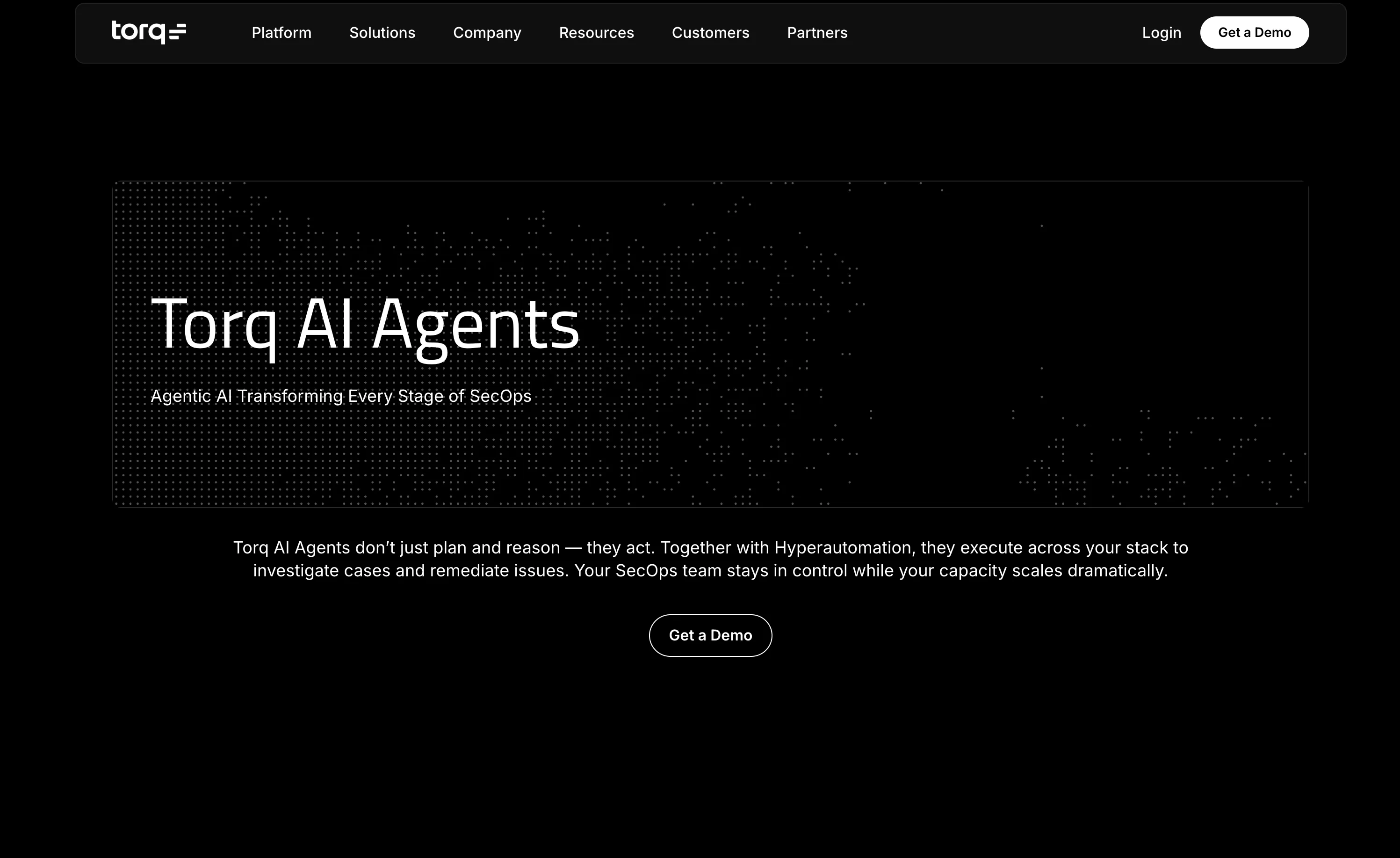
Torq Agentic AI for Security Operations is an advanced tool specifically designed to enhance security operations centers' (SOC) efficiency. It employs specialized AI agents to triage alerts, investigate threats, and automate responses in real-time.
These agents not only plan and reason but also act autonomously to investigate and remediate issues using hyperautomation. By doing so, the tool allows the SecOps team to gain control while significantly boosting their capacity.
The Torq HyperAgents, which are part of this platform, automate repetitive tasks and infuse agentic reasoning into security workflows to expedite analysis, response, and communication.
The AI agents can also interact together and expand the capabilities of security operations with their specialized skills. Agentic analysis offloads repetitive tasks, heightening speed and scale to deal more accurately with alerts across the entire threat lifecycle.
The platform, Torq Socrates, serves as the core orchestrator on the platform. It coordinates the work of HyperAgents across the threat lifecycle, which results in faster security operations end-to-end.
Socrates also manages a force of specialized AI agents to investigate threats, take actions, and improve the existing team of experts by learning from historical data and recognizing patterns to adapt to emerging threats.
Socrates can also initiate response actions across the security stack, reducing Mean Time to Resolution (MTTR), containing threats, and ensuring a more efficient use of the human resources for high severity threats.
Access & connections
Where you can use Torq Agentic AI.
Platforms
Capabilities
What this tool accepts, produces, and is strongest at.
Input
- Tabular
Output
- Text
Pros & cons
Pros
- Security operations enhancement
- Real-time threat responses
- Hyperautomation deployment
- Increases SecOps team control
- Boosts security capacity
- Automates repetitive tasks
- Enhances speed and scale
- Covers entire threat lifecycle
Show 38 more
- Orchestrates work of HyperAgents
- Improves team with learning
- Reduces Mean Time to Resolution
- Human resource efficiency improvement
- Offers Agentic analysis
- Implementable alert triage
- Adaptive learning and pattern recognition
- Specialized in threat investigation
- Streamlines security orchestration
- 24/7 SOC operations automation
- Agentic reasoning in workflows
- Initiates response actions
- Auditable logs of actions
- Real-world results feedback loop
- Infuses agentic reasoning into workflows
- Offloads repetitive tasks
- Context-aware action execution
- Faster end-to-end security operations
- Autonomous threat remediation
- Natural language command capability
- Contains threats efficiently
- Threat hunting with precision
- Enhanced communication and collaboration
- Multi-agent coordination
- Investigates and remediates issues
- Expands SOC Capacity
- Agents learn from history
- Automated runbooks execution
- Threat prioritization decisions
- Handles Tier-1 security alerts
- Declarative Instruction for HyperAgents
- Agentic case management
- Transparency in decision making
- Accelerates incident response
- Seamless agent interaction
- Proactive threat hunting
- Customizable templates available
- Reasoning and action visibility
Cons
- Limited adaptability to edge cases
- Requires manual tuning upkeep
- Dependency on human-on-loop confirmation
- Limited to SOC-related operations
- Over-reliance on historical data
- HyperAgents require specific instructions
Compare alternatives
Similar tools in the catalog — with a clear reason to open each one.





Releases 1
FAQ 12
What does Torq Agentic AI for Security Operations do?
How does Torq Agentic AI improve SOC efficiency?
What are the roles of specialized AI agents in Torq Agentic AI?
What is the role of hyperautomation in Torq Agentic AI system?
Can the AI agents of Torq Agentic AI interact together?
What is the purpose of Torq HyperAgents?
What is the function of Torq Socrates on the platform?
How does Torq Socrates manage to reduce MTTR?
How does Torq's AI platform automate SOC operations?
What are the benefits of having Torq HyperAgents in my SecOps team?
How do AI agents infuse agentic reasoning into security workflows?
How does the Torq Agentic AI system adapt to emerging threats?
Related tools
Recommended

OC Maker ✓
FreemiumTransform character ideas into beautiful artwork with AI.

Belin Doc ✓
FreemiumOne-click high-quality AI document translation.

Comp AI ✓
UnknownAutomate compliance for SOC 2, ISO 27001 & GDPR in weeks.

Steve ✓
UnknownAI competitive intelligence to win more B2B deals

Soniox Speech-to-Text AI ✓
FreemiumHigh-accuracy multilingual Speech-to-Text API

ChartGen ✓
FreemiumTransform data into professional charts in seconds.