

SOC 2026 Rank: #3031
Dropzone Threat Hunter ✓
Autonomous threat hunting across SIEM, EDR, and cloud 24/7.
from $36000/yr
Verdict
A quick read before you dig into the full page.
- Best if
- Autonomous threat hunting across SIEM, EDR, and cloud 24/7
- Skip if
- Single search limit of 500,000 rows
- Pick this when
- Autonomous threat hunting
Considering Anomali Agentic AI instead? Compare side by side
Overview
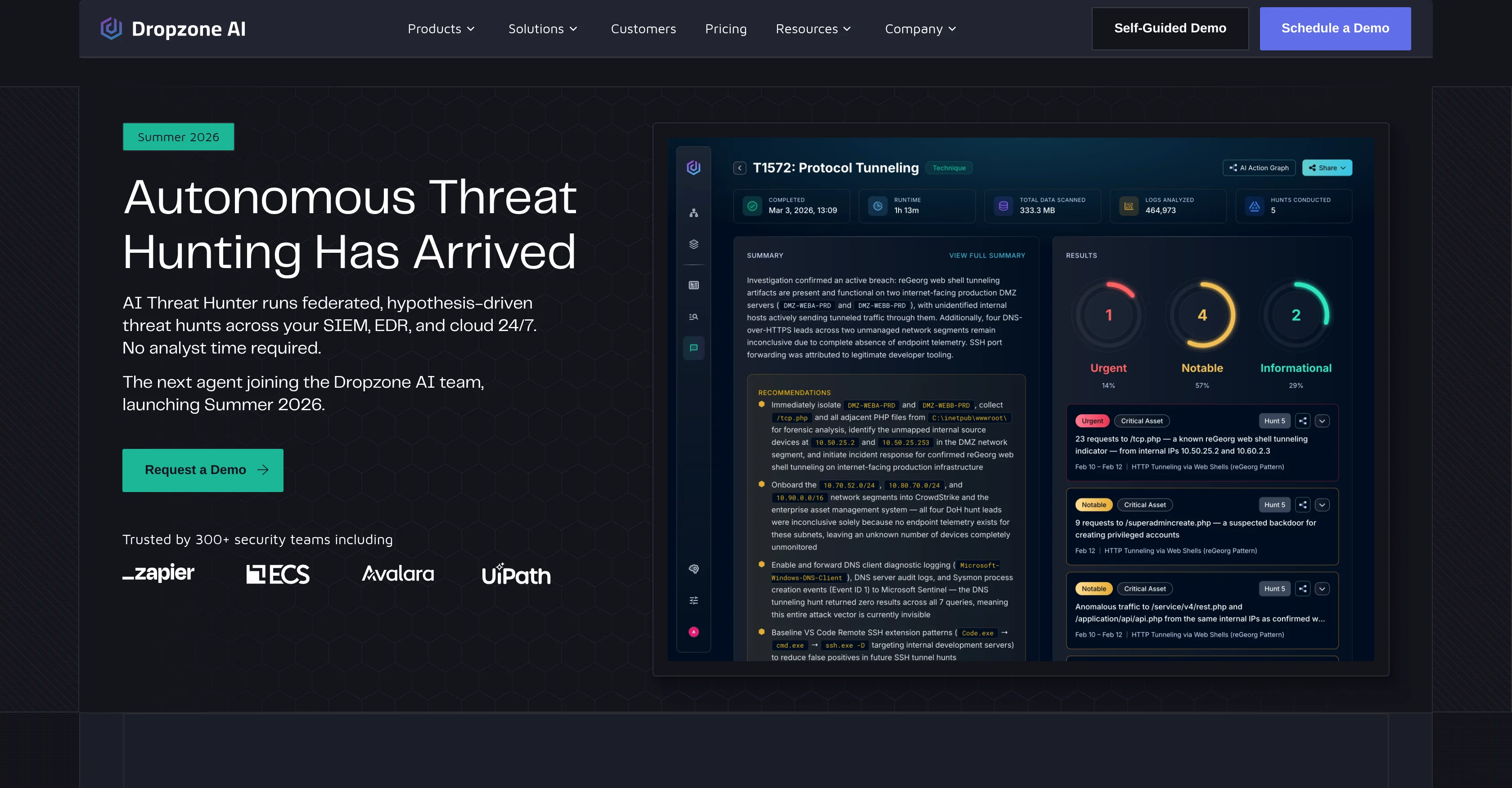
AI Threat Hunter is an AI-based tool developed by Dropzone for autonomous threat hunting across security information and event management (SIEM), endpoint detection and response (EDR), and cloud environments.
Continuously operational, this tool conducts federated, hypothesis-driven threat searches, eliminating the need for constant analyst oversight. AI Threat Hunter reads advisories, extracts important information, crafts hunt packs that are then autonomously executed.
The tool is able to integrate with a wide variety of alert investigation tools and systems, increasing its versatility and utility. It is designed to enhance efficiency and reduce mean time to respond (MTTR), allowing security operations center (SOC) to scale without extra team members.
AI Threat Hunter also provides proactive defense capabilities for enterprises, sweeping for potential security gaps and vulnerabilities, as well as emerging threats.
It has the ability to process large amounts of data, cast wide searches, filter relevant data, and conduct deep investigations simultaneously to confirm if anomalies pose real threats.
The tool is also effective in identifying non-attack insights such as misconfigurations, shadow IT, and other vulnerabilities even when no active attacker is detected.
It offers autonomous threat hunting that reduces the amount of analyst time required during execution. Lastly, AI Threat Hunter offers protection against emerging threats, known threat actors, and vulnerabilities, and detects operational anomalies and unusual activities.
Access & connections
Where you can use Dropzone Threat Hunter.
Platforms
Capabilities
What this tool accepts, produces, and is strongest at.
Input
- API
Output
- API
Highlights
- Agents
- API
Supported features
- Cybersecurity
- Agents
- Automation
- Integrations
- API
- SOC 2 Compliance
Pros & cons
Pros
- Autonomous threat hunting
- Operational 24/7
- Hypothesis-driven threat searches
- Eliminates constant analyst oversight
- Reads and extracts advisories
- Crafts and executes hunt packs
- Integrated with various alert tools
- Enhance SOC efficiency
Show 36 more
- Reduces MTTR
- Scales SOC without extra members
- Proactive defense capabilities
- Sweeps for security gaps
- Identifies vulnerabilities and threats
- Large-scale data processing
- Conducts wide searches
- Filters relevant data
- Deep simultaneous investigations
- Anomaly verification
- Identifies non-attack insights
- Detects misconfigurations
- Locates shadow IT
- Reduces analyst time
- Defends against emerging threats
- Detects known threat actors
- Detects operational anomalies
- Identifies unusual activities
- Protection against vulnerabilities
- High integration capabilities
- Detects active and potential threats
- Curates and executes hunt packs
- Follows evidence autonomously
- Federated search across tools
- Data filtering at scale
- Detects and reports misconfigurations
- Defends against new threat intelligence
- Hunts specific threat actors
- Evaluates threat exposure
- Probes for active exploitation of CVEs
- Analyses below detection threshold techniques
- Detects business operational anomalies
- Transparent, audit-friendly operation
- No vendor lock-in
- Autonomous operation in a closed-loop
- High-volume alert analysis automation
Cons
- Single search limit of 500,000 rows
- Limited to 90 integrations
- Zero manual oversight during operation
- Potentially overwhelming results volume for analysts
- Offers no stand-alone function
- Un-clear proactive defense approach
- Unknown response time to emerging threats
- No detailed misconfiguration solutions offered
Show 2 more
- Specificity of threat actor recognition under-defined
- Operational anomaly detection scope unclear
Compare alternatives
Similar tools in the catalog.





Releases 1
FAQ 12
What is Dropzone Threat Hunter AI?
How does Threat Hunter AI operate autonomously?
What kind of threats can the AI Threat Hunter detect?
How does AI Threat Hunter integrate with other alert investigation tools?
How does AI Threat Hunter contribute in reducing the Mean Time To Respond (MTTR)?
How does AI Threat Hunter help in identifying security vulnerabilities?
How capable is AI Threat Hunter in processing and filtering data?
Can AI Threat Hunter identify misconfigurations and shadow IT?
What is the role of AI Threat Hunter in anomaly detection?
How does AI Threat Hunter assist in identifying emerging threats?
Does AI Threat Hunter require constant analyst oversight?
What kind of data can AI Threat Hunter process?
Related tools
Recommended

JustVibe ✓
FreeThe search engine for doing, with instant apps built for you

isFake.ai ✓
FreemiumDetect AI-generated text, images, video, and audio.

Face ID Search.com ✓
PaidFind anyone by photo in 60 seconds.

Continua AI ✓
Free TrialDeep research on your own files, every page read, every claim cited.

Pixalytica ✓
PaidAI-powered KYC reports using facial recognition technology.

Translate Image.io ✓
FreemiumTranslate text in photos to 130+ languages instantly.
