
SupportGPT ✓
Transform customer experience with generative AI
Verdict
A quick read before you dig into the full page.
- Best if
- Transform customer experience with generative AI
- Skip if
- Limited specific industry adaptation
- Pick this when
- Automates customer support workflows
Considering GPT Trainer instead? Compare side by side
Overview
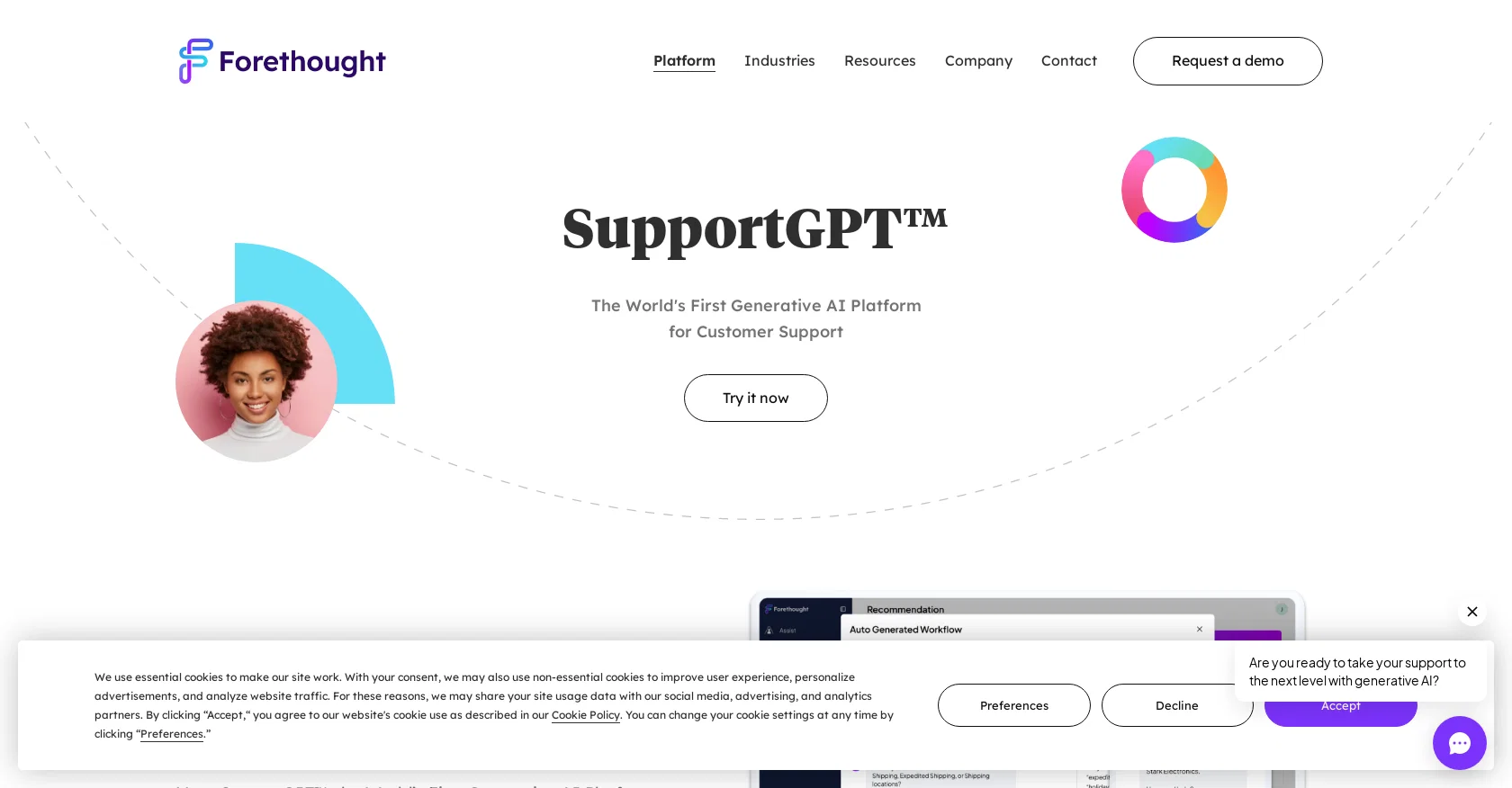
SupportGPT™ is a generative AI platform for customer support developed by Forethought, which leverages OpenAI's Large Language Models to power human-like, dynamic responses.
The platform fine-tunes the models based on a company's conversation history to automate workflow discovery, identify support coverage gaps, and lower case volume by generating new knowledge articles.
SupportGPT™ provides fully-formed suggested responses to agents, which are based on the context of each ticket and powered by generative AI. This product is ideal for organizations looking to enhance customer support experiences through intelligent automation, efficiency, and accuracy.
SupportGPT™ is fully integrated with a company's conversation history and has tailored workflows for different industries, including e-commerce, SaaS, FinTech, and travel.
Forethought's generative AI platform can generate proactive insights and predict, prioritize and route tickets that can aid different businesses. SupportGPT™ also offers integrations with a range of support platforms such as Salesforce, Zendesk, and Freshdesk, ensuring efficient management of customer support across platforms.
By leveraging the power of generative AI, SupportGPT™ can transform the customer experience by providing empathetic and human-like conversations that adapt to customer context.
Overall, SupportGPT™ is a powerful tool that can help businesses automate customer support in a smart and efficient way, ultimately improving customer satisfaction and loyalty.
Access & connections
Where you can use SupportGPT, and what it plugs into.
Platforms
Integrations
Capabilities
What this tool accepts, produces, and is strongest at.
Input
- API
- Text
Output
- API
- Text
Pros & cons
Pros
- Automates customer support workflows
- Incorporates Large Language Models
- Tailored to company's conversation history
- Identifies support coverage gaps
- Automatically generates knowledge articles
- Provides suggested responses to agents
- Responses based on ticket context
- Individualized workflows for specific industries
Show 10 more
- Generates proactive insights
- Predicts, prioritizes, and routes tickets
- Integrates with multiple support platforms
- Facilitates human-like conversations
- Adapts to customer context
- Improves customer satisfaction and loyalty
- Unveils new workflows automatically
- Efficient management across platforms
- Aids various businesses
- Accelerates intelligent automation
Cons
- Depending on company's conversation history
- Limited specific industry adaptation
- Limitations in integrations offered
- Potential privacy concerns
- Accuracy of generated responses
- Empathy levels in conversations
- Requires extensive training
- Platform-specific functionality
Compare alternatives
Similar tools in the catalog — with a clear reason to open each one.

GPT Trainer ✓
FreemiumAI Voice and Text Agents with No-Code
Why look Offers a public API
Full comparison
Social Intents ✓
Free TrialReal-time support & sales via messaging platforms.
Free + from $39/mo
Full comparison
Chatisto ✓
FreemiumAI-powered live chat for better customer support.
Why look Higher community rating
Full comparison
IllumiChat ✓
FreemiumFrom Ticket Backlog to Instant Answers Powered by AI
Why look Offers a public API
Full comparison

CoSupport AI ✓
Free TrialAI for support ops that drown in repetitive tickets.
Why look Offers a public API
Full comparisonReleases 1
FAQ 12
What is SupportGPT?
How does SupportGPT use generative AI?
How can SupportGPT lower case volumes?
How does SupportGPT uncover workflows?
Can SupportGPT help me understand support coverage gaps?
Which industries can SupportGPT cater to?
What integrations does SupportGPT offer?
How does SupportGPT adapt to user context?
What is the link between SupportGPT and OpenAI's ChatGPT?
How can SupportGPT improve my customer satisfaction?
What kind of responses does SupportGPT provide to agents?
How does SupportGPT interact with conversation history?
Related tools
Recommended

Hints ✓
Free TrialEfficient and automated business task assistant.

Galeby ✓
PaidAnswer repetitive customer service 2x faster with AI-powered templates.

VenturusAI ✓
FreemiumBusiness idea analysis and reporting.

MagicSlides.app AI PPT Maker ✓
FreemiumCreate Stunning PPTs in Seconds with the AI PPT Maker

Photo AI ✓
PaidCreate beautiful AI photos and videos of real people

Hyperis ✓
FreemiumOrganized task prioritization.