

RunSybil ✓
AI-powered pentesting that thinks like elite hackers.
Verdict
A quick read before you dig into the full page.
- Best if
- AI-powered pentesting that thinks like elite hackers
- Skip if
- Constant real-time scanning may affect performance
- Pick this when
- Continuous offense testing
Considering ZeroThreat.ai instead? Compare side by side
Overview
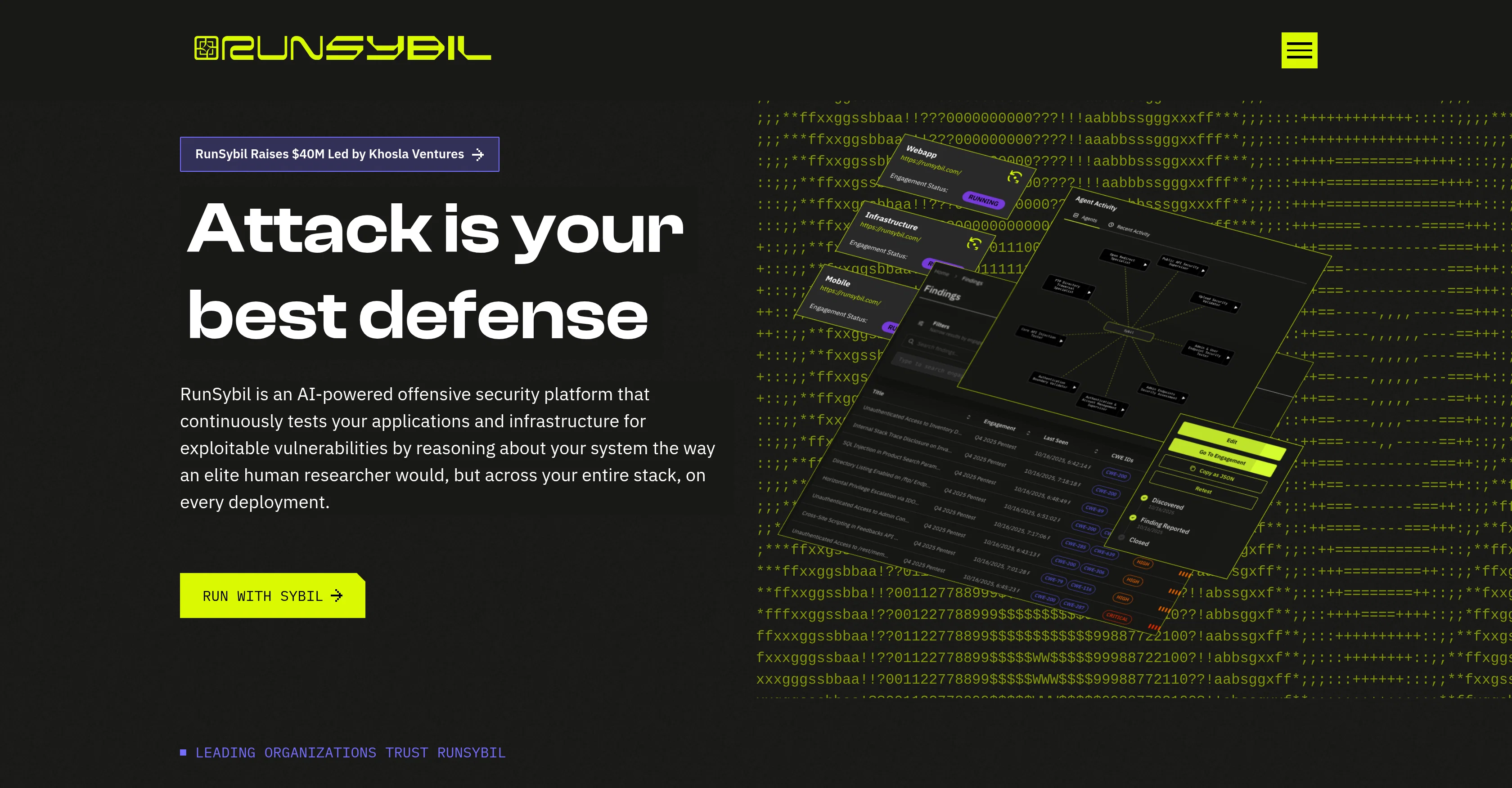
RunSybil is an AI-powered offensive security platform designed to continuously scan the applications and infrastructure of an organization for potential vulnerabilities.
Using a method similar to how an experienced researcher would approach a system, it spans your software stack and analyzes every deployment to identify exposures.
It's particularly effective in pinpointing vulnerabilities where different components connect, a detail often overlooked by other scanners. RunSybil operates on a proactive basis, re-evaluating your security posture in real-time to suit your system's current conditions.
It also provides security feedback on every pull request, spotting vulnerabilities early rather than after a breach. Unlike traditional scanning setups that often look for known signatures, RunSybil thinks like an actual attacker, chaining vulnerabilities across your system to uncover genuine, exploitable paths.
Five main uses of RunSybil include continuous attack surface monitoring, multi-tenant and business logic testing, bug bounty and pentesting, cloud and infrastructure security validation, and enabling CTEM programs.
It builds a model of your application and infrastructure, updates it regularly, and evaluates the changes to your specific attack surface to disclose only new or relatively exploitable risks.
In terms of cloud security, it identifies how an application vulnerability turns into the starting point for a full infrastructure compromise. RunSybil provides continuous offensive testing, transforming your CTEM program from a simple framework to an operational reality.
Access & connections
Where you can use RunSybil.
Platforms
Capabilities
What this tool accepts, produces, and is strongest at.
Input
- Tabular
Output
- Text
Pros & cons
Pros
- Continuous offense testing
- Proactive security posture adjustment
- Security feedback on PRs
- Thinks like an attacker
- Multilayer vulnerability chaining
- Cloud and infrastructure security
- Real-time applications and infrastructure scanning
- Pinpoints connection component vulnerabilities
Show 40 more
- Continuous attack surface monitoring
- Multi-tenant and business logic testing
- Bug Bounty and pentesting support
- Identifies starting points for compromise
- CTEM program transformation
- Evaluates specific attack surface changes
- Regular infrastructure model updates
- Delivers newly exploitable risks
- Maintains updated attack surface model
- Intelligent vulnerability path exposure
- Continuous application and infrastructure attack
- Deploys adversarial reasoning
- Expensive bug bounty replacement
- Infrastructure compromise identification
- CTEM program operational transformation
- Pre-validated findings
- Predictable testing cost
- Zero triage burden
- Provides cross-layer reasoning
- Validates real exploitability
- Not periodic offensive testing
- Coverage across application and infrastructure
- Enterprise-ready capabilities
- Mapping of entire stack
- Reasons like an attacker
- Proactive attack surface change evaluation
- Exploitable findings and results
- Improve development velocity
- Reasons across system layers
- Cloud security validation
- Transaction manipulation testing
- Container escapes identification
- CI/CD secret exposure testing
- Lateral movement paths testing
- Measurable improvements to security posture
- Security test cadence
- Authoritative in high-end security audits
- Not periodic but continuous testing
- Comprehensive programmatically discovered vulnerabilities catalogue
- Enhances multi-tenant data access security
Cons
- Constant real-time scanning may affect performance
- No mentioned support for legacy systems
- No explicit data privacy measures
- Not clear on remediation insights for issues
- No multi-language support mentioned
- No customization options stated
- Lack of integrations with other security tools
- No emergency support or SLA mentioned
Show 2 more
- Potential for false positives not addressed
- No mention of handling encrypted data
Compare alternatives
Similar tools in the catalog — with a clear reason to open each one.

ZeroThreat.ai ✓
FreemiumFastest AI-Powered AppSec & Automated Pentesting Platform
Free + from $100/mo
Full comparison
HackerAI ✓
UnknownAI assistant that automates penetration testing workflows.
Why look Higher community rating
Full comparison
Maced AI ✓
PaidAI penetration testing that runs itself.
Why look Offers a public API
Full comparison
XBOW ✓
PaidAutonomous AI penetration testing at machine scale.
Why look Offers a public API
Full comparison

AISafe Labs ✓
FreemiumAI agents that assess your app with hacker expertise at machine speed.
Why look Offers a public API
Full comparisonReleases 1
FAQ 12
What is RunSybil?
How does RunSybil analyze vulnerabilities?
What makes RunSybil more effective than other scanners?
What does RunSybil mean by re-evaluating your security posture in real-time?
What kind of security feedback does RunSybil provide on pull requests?
How does RunSybil think like an attacker?
What are the main uses of RunSybil?
How does RunSybil build a model of your application and infrastructure?
How does RunSybil approach cloud security?
How does RunSybil transform CTEM programs from a simple framework to an operational reality?
What is the meaning of continuous offensive testing?
How does RunSybil help in multi-tenant and business logic testing?
Related tools
Recommended

Momentic ✓
FreemiumStop wasting time on flaky tests

AI QA Monkey ✓
FreemiumInstant AI Security Score: Scan Free, Fix with AI, Monitor 24/7.

CoTester by TestGrid ✓
PaidEnterprise-Grade AI Software Testing Agent

Semaloop ✓
UnknownCatch mobile bugs before your users do.

CodeThreat ✓
FreemiumCode analysis detects vulnerabilities.

Testsigma ✓
UnknownAI-powered codeless test automation platform