

Task automation 2026 Rank: #2726
Nebula ✓
Build your company with autonomous AI agents.
from $5/mo
Verdict
A quick read before you dig into the full page.
- Best if
- Build your company with autonomous AI agents
- Skip if
- Possibly high learning curve
- Pick this when
- Manages autonomous companies
Considering SureThing.io - "OpenClaw" for Beginners instead? Compare side by side
Overview
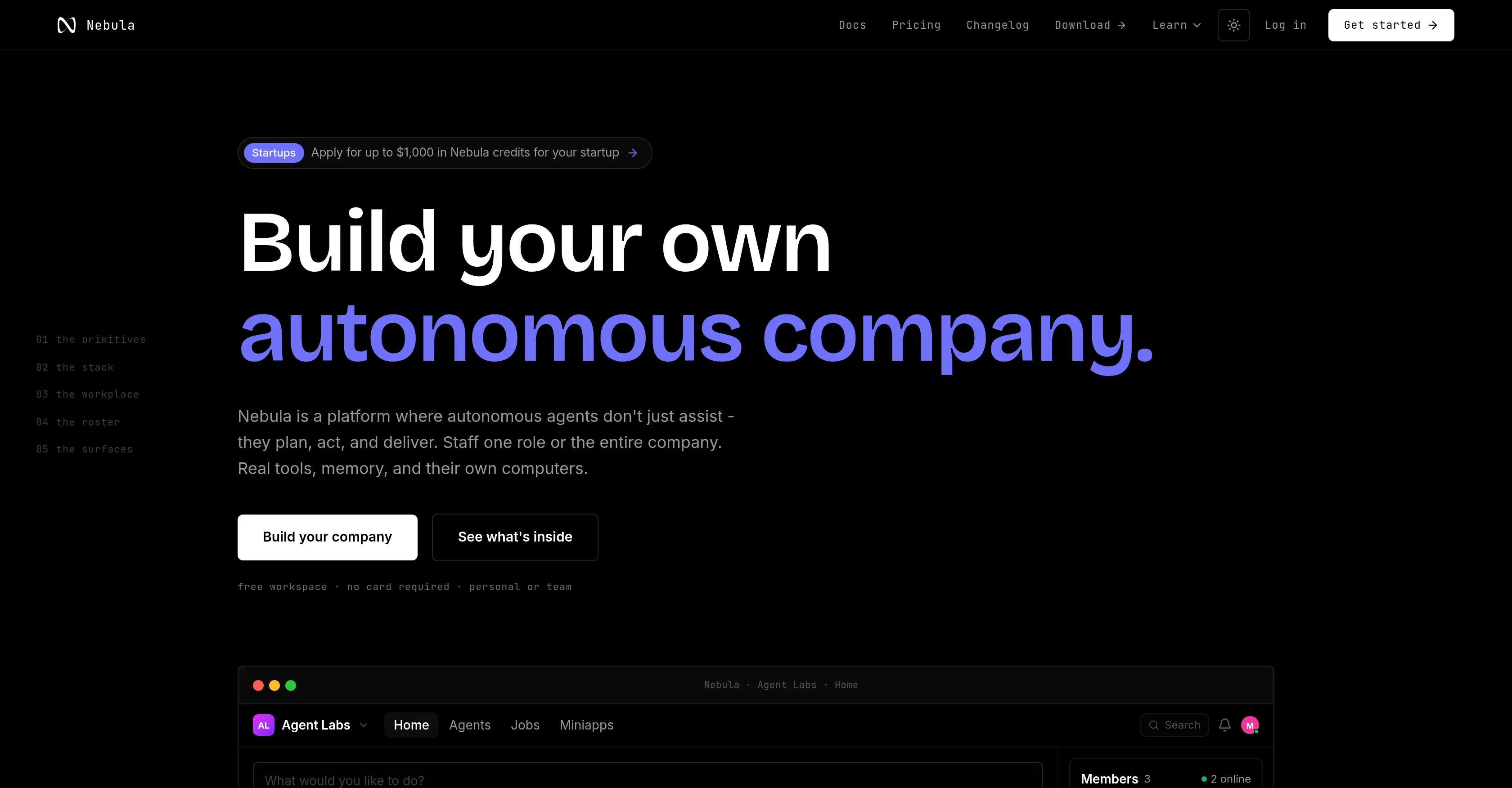
Nebula is a platform aimed to build and manage autonomous companies. It uses autonomous agents who are programmed to work end-to-end - planning, execution, and delivery.
The platform allows a wide range of use-cases, from staffing a single role to an entire company using these agents. Each Nebula agent operates like a full-function computer, having its own tools, memory, and running on the cloud.The agents function more like real team members as opposed to simple chat boxes.
They are assigned roles, and take work from start to finish, including giving reports on the tasks undertaken. These tasks range from basic duties to complex tasks that essentially run the organization.Nebula also offers a rich set of toolkits.
There are thousands of built-in tools and all these tools are unified under a single bill, eliminating the need for separate API keys. The platform also allows for the addition of custom tools as needed.There's a feature for persistent memory, which means the agents' knowledge, experience, and context do not have to be reset after each interaction.
This allows for more efficient and streamlined operations.The agents are also capable of working for long hours without supervision. They can autonomously plan, act, and verify outcomes, only seeking human intervention when necessary.
This greatly enhances productivity and efficiency within the company.Instead of a simple chat interface, Nebula creates a whole workspace where agents can be interacted with.
They can be assigned work in any available thread and then left to carry out the task on their own. They can join live sessions, keep working while interacting with human counterparts and publish the summary of discussions after the meeting.
Access & connections
Where you can use Nebula.
Platforms
Capabilities
What this tool accepts, produces, and is strongest at.
Input
- Text
Output
- Text
Pros & cons
Pros
- Manages autonomous companies
- End-to-end operations
- Built-in toolkits
- Single billing
- Persistent agent memory
- Operate without supervision
- Can work long hours
- Interactive workspace
Show 43 more
- Addition of custom tools
- Autonomously plans, acts, verifies
- Human intervention only when necessary
- Real-functional agents
- Agents have their own memory
- Agents operate on cloud
- Agents give task reports
- Thousands of built-in tools
- No need for separate API keys
- Agents function as team members
- Streamlined operations
- Can staff entire company
- Agents can join live sessions
- Full company management
- Complex task handling
- Interactive agents
- Efficient task automation
- Cloud-based platform
- Flexible use-cases
- Agents hold task context
- Assign work to agents
- Unified toolkits and billing
- Workspace-wide memory
- Report generation capabilities
- Allows for complex tasks
- Agents mimic real team members
- Handles basic to complex duties
- Task summarizing after meetings
- Persistent cloud computing
- Unified memory across all conversations
- Autonomous execution and verification
- Always on, always available
- Native interface across devices
- Role-based staffing capability
- Long and complex job handling
- Support for live voice sessions
- Agent interaction in any thread
- Maintains full task history
- Agent recruitment and management
- Interface for adding proprietary tools
- Agents have their own computers
- Agent tools customized for tasks
- Operates on a Linux computer
Cons
- Possibly high learning curve
- Autonomy may lead to uncontrolled mistakes
- May lack certain specialized skills
- Persistent memory feature potential privacy concern
- Relying on single billing could be limiting
- Custom tool development could be complex
- Long unsupervised working hours could result in unwanted actions
- Excessive multitasking may affect work quality
Show 2 more
- Difficult to make quick changes in autonomous operations
- Potential lack of integration with external tools
Compare alternatives
Similar tools in the catalog — with a clear reason to open each one.

SureThing.io - "OpenClaw" for Beginners ✓
FreemiumFirst General AI Agency. Designed for long-horizon tasks.
Why look Freemium alternative
Full comparison

Manus ✓
FreemiumTurn your thoughts into actions with AI
Why look Freemium alternative
Full comparison
Raccoon AI ✓
FreemiumThe AI Coworker for Apps, Research, Docs & Everything Else
Why look Freemium alternative
Full comparison
Autopilots by Athena AI ✓
Free TrialAutonomous AI agents that execute tasks for you.
Why look Higher community rating
Full comparison
Releases 1
FAQ 12
What is the main purpose of Nebula?
How do the autonomous agents in Nebula function?
What kind of roles can I assign to the Nebula agents?
What types of tasks can Nebula agents undertake?
How does Nebula's toolkit feature work?
Can I add custom tools to Nebula?
What does Nebula mean by persistent memory?
Do Nebula agents require constant supervision?
How does Nebula enhance productivity and efficiency in a company?
What is different about Nebula's workspace?
Can Nebula agents take part in live sessions and meetings?
How does single billing work in Nebula?
Related tools
Recommended

Whacka ✓
Free TrialTurn ideas into real apps from your phone.

PersonWise ✓
FreemiumCreate AI courses learners can talk to and embed anywhere

JBOX ✓
Free TrialTurn one prompt into a full-stack app.

FindOutMy | Rate My Body ✓
FreeHonest AI rating of how your body looks from one photo.

explain.ink ✓
Free TrialTurn any topic into hand-drawn explainer videos.

CPages ✓
FreemiumTurn any text or photo into printable coloring pages.