

LangWatch ✓
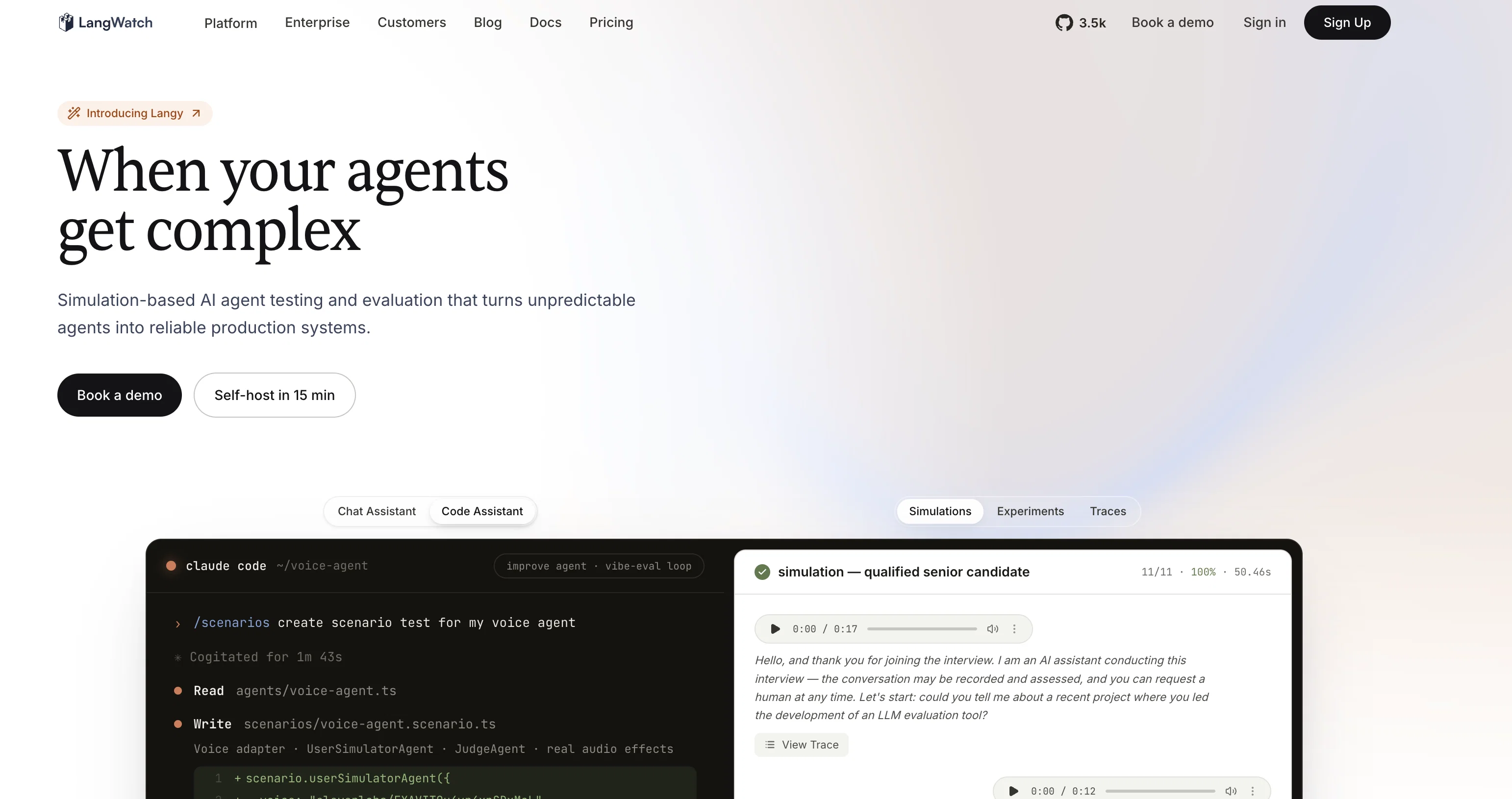
Simulation-based AI agent testing and evaluation that turns unpredictable agents into reliable
from $29/mo
Verdict
A quick read before you dig into the full page.
- Best if
- You are aI Engineers and need: Identify, debug, and resolve blindspots in AI stacks
- Skip if
- May have learning curve
- Pick this when
- Agent Simulations
Considering AI Security Gateway instead? Compare side by side
Overview


"LangWatch is the open-source (Apache-2.0) platform for teams shipping AI agents to production. Agent simulations test multi-turn and voice agents before release: a user simulator drives realistic conversations while a judge agent scores every turn, running locally, in CI, or no-code.
In production, the same evaluators score live traffic in real time, guardrails protect against PII leaks and prompt injection, and OpenTelemetry-native tracing makes multi-agent systems legible.
An AI gateway governs every model, key, and tool across the organization. Self-hosted, hybrid, or cloud (EU/US/UK/APAC), ISO 27001 certified and GDPR compliant.
Built in Amsterdam, trusted by enterprises in banking and payments including Deloitte, Backbase, and PagBank."
Best for
Short scenarios where LangWatch tends to shine.
-
Identify, debug, and resolve blindspots in AI stacks.
Best for AI Engineers
-
Integrate automated LLM evaluations directly into workflows.
Best for AI Architects
-
Keep AI reliable and under control with real-time monitoring.
Best for AI Researchers
-
Improve data with human-in-the-loop workflows for annotations and labeling.
Best for Data Scientists
-
Automatically find the best prompt and few shot examples for the LLMs.
Best for MLOps Engineers
Example outputs 1
Sample generations and before/after results for LangWatch.
Access & connections
Where you can use LangWatch, and what it plugs into.
Platforms
Integrations
Capabilities
What this tool accepts, produces, and is strongest at.
Input
- API
- Tabular
- Image
- Video
- Audio
Output
- API
- Text
Highlights
- Agents
- API
- MCP
- No Signup
- Open Source
- Local
Supported features
- Agents
- API
- MCP
- No Signup
- Open Source
- Runs Locally
Pros & cons
Pros
- Agent Simulations
- Speeds up quality assurance
- Agent evaluations
- Stanfords DSPy framework integration
- LLM observability
- AI agent Governance
- Claude code usage / spend
- Continual progress stimulation
Show 31 more
- Reduces manual work
- Applicable to various fields
- Measurable quality, assurance, latency, cost
- Message and output debugging
- Keeps track of versioned experiments
- Facilitates full dataset management
- Compatible with all LLM models
- Tracks optimization progress visually
- One-click LLM performance optimization
- Prompt discovery
- Auto-optimization
- Legal, sales, customer service tools
- Healthcare and financial analysis
- Latency reduction
- Allows domain experts involvement
- Enterprise-grade controls
- Self-hosted deployment
- GDPR compliant
- Role-based access controls
- Custom models integration
- API-accessible tools integration
- Datasets and cost tracking
- Annotations
- Topic, events, custom graph analytics
- Jailbreak detection
- Optimization studio integration
- Supports all LLMs
- Features chain of thought prompting technique
- Structured vibe-checking
- Safety and compliance tools
- Performance measurement tools
Cons
- No mention of mobile support
- Potential privacy issues (domain experts)
- Uncertain compatibility with non-LLM models
- No built-in app integration
- May have learning curve
Compare alternatives
Similar tools in the catalog — with a clear reason to open each one.

AI Security Gateway ✓
FreemiumAI Firewall & LLM Proxy — PII Redaction, Smart Routing, Budget Enforcement
Why look Freemium alternative
Full comparison
iDox.ai Guardrail ✓
Free TrialStop sensitive data leaks to AI tools.
Why look Typically cheaper
Full comparison
Adrian ✓
FreeAI agent security guard that stops threats instantly.
Why look Fully free option
Full comparisonPeople also view
Tools that often show up alongside LangWatch in collections and comparisons.

OWASP Agent Memory Guard ✓
UnknownGuard your AI agent's memory from security threats.
iDox.ai Guardrail ✓
Free TrialStop sensitive data leaks to AI tools.
AI Security Gateway ✓
FreemiumAI Firewall & LLM Proxy — PII Redaction, Smart Routing, Budget Enforcement
Adrian ✓
FreeAI agent security guard that stops threats instantly.

Liminal ✓
UnknownSecure generative AI without compromising data

HiddenLayer ✓
UnknownThe most comprehensive AI security platform.

AI Builder | Hostinger Horizons ✓
Free TrialBuild web apps and websites without writing any code.

Exogram ✓
Free TrialThe Infrastructure Substrate for Safe, Stateful, and Autonomous AI Agents
Releases 1
Imported reviews 1
Best LLMops tool in the market.
FAQ 12
What is the primary function of LangWatch?
Can LangWatch be used for various fields like Legal, Sales, Health etc?
What is the DSPy framework in LangWatch?
Does LangWatch support all LLM models and optimizers?
How does the drag and drop feature of LangWatch enhance collaboration?
What is the role of the analytics dashboard in LangWatch?
How does LangWatch help in reducing latency?
What is the purpose of versioned experiments in LangWatch?
Does LangWatch allow debugging of messages and outputs?
How is manual work reduced with LangWatch?
How does LangWatch ensure quality assurance?
What does LangWatch offer for dataset management?
Related tools
Recommended

BotDojo ✓
UnknownThe Fastest Way to Build AI Agents

NotebookLM ✓
FreemiumAI-powered note-taking and research assistant

TheLibrarian.io ✓
Free TrialYour WhatsApp AI assistant for instant productivity.

CodeRabbit ✓
Free TrialEnhanced code review for improved workflow and quality.

MarketAlerts.ai ✓
FreemiumInvest smarter with AI on your side

Recall ✓
FreemiumSummarize Anything, Forget Nothing!