

Enterprise architecture 2026 Rank: #2346
Exogram ✓
The Infrastructure Substrate for Safe, Stateful, and Autonomous AI Agents
Verdict
A quick read before you dig into the full page.
- Best if
- The Infrastructure Substrate for Safe, Stateful, and Autonomous AI Agents
- Skip if
- Complex setup
- Pick this when
- Runtime governance layer
Considering Unframe AI instead? Compare side by side
Overview


While frontier LLMs excel at cognition, deploying them as true autonomous agents requires persistent state memory, context continuity, and strict execution boundaries.
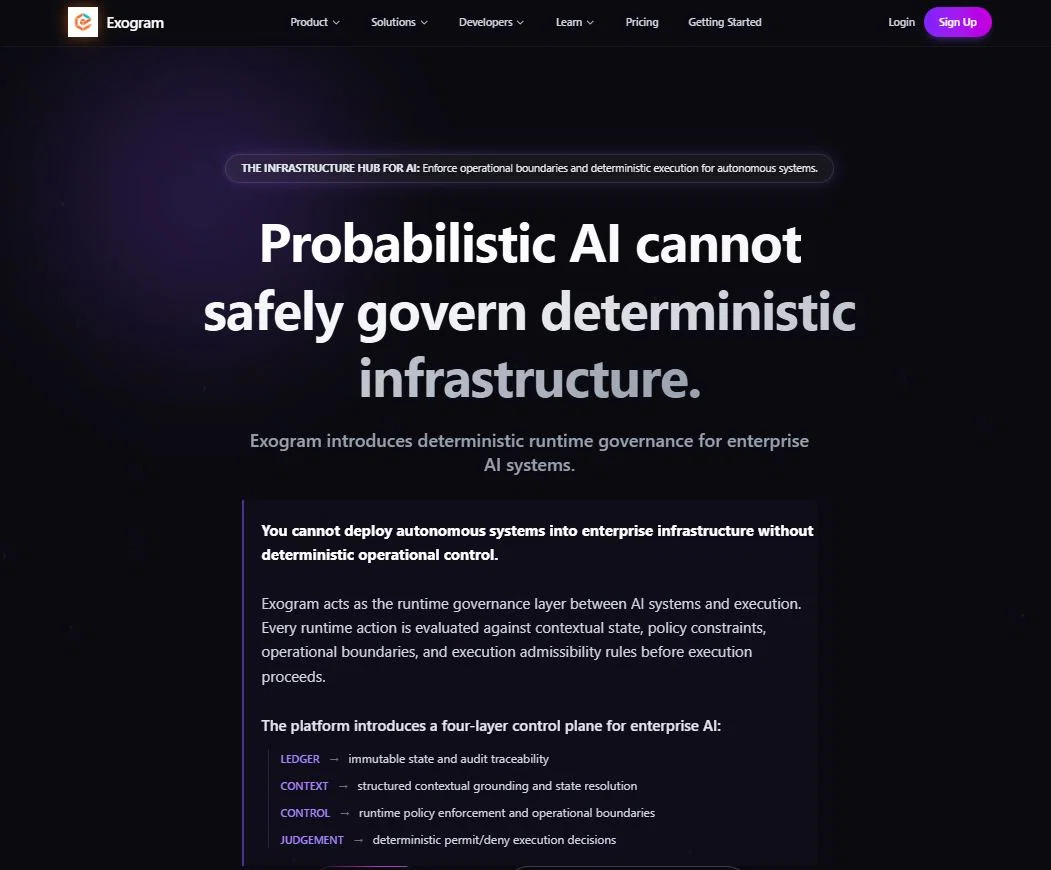
Exogram acts as the infrastructure substrate between AI agents and production systems—ensuring agents retain unified context across workflows, respect operational guardrails, and execute authorized actions safely across APIs, databases, and MCP tools.
Built for developers and enterprise engineering teams who need to move AI from experimental chats into trusted, stateful production environments.
- Ai Agent Governance
- Runtime Governance
- Policy Enforcement
- Ai Security Firewall
- Stateless Ai Firewall
- Ai Infrastructure
Best for
Short scenarios where Exogram tends to shine.
-
The Infrastructure Substrate for Safe, Stateful, and Autonomous AI Agents
Example outputs 1
Sample generations and before/after results for Exogram.
Access & connections
Where you can use Exogram, and what it plugs into.
Platforms
Capabilities
What this tool accepts, produces, and is strongest at.
Input
- API
- Code
- Tabular
- Text
Output
- Code
- Tabular
- API
- Text
Highlights
- API
- MCP
- No Signup
- Local
- Agents
Supported features
- API
- MCP
- Cybersecurity
- No Signup
- Runs Locally
- Agents
Pros & cons
Pros
- Runtime governance layer
- Intercepts agent actions
- Evaluates against policy constraints
- State-aware rule evaluation
- Blocks unsafe operations
- Governs execution and infrastructure
- Bounded execution policy enforcement
- Append-only audit trails
Show 16 more
- Runtime admissibility controls
- Integration with agent frameworks
- Control-plane architecture
- Persistent memory functionality
- Execution Authority Layer
- Operational Boundaries
- Real-time action evaluation
- Fintech, Healthcare, SaaS, Legal applications
- Protocol (EAAP) Integration
- Database Governance
- CLI including Terminal commands
- State verification features
- Controls execution
- Allows or blocks requests
- Execution boundary enforcement
- Resolving Action Admissibility
Cons
- Deterministic controls may restrict agent autonomy
- Not an orchestration platform
- Requires governance policy configuration
- Built for enterprise workflows, not consumers
- Limited ecosystem integrations currently
- Early-stage infrastructure product
- Requires technical implementation
- Complex setup
Show 6 more
- Limited integrations
- No autonomous action generation
- Difficulties with large-scale implementation
- Requires extensive technical knowledge
- No orchestration capabilities
- Strict execution boundaries
Compare alternatives
Similar tools in the catalog — with a clear reason to open each one.

PoYo.AI ✓
FreemiumHigh concurrency. Stable AI API. Better pricing.
Why look Typically cheaper
Full comparison
ClarifyNow.AI ✓
FreemiumGenerate professional technical documents in seconds with AI.
Why look Typically cheaper
Full comparison
TinyFish ✓
Free TrialEnterprise infrastructure for AI web agents.
Why look Typically cheaper
Full comparisonPeople also view
Tools that often show up alongside Exogram in collections and comparisons.

Unframe AI ✓
UnknownThe Managed AI Delivery Platform
TinyFish ✓
Free TrialEnterprise infrastructure for AI web agents.

Stilla ✓
FreemiumYour all-in-one AI hire
PoYo.AI ✓
FreemiumHigh concurrency. Stable AI API. Better pricing.
ClarifyNow.AI ✓
FreemiumGenerate professional technical documents in seconds with AI.

ImageToVideoAI.net ✓
FreemiumAI Image to Video Generator | Free to Start, 14 AI Models

Himedia AI Video Generator ✓
Free TrialCreate any AI Videos, Images and Music - No creative limits

ChatGPT ✓
FreemiumAsk anything, create anything, and move from idea to action.
Releases 1
FAQ 12
What is Exogram and what does it do?
How does Exogram combat session amnesia in AI?
What is the function of the 4-layer control plane in Exogram?
How does Exogram eliminate hallucination drift in AI?
What are operational boundaries and trust ledgers in Exogram?
How does Exogram ensure safety and security in AI application?
Can Exogram be utilized across different enterprise AI applications?
How does Exogram maintain a unified ledger of state and context?
What kind of AI systems require Exogram for their functionality?
How does Exogram assist in stopping AI hallucinations against the enterprise infrastructure?
How does Exogram enforce operational boundaries?
What does the term 'Execution Authority Layer' mean in reference to Exogram?
Related tools
Recommended
ChatGPT ✓
FreemiumAsk anything, create anything, and move from idea to action.

Automateed ✓
Free TrialCreate eBooks effortlessly with Automateed, the AI-powered writing tool.

Notis ✓
Free TrialThe first WhatsApp assistant that runs on your ChatGPT and Claude subscriptions

leania.ai ✓
Free TrialMRI scan for Businesses: Find What to Cut, Replace, Automate with AI

Serno ✓
FreemiumCustom AI experts that map what one AI can't

Vidnix | AI Image to Video Generator ✓
Free TrialTurn text into stunning AI videos.