

Context engineering 2026 Rank: #2419
iGPT ✓
Turn email into actionable data.
Free + from $20/mo
Verdict
A quick read before you dig into the full page.
- Best if
- You are aI enthusiasts and need: Discovering new and interesting GPTs for various purposes
- Skip if
- No offline functionality
- Pick this when
- Transforms unstructured emails into actionable data
Considering Knowledge Plane instead? Compare side by side
Overview
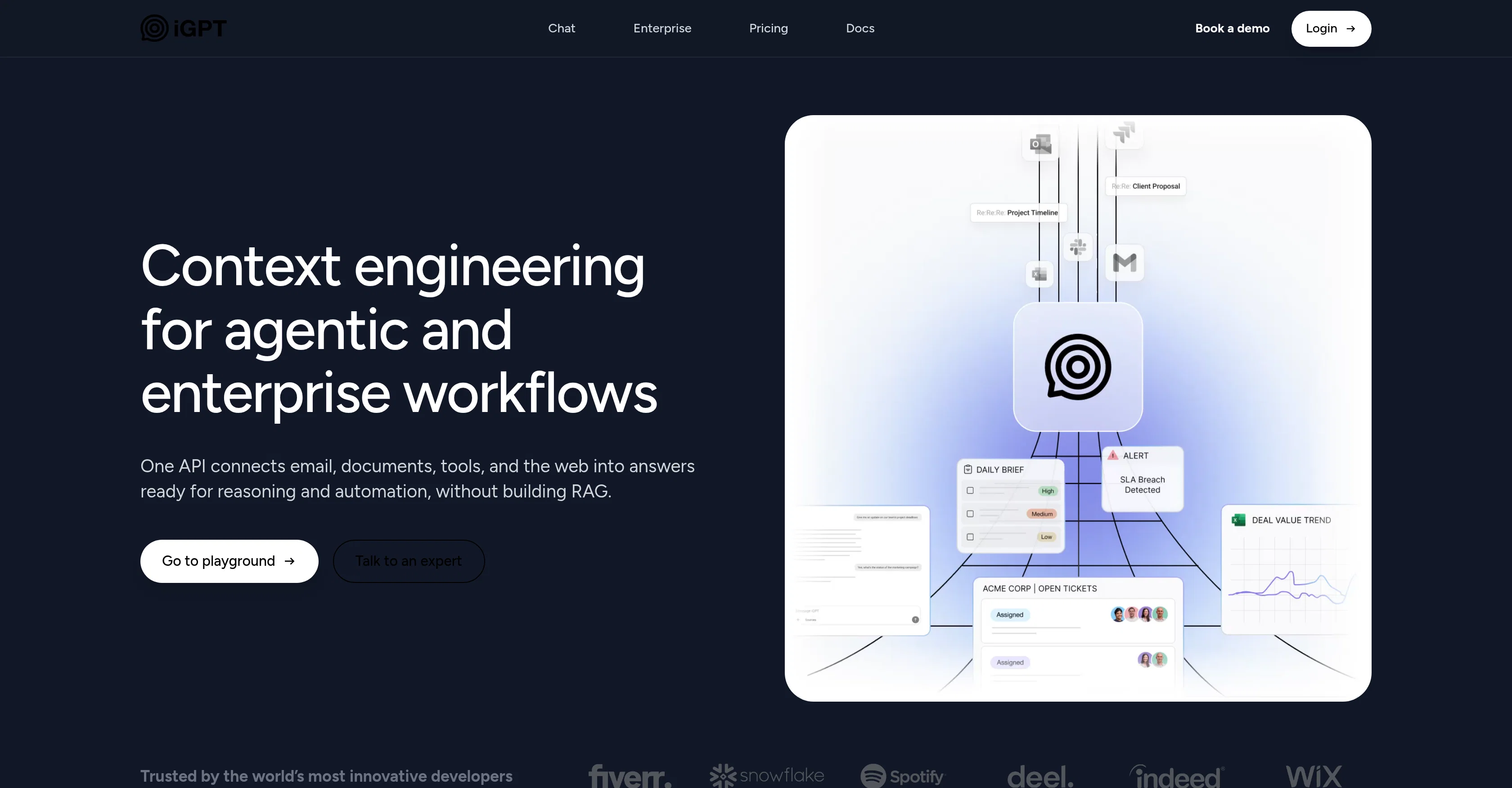
iGPT is an AI tool designed to transform company data, tools, and knowledge into context that can be used for reasoning by different AI systems, workflows, and teams.
Essentially, it brings context engineering to agentic and enterprise workflows. iGPT accomplishes this by deeply indexing email, documents, and work data and connecting them into a unified endpoint.
This single endpoint carries out retrieval, context shaping, and reasoning in one pipeline. The responses from this system are structured to enable reasoning and automation.
There's no need to worry about parsing, chunking, and indexing, or tuning the prompts for maintenance. iGPT provides a single unified call to build with context.
This tool allows input in your preferred language with a typical JSON response in structured format. It also offers real-time ingestion of new messages and attachments.
The tool's hybrid retrieval feature combines semantic and keyword filters and scores in a single call. Communication threads and structured data and text from documents are automatically processed to provide a continuous flow of data.
iGPT has utility in sales workflows, task automation, account intelligence support agents, recruiting workflows, compliance reviews, audits and internal analytics, amongst others.
Security is prioritized with features such as data never being used for training models, Role-Based Access Control (RBAC), zero data retention, and full transparency in processing steps.
The tool presents deployment options such as cloud, hybrid and fully private for greater control, reinforcing its commitment to enterprise-grade protection.
Best for
Short scenarios where iGPT tends to shine.
-
Discovering new and interesting GPTs for various purposes
Best for AI enthusiasts
-
Evaluating the quality and usefulness of GPTs
Best for GPT developers
-
Connecting with other GPT enthusiasts
Best for Educators
-
Finding GPTs tailored to specific needs (e.g., education, entertainment)
Best for Researchers
Example outputs 1
Sample generations and before/after results for iGPT.
Access & connections
Where you can use iGPT.
Platforms
Capabilities
What this tool accepts, produces, and is strongest at.
Input
- API
Output
- API
Highlights
- Agents
- API
- Local
Supported features
- Agents
- API
- Assistant
- Automation
- Deep Research
- Integrations
- Memory
- Runs Locally
- Search
Show 2 more
- SOC 2 Compliance
- Writing
Pros & cons
Pros
- Transforms unstructured emails into actionable data
- Unified endpoint for retrieval, shaping, context shaping, reasoning
- No need for parsing, indexing, chunking, or prompt tuning
- Supports input in any preferred language
- Structured JSON responses
- Real-time ingestion of new messages and attachments
- Offers combined semantic and keyword filters
- Automated processing of communication threads, structured data, and text
Show 36 more
- Enables continuous flow of data
- Extensive application in sales, automation, recruitment, compliance, intelligence support, internal analytics
- Emphasizes security: doesn't use data for model training
- Stores zero data after processing
- Role-Based Access Control
- Full transparency in processing steps
- Options for cloud, hybrid, and private deployments
- Real-time transformation of company data into actionable context
- Single API call for context-rich data
- Integrates with CRMs, project tools, and collaboration platforms
- Can detect and structure action items, deadlines, follow-ups, sentiment, priorities, relationship maps
- Integrates seamlessly with Python, JavaScript/TypeScript, and Go
- Data never leaves company's control
- Facilitates intent extraction from communication threads
- Automatically processes attachments
- SDKs and live examples for easy integration
- Context extraction from large inboxes
- Enables workflow-focused builds instead of email parsing
- Structured responses for reasoning and automation
- Utility in audit support tasks
- Processing of emails into structured reasoning context
- Facilitates agent memory based on past interactions
- Automatic detection of intent and decisions in emails
- Provides key insights like tone, confidence levels, and blockers
- Rapid prototyping for production
- Secure OAuth-only processing
- Restricted to authorized accounts
- Complies with SOC2 and GDPR regulations
- Enables risk pattern extraction for legal data discovery
- Enables CRM sales, customer success support
- Ideal for workflow automation, BI & Analytics, and agent triggers
- Compatible with operations management and project management tools
- Provides cited responses for verification and audit
- Ready to use API with no credit card required for initial use
- Enables automatic task updates based on email content
- API response well structured for developer use
Cons
- No offline functionality
- Possible delay real-time ingestion
- Depends on third-party email services
- Requires continuous data flow
- Comprehension restricted to email threads
- No standalone data storage
- Unspecified SOC2, GDPR compliance schedule
- Unclear retrieval accuracy rate
Show 2 more
- No built-in CRM functionality
- Data privacy heavily reliant on deployment model
Compare alternatives
Similar tools in the catalog — with a clear reason to open each one.

Knowledge Plane ✓
FreemiumShared memory for AI agents and teams.
Free + from $19/mo
Full comparison
Aiqbee ✓
Free TrialGive any AI tool persistent organizational context.
Why look Typically cheaper
Full comparison
Glean ✓
UnknownWork AI connected to your company's tools, data, and context
Personal assistant
Full comparison
Slashspace (Formerly RabbitHoles AI) ✓
PaidIntelligence canvas for ambitious work
from $89
Full comparison
Qoder ✓
FreemiumAgentic Coding Platform for Real Software
Why look Better fit for coding
Full comparisonPeople also view
Tools that often show up alongside iGPT in collections and comparisons.

Zens AI ✓
FreemiumAI support that fixes your product while it helps customers.
Slashspace (Formerly RabbitHoles AI) ✓
PaidIntelligence canvas for ambitious work
Qoder ✓
FreemiumAgentic Coding Platform for Real Software

moar ✓
FreemiumYour documents. AI Ready.
Knowledge Plane ✓
FreemiumShared memory for AI agents and teams.
Glean ✓
UnknownWork AI connected to your company's tools, data, and context

CoreStory ✓
UnknownRequire Intelligence
Aiqbee ✓
Free TrialGive any AI tool persistent organizational context.
Releases 1
FAQ 12
What's the main functionality of iGPT?
What does 'context engineering' mean in relation to iGPT?
How does iGPT index data?
What is the 'unified endpoint' in iGPT?
How does iGPT enable reasoning and automation?
What kind of input does iGPT accept?
What is the 'hybrid retrieval' feature of iGPT?
How does iGPT process communication threads?
Can iGPT be used for recruiting workflows?
What measures does iGPT take to ensure data security?
What are the deployment options for iGPT?
Can iGPT help with sales workflows?
Related tools
Recommended

Automateed ✓
Free TrialCreate eBooks effortlessly with Automateed, the AI-powered writing tool.

Kin - Personal AI Advisors ✓
FreePrivacy-first & designed your for mind, and life at work

Notis ✓
Free TrialThe first WhatsApp assistant that runs on your ChatGPT and Claude subscriptions

freebeat AI ✓
FreemiumTurn Music & Ideas into Viral Videos In One Click

remio: Your Personal ChatGPT ✓
FreemiumGet Tailored Answer with Your Personal ChatGPT

MarketAlerts.ai ✓
FreemiumInvest smarter with AI on your side
