

Data on Demand ✓
Integrate and embed AI for seamless data management.
from $40/mo
Verdict
A quick read before you dig into the full page.
- Best if
- Integrate and embed AI for seamless data management
- Skip if
- No privacy information available
- Pick this when
- Manages data from diverse sources
Considering Columns instead? Compare side by side
Overview
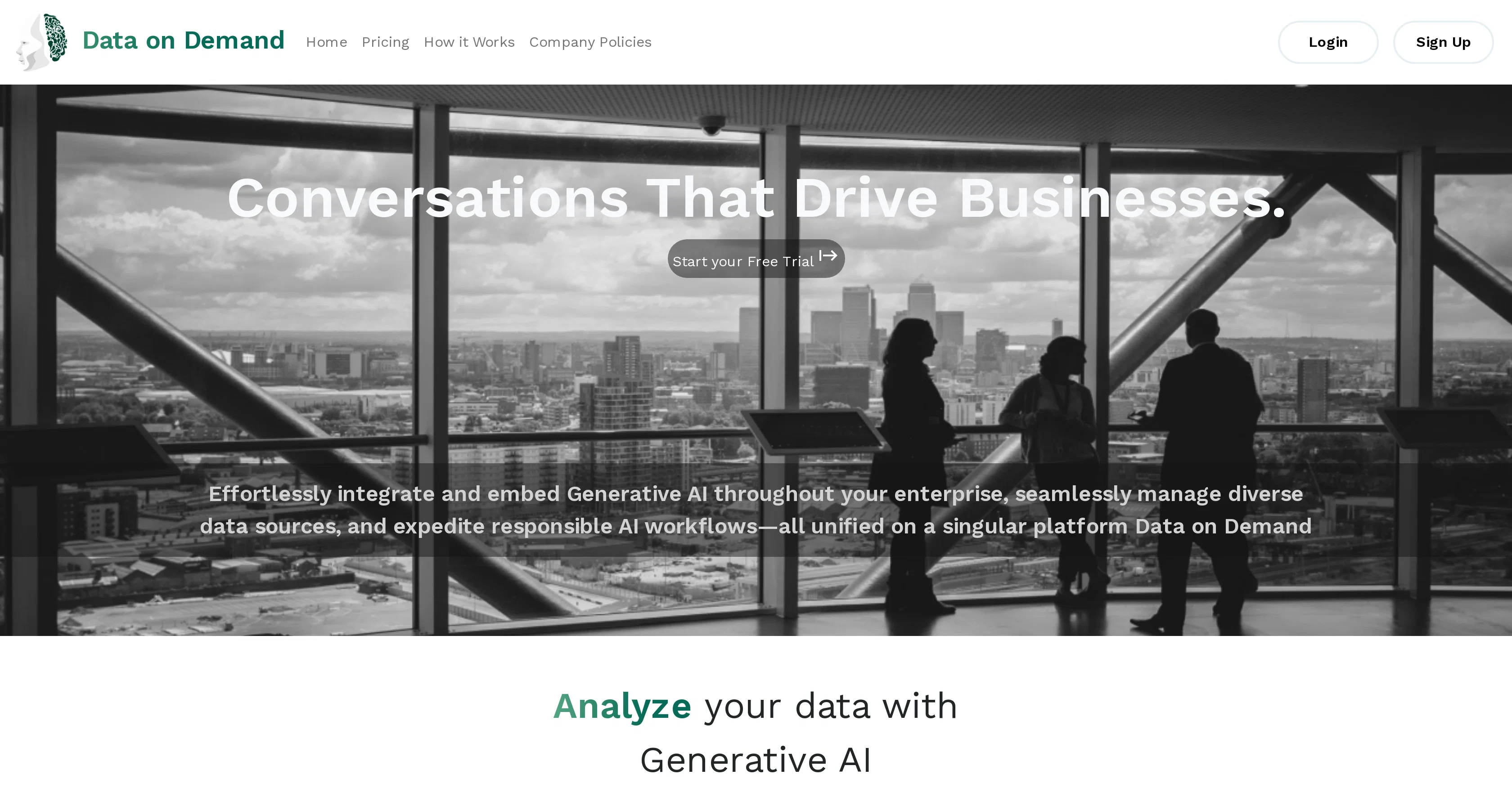
Data on Demand is a generative AI platform focused on providing actionable business insights. It integrates and manages data from diverse sources on a single platform, facilitating smooth AI workflows.
The tool allows users to effortlessly extract relevant data from different sources. It conducts in-depth analysis of patterns, trends, and anomalies, translating sophisticated datasets into easy-to-understand visual representations, such as charts and graphs.
Moreover, Data on Demand provides actionable recommendations based on its analysis. It benefits businesses by reducing their dependence on specialized personnel as it enables users to independently extract and interpret valuable insights.
The tool offers real-time insights and integrates efficiently with existing systems without requiring extensive overhaul. Through predictive analytics, it can forecast future demand using historical sales data, seasonality, and external factors, optimizing operational efficiency across sectors like eCommerce, Logistics, Finance, Consumer Produced Goods, and Manufacturing.
Access & connections
Where you can use Data on Demand, and what it plugs into.
Platforms
Capabilities
What this tool accepts, produces, and is strongest at.
Input
- Tabular
- Text
Output
- Text
Pros & cons
Pros
- Manages data from diverse sources
- Effortless data extraction
- In-depth pattern analysis
- Trend detection
- Anomaly detection
- Easy-to-understand visual representations
- Actionable insight recommendations
- Real-time insight generation
Show 34 more
- Efficient system integration
- Predictive analytics capabilities
- Facilitates independent data interpretation
- Reduces dependence on specialized personnel
- Optimizes operational efficiency
- Suitable for multiple sectors
- Ecommerce, logistics, finance data handling
- Minimizes manual effort
- Boosts decision making speed
- Increases profitability
- Enhances productivity
- Reduces costs
- Reduces IT and analyst dependence
- Dynamic chart and graph generation
- Access to instant insights
- No need for extensive overhauls
- Proactive procurement facilitation
- Prevents inventory excess/shortages
- Enhances production planning
- Minimizes downtime
- Optimizes resource allocation
- Quick financial data access
- Improves accuracy in demand prediction
- User friendly data presentation
- Seamless document interaction
- Streamlines complex research analysis
- Cloud storage integration
- Textual data contextual analysis
- Interactive result presentation
- Instant information retrieval
- Saves valuable time
- Controlled access to sensitive information
- Boosts productivity
- Reduces risk of errors
Cons
- No privacy information available
- Lacks customizability
- No mention of data security
- No API mentioned
- Not user-friendly
- Relies heavily on external data
- No trial period mentioned
- Unclear pricing model
Show 2 more
- No offline access
- Integration capabilities not specified
Compare alternatives
Similar tools in the catalog — with a clear reason to open each one.

Columns ✓
FreemiumAutomate clear insights from any data
Why look Freemium alternative
Full comparison
Analytify - A GenBI Platform ✓
Free TrialAI-powered analytics that unlock smarter business insights.
Why look Typically cheaper
Full comparison
Vizologi ✓
Free TrialAI to boost your business strategy.
Why look Typically cheaper
Full comparison
Springboard ✓
FreeKickstart workshops with instant market insights.
Why look Fully free option
Full comparison
Jeda AI ✓
FreemiumAI workspace canvas for instant productivity.
Why look Freemium alternative
Full comparisonReleases 1
FAQ 12
What is Data on Demand?
How does Data on Demand integrate and manage data from diverse sources?
What types of data analysis does Data on Demand perform?
How does Data on Demand provide visual representations of datasets?
Can I extract data from various sources independently with Data on Demand?
In what sectors can Data on Demand predict future demand?
How can Data on Demand's real-time insights benefit my business?
Does Data on Demand require an overhaul of my existing systems to integrate?
What types of actionable recommendations does Data on Demand provide?
What is Generative AI in the context of Data on Demand?
How is data visualized in Data on Demand?
Can Data on Demand analyze patterns, trends, and anomalies within large datasets?
Related tools
Recommended

GPTExcel ✓
FreemiumGenerate spreadsheet formulas with AI

AppsMakerStore ✓
FreemiumCreating and sharing your own mobile application has never been easier.

InSummary ✓
UnknownAutomatic Performance Reviews & Status Reports

SheetyAI ✓
FreeAI-powered spreadsheet formula generator

Appified.ai ✓
FreemiumTurn your OpenAI Assistant into a Web App in minutes.

LearningStudioAI ✓
Free TrialAI-powered authoring tool for effortless online course creation.