

Dashbot ✓
Next-gen text analytics for unstructured customer data.
Verdict
A quick read before you dig into the full page.
- Best if
- Next-gen text analytics for unstructured customer data
- Skip if
- Doesn't detail security measures
- Pick this when
- Extracts actionable insights
Considering Grapha AI instead? Compare side by side
Overview
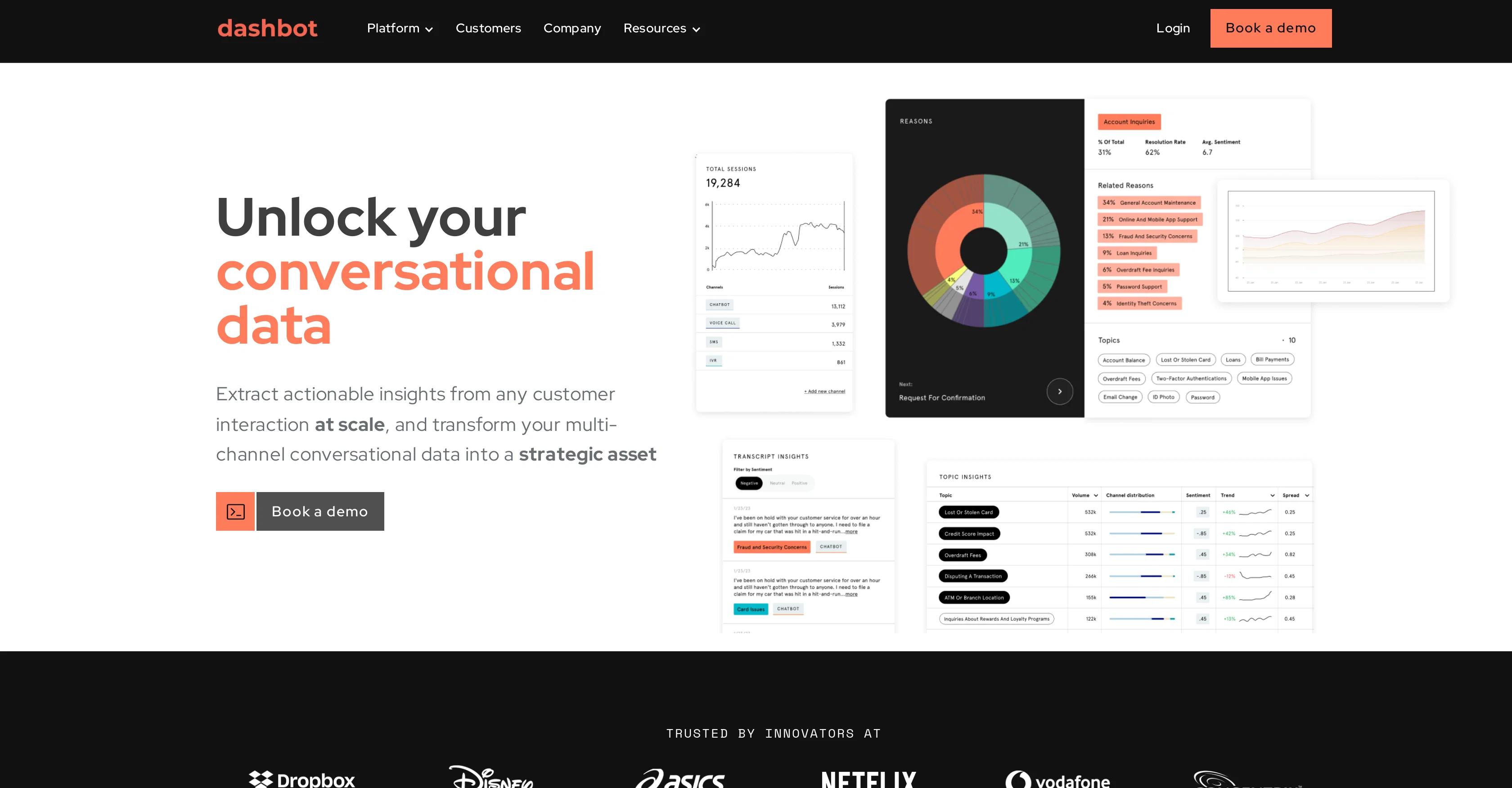
Dimension Labs is a platform dedicated to providing observability of unstructured customer data. The tool analyses feedback from a variety of sources including chat, email, calls, surveys, and reviews.
This unstructured data is then transformed into structured, analytics-ready insights. These insights can then correlate with measurable impacts on revenue, allowing businesses to improve customer experience (CX) and achieve better business outcomes.
Utilizing this tool, companies can prioritize elements based on their importance and potential influence on the company's revenue. The platform is designed for professionals like AI and Chatbot product managers, data and insight teams, contact center teams, customer experience leaders, and marketing leaders.
Its unique feature lies in the conversion of dark data (unstructured text from customer conversations) into structured data that can be smoothly incorporated into business intelligence (BI) and AI workflows.
Unlike traditional business intelligence tools, Dimension Labs handles large datasets and real-time analytics. The limitation of relying on structured data and manual tagging is overcome by using AI-powered enrichment and the automatic grouping of themes.
It eliminates the need for manual tagging and delivers proactive and consistent insights. Dimension Labs also provides a mechanism to detect emerging themes, visualize complex unstructured data, perform comprehensive drill-downs, and trace insights back to the source data.
This ensures businesses have a clear view of customer interactions across multiple channels which further facilitates effective decision making.
Access & connections
Where you can use Dashbot.
Platforms
Capabilities
What this tool accepts, produces, and is strongest at.
Input
- API
- Tabular
- Text
Output
- Tabular
- API
- Text
Pros & cons
Pros
- Extracts actionable insights
- Transforms multi-channel conversational data
- Unifies siloed data sources
- Enhances chatbot performance
- No-code automation tools
- Data-driven organizational improvement
- Visualized multichannel customer journey
- Optimizes Natural Language Processing
Show 41 more
- Enriches Customer and Employee Experience
- Accelerates innovation
- Unified view of data
- Fast access to actionable data
- Used across various industries
- Central data hub
- Comprehends dark data
- Surveys' deep analytics
- CX channels integration
- Cross-departmental collaborations supported
- Conversational data platform
- Facilitates data exploration
- Trusted by innovators
- Omni-channel data approach
- Can handle 100BN+ messages
- Handles 25K+ data sources
- Automates data organization
- Transforms unstructured data
- Structures conversational data
- Advanced machine learning capabilities
- Customizable dashboards
- Out of the box reports
- Data source integration
- Raw data file support
- Asynchronous and non-blocking API
- Live-agent conversations support
- Raw conversational data support
- Supportive expert consultations
- User experience optimization
- Facilitates data-first strategy
- Low-code business-user-friendly experience
- Massive data processing capabilities
- Enables survey feedback analytics
- Plug-n-play with multiple tools
- Connects all data silos
- Faster time to market
- Drives CX and EX growth
- Drives operational efficiencies
- Installs from CDN
- Personalized data exploration
- Supports code documentation
Cons
- Doesn't detail security measures
- No specific industry specialization
- Lacks transparent pricing information
- Dependent on external data sources
- No mobile application mentioned
- Lacks multilingual support
- Doesn't support all data formats
- No personalized training mentioned
Show 2 more
- Undefined process for error handling
- Doesn't state GDPR compliance
Compare alternatives
Similar tools in the catalog — with a clear reason to open each one.

Grapha AI ✓
PaidUncover hidden trends and patterns in your data effortlessly.
from $150
Full comparison
DataSquirrel ✓
FreemiumData cleaning & visualization for insights gained.
Why look Higher community rating
Full comparison
Breadcrumb ✓
FreemiumAutomate data work and reporting with AI Agents. No data|coding skills required.
Why look Better fit for coding
Full comparison
Anomaly AI ✓
FreemiumAI data analysis workspace for business datasets and reports.
Free + from $25/mo
Full comparison

ChartPixel ✓
FreemiumAI-assisted graphs and insights in 30 seconds!
Why look Offers a public API
Full comparisonReleases 1
FAQ 12
What is Dashbot's purpose?
How does Dashbot extract actionable insights from customer interactions?
What is Dashbot's role in transforming multi-channel conversational data?
What kind of use cases can Dashbot support?
How does Dashbot integrate different data sources across an organization?
What exactly is Dashbot's no-code automation?
How does Dashbot support data visualization?
In what ways does Dashbot enhance user experience optimization?
How is Dashbot useful for customer experience teams?
Which industries can benefit from Dashbot?
How can Dashbot accelerate innovation?
How does Dashbot optimize Natural Language Processing data models?
Related tools
Recommended

B12 AI Website Builder ✓
FreemiumAI-powered website builder

ownAI ✓
FreemiumThe AI that belongs to you – open source, local, self-evolving.

selfGPT ✓
PaidTransform your files into AI-powered insights.

Sisense ✓
UnknownEmbed AI-powered analytics to monetize your data.

LearningStudioAI ✓
Free TrialAI-powered authoring tool for effortless online course creation.

VenturusAI ✓
FreemiumBusiness idea analysis and reporting.