

Ad optimization 2026 Rank: #1686
CloudX ✓
Ad Infrastructure for the Intelligence Era
Verdict
A quick read before you dig into the full page.
- Best if
- Ad Infrastructure for the Intelligence Era
- Skip if
- Limited integration with smaller platforms
- Pick this when
- Integrated with major platforms
Considering Didoo AI instead? Compare side by side
Overview
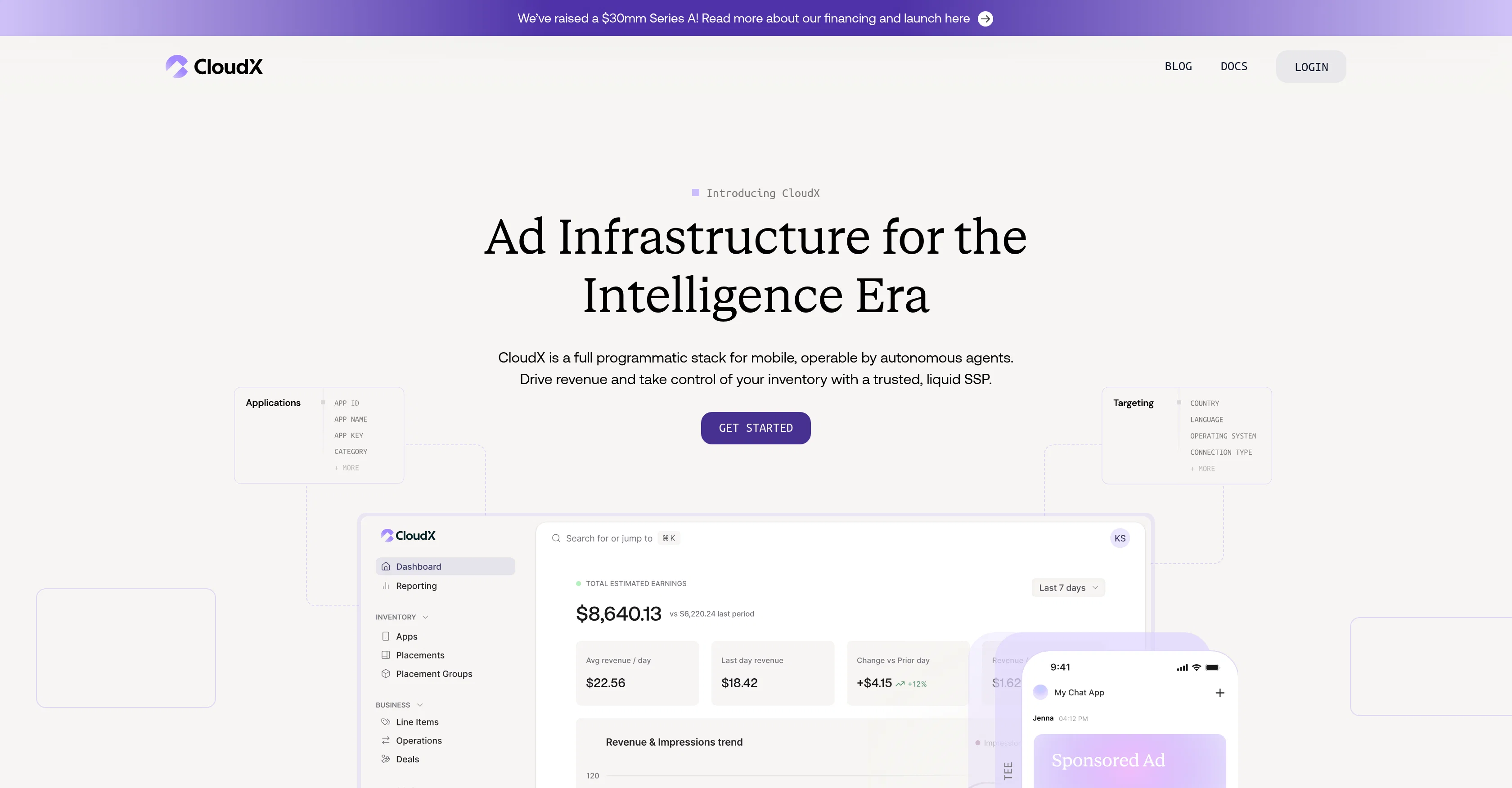
CloudX is a supply-side programmatic platform engineered specifically for mobile as well as AI publishers. The platform aims to augment revenue via AI workflows and liquid marketplace.
CloudX equips publishers with a trusted stack, providing control over inventory and bolstering revenue generation. It is operable by autonomous agents, suggesting easy integration and usage.
The platform integrates with other major platforms like Meta, Unity, Liftoff, Magnite, InMobi, Mintegral, and Moloco. CloudX offers publishers direct control over who they compete with, access to inventory, and the capability to optimize monetization against long-term value.
The platform allows publishers to introduce new monetization ideas with holistic visibility into bids, auction results, and performance. The platform's 'Monetization as Code' approach includes features like line items for multiple auction scenarios, per-request price floors, real-time analytics, log-level access, release tracking, and auction simulation.
It also accommodates non-SDK programmatic buyers, enabling them to compete in the same auction with SDK bidders. This widespread competition offers publishers access to a spectrum of demand, from performance to brand.
And all these while avoiding the addition of more SDKs to their systems. A unique feature of the platform is CloudX's layered AI agent system which automates mobile SDK integration, drastically reducing integration time.
Further, it offers production-ready code promptly, facilitating quick integration for publishers.
Best for
Short scenarios where CloudX tends to shine.
-
Ad Infrastructure for the Intelligence Era
Example outputs 1
Sample generations and before/after results for CloudX.
Access & connections
Where you can use CloudX, and what it plugs into.
Platforms
Integrations
Capabilities
What this tool accepts, produces, and is strongest at.
Input
- Code
- Tabular
Output
- Code
- Tabular
Highlights
- Agents
- MCP
Supported features
- Agents
- Automation
- Integrations
- MCP
- Ads
Pros & cons
Pros
- Integrated with major platforms
- Control over inventory
- Holistic visibility into bids
- Monetization as Code
- Real-time analytics
- Automated mobile SDK integration
- Rapid integration for publishers
- Multiple auction scenarios
Show 24 more
- Per-request price floors
- Accommodates non-SDK buyers
- Direct control over competition
- Prevents addition of more SDKs
- Long-term value optimization
- Visible auction results
- Log-level access
- Release tracking
- Auction simulation features
- Spectrum of demand access
- Production-ready code provision
- Intelligent revenue augmentation
- Allows new monetization ideas
- Cloud-based platform
- Battle-tested features
- Advert performance visibility
- Agentic enabled approach
- Operable by autonomous agents
- Increased revenue generation
- Built for mobile publishers
- Liquid marketplace provision
- Trusted advertising stack
- Observability into auctions
- MCP and Agent stack
Cons
- No web-based functionality
- Lack specific data privacy features
- Dependency on autonomous agents
- Lacks offline work capability
- Limited integration with smaller platforms
- Potential compatibility issues with non-SDK bidders
- Lack of multi-language support
- No mentioned user roles/permission feature
Show 2 more
- Absence of detailed error reports
- No demonstration of robust scalability
Compare alternatives
Similar tools in the catalog — with a clear reason to open each one.

Didoo AI ✓
Free TrialYour AI Media Buyer. Actually Knows You.
Why look Higher community rating
Full comparison
Search Ads Optimization AI ✓
Free TrialAutomate Apple Search Ads for better ROI.
Free + from $49/mo
Full comparison


People also view
Tools that often show up alongside CloudX in collections and comparisons.

BidHelm ✓
Free TrialYour Complete AI Marketing Department. Fully Autonomous.

AdScriptly ✓
Free TrialAI ad optimization for predictable revenue.

AdMake AI ✓
PaidSpy on competitor ads, create winning creatives.

Mintly 2.0 ✓
PaidAI Ad Generator for E-commerce: UGC Videos, Product Ads, & Models

AI Ads ✓
FreemiumGenerate winning video ads from just a store URL

AdsGo AI ✓
Free TrialAI That Plans, Launches & Optimizes Ads for You

Shown.io ✓
Free TrialAI-powered ad optimization for higher ROI
Search Ads Optimization AI ✓
Free TrialAutomate Apple Search Ads for better ROI.
Releases 1
FAQ 12
What is CloudX?
What does CloudX provide for mobile and AI publishers?
How does CloudX improve revenue?
Can you explain the 'Monetization as Code' approach in CloudX?
Which platforms does CloudX integrate with?
How does CloudX give publishers direct control over their competitors?
How do the autonomous agents in CloudX work?
Can CloudX accommodate non-SDK programmatic buyers?
What is the layered AI agent system in CloudX?
What benefits do I get from CloudX's AI workflows and liquid marketplace?
How does CloudX help optimize monetization against long-term value?
How does real-time analytics work in CloudX?
Related tools
Recommended

Supernormal App ✓
FreemiumThe AI assistant app that turns meetings into completed work

SureThing.io - "OpenClaw" for Beginners ✓
FreemiumFirst General AI Agency. Designed for long-horizon tasks.

illumi ✓
FreemiumAI visual workspace that takes you from thinking to delivery

Modulate ✓
UnknownBuilding AI that understands real conversations better than LLMs.

Blackbox AI ✓
PaidAI-powered coding agent for multiple development platforms.

Recall ✓
FreemiumSummarize Anything, Forget Nothing!