

BenchLLM ✓
Evaluate LLMs and generate quality reports
Verdict
A quick read before you dig into the full page.
- Best if
- Evaluate LLMs and generate quality reports
- Skip if
- Limited evaluation strategies
- Pick this when
- Allows real-time model evaluation
Considering Langtail instead? Compare side by side
Overview
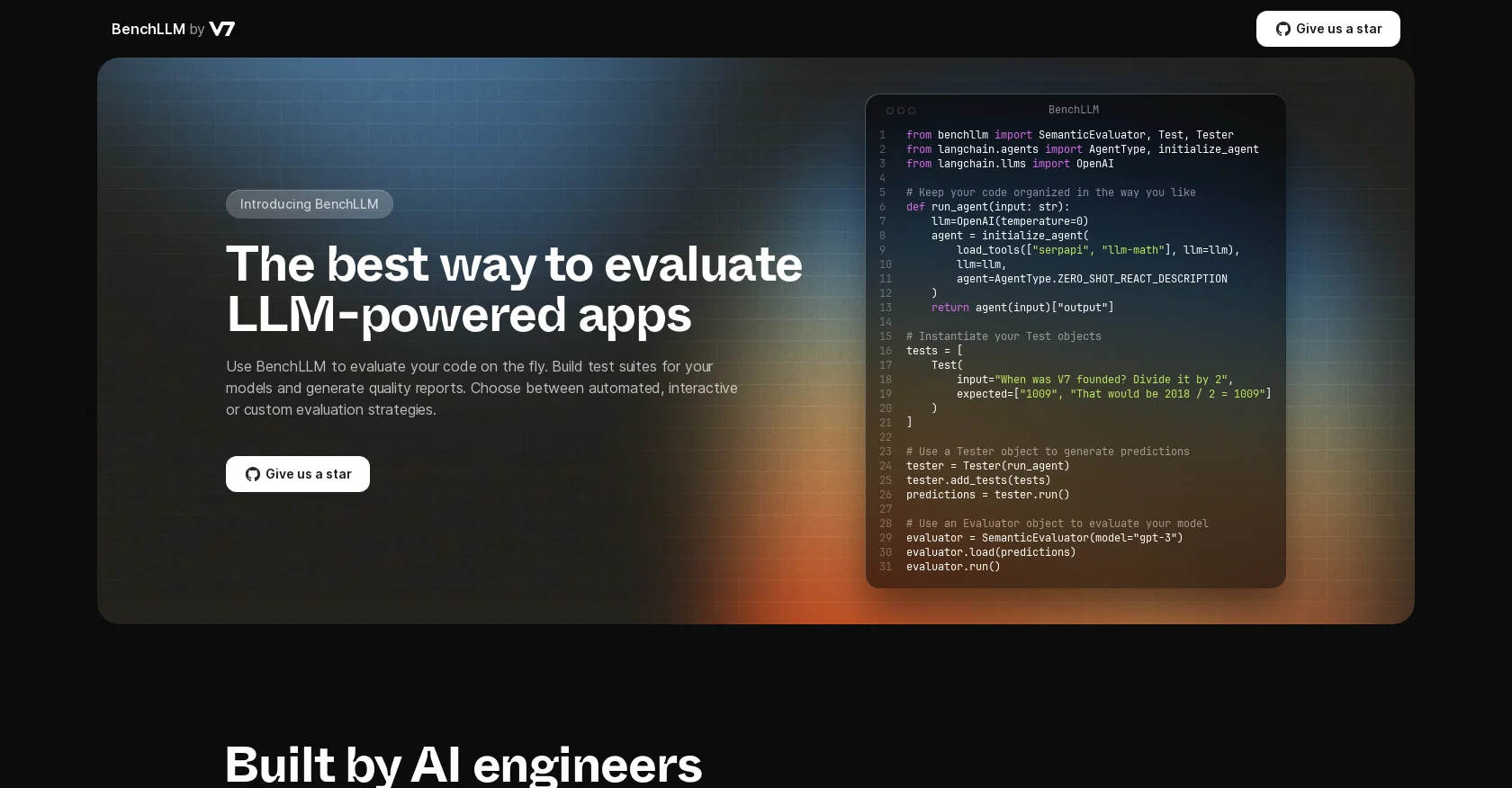
BenchLLM is an evaluation tool designed for AI engineers. It allows users to evaluate their machine learning models (LLMs) in real-time. The tool provides the functionality to build test suites for models and generate quality reports.
Users can choose between automated, interactive, or custom evaluation strategies.To use BenchLLM, engineers can organize their code in a way that suits their preferences.
The tool supports the integration of different AI tools such as "serpapi" and "llm-math". Additionally, the tool offers an "OpenAI" functionality with adjustable temperature parameters.The evaluation process involves creating Test objects and adding them to a Tester object.
These tests define specific inputs and expected outputs for the LLM. The Tester object generates predictions based on the provided input, and these predictions are then loaded into an Evaluator object.The Evaluator object utilizes the SemanticEvaluator model "gpt-3" to evaluate the LLM.
By running the Evaluator, users can assess the performance and accuracy of their model.The creators of BenchLLM are a team of AI engineers who built the tool to address the need for an open and flexible LLM evaluation tool.
They prioritize the power and flexibility of AI while striving for predictable and reliable results. BenchLLM aims to be the benchmark tool that AI engineers have always wished for.Overall, BenchLLM offers AI engineers a convenient and customizable solution for evaluating their LLM-powered applications, enabling them to build test suites, generate quality reports, and assess the performance of their models.
Access & connections
Where you can use BenchLLM.
Platforms
Capabilities
What this tool accepts, produces, and is strongest at.
Input
- API
- Code
- Text
Output
- Code
- API
- Text
Supported features
- QA Automation
Pros & cons
Pros
- Allows real-time model evaluation
- Offers automated, interactive, custom strategies
- User-preferred code organization
- Creating customized Test objects
- Predictions generation with Tester
- Utilizes SemanticEvaluator for evaluation
- Quality reports generation
- Open and flexible tool
Show 15 more
- LLM-specific evaluation
- Adjustable temperature parameters
- Performance and accuracy assessment
- Supports 'serpapi' and 'llm-math'
- Command line interface
- CI/CD pipeline integration
- Models performance monitoring
- Regression detection
- Multiple evaluation strategies
- Intuitive test definition in JSON, YAML
- Tests organization into suites
- Automated evaluations
- Insightful report visualization
- Versioning support for test suites
- Support for other APIs
Cons
- No multi-model testing
- Limited evaluation strategies
- Requires manual test creation
- No option for large scale testing
- No historical performance tracking
- No advanced analytics on evaluations
- Non-interactive testing only
- No support for non-python languages
Show 2 more
- No out-of-box model transformer
- No real-time monitoring
Compare alternatives
Similar tools in the catalog — with a clear reason to open each one.

Langtail ✓
FreemiumThe low-code platform for testing AI apps
Why look Better fit for coding
Full comparison
Local.ai ✓
FreeExperiment with AI models locally, no GPU required.
Why look More privacy-focused
Full comparison
Rhesis AI ✓
UnknownBuild trustworthy AI: Test LLM apps for robustness and compliance.
No pricing
Full comparison

Featherless - Serverless LLM Hosting ✓
Free TrialDeploy any open AI model effortlessly.
Why look Offers a public API
Full comparisonReleases 1
FAQ 12
What is BenchLLM?
What functionalities does BenchLLM provide?
How can I use BenchLLM in my coding process?
What AI tools can BenchLLM integrate with?
What does the 'OpenAI' functionality in BenchLLM do?
Can I adjust temperature parameters in BenchLLM's 'OpenAI' functionality?
What is the process of evaluating a LLM in BenchLLM?
What do the Tester and Evaluator objects do in BenchLLM?
What model does the Evaluator object utilize in BenchLLM?
How can BenchLLM help me assess my model's performance and accuracy?
Why was BenchLLM created?
What are the evaluation strategies offered by BenchLLM?
Related tools
Recommended

ElevenLabs ✓
FreemiumCreate lifelike AI voices for compelling storytelling.

FetchFox ✓
FreemiumScrape any data from any website, with AI

AnythingLLM ✓
FreemiumAn AI Agent that lives at your mouse cursor. Fully local.

AI-Flow ✓
PaidConnect multiple AI models easily.

User Evaluation ✓
FreemiumStreamline your data discovery with AI

LLMStack ✓
FreeCreate AI apps and chatbots in minutes without coding