

Athena Intelligence ✓
Meet Athena: Your 24/7 AI Data Analyst
Verdict
A quick read before you dig into the full page.
- Best if
- Meet Athena: Your 24/7 AI Data Analyst
- Skip if
- Limited programming languages
- Pick this when
- Optimizes analytic workflows
Considering Grapha AI instead? Compare side by side
Overview
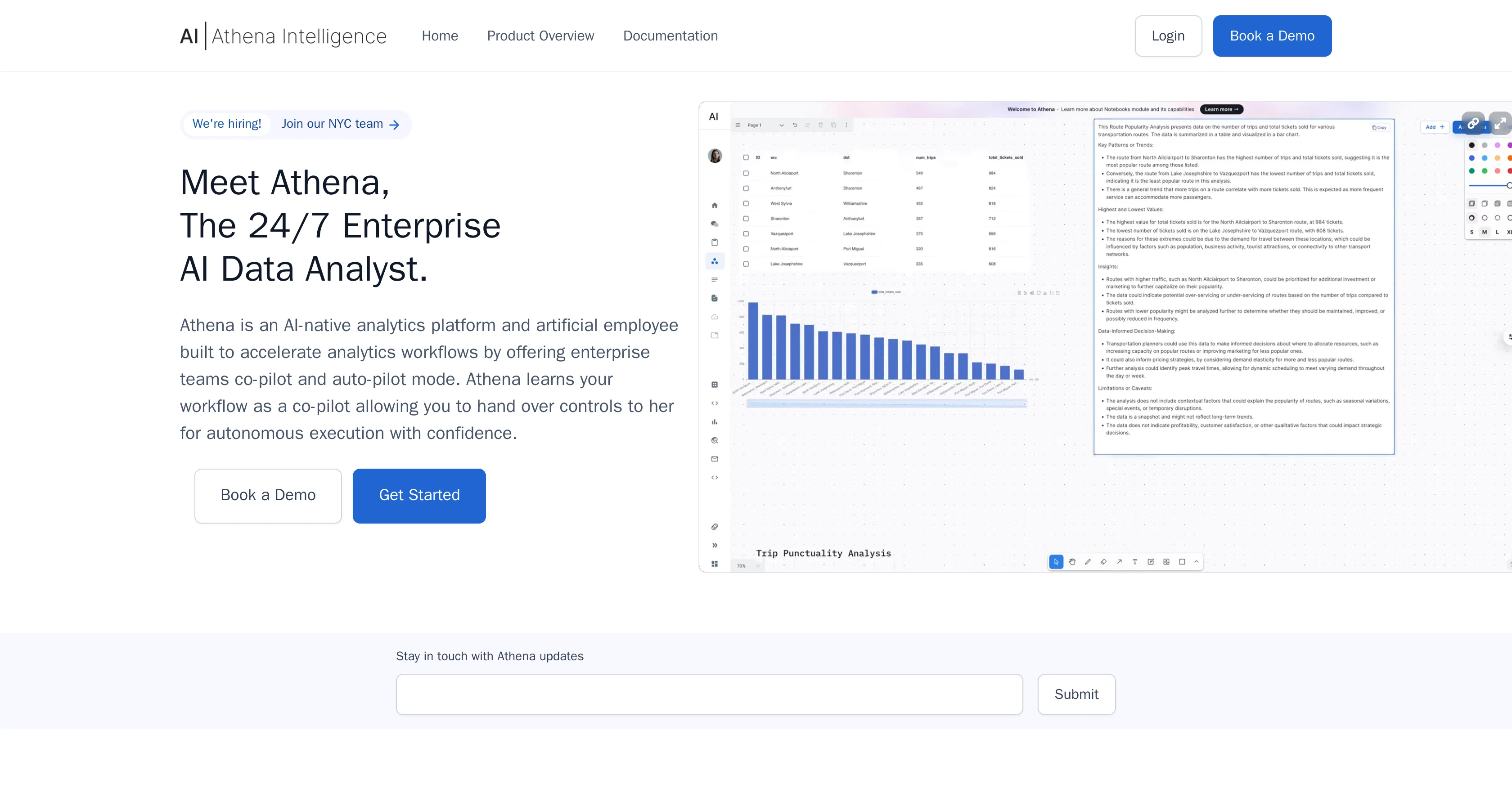
Athena is the first AI-native analytics platform and artificial employee designed to optimize analytic workflows for enterprise teams. It plays two roles: as a co-pilot, it learns your workflow and as an auto-pilot, it allows for autonomous execution.
Athena is a comprehensive tool for data analysis as it allows for data exploration, report compilation, and follow-up questions. Moreover, it can cope with complex industry-specific workflows, offering SQL and Python-based execution environments.
Taking advantage of its powerful, self-serve platform, its aim is to help users explore, analyze, and act on their data. Athena features a natural language interface for data interaction, and its capability of learning from existing documentation, data, and analyses allows teams to focus more on creating new insights.
This tool offers scalability in enterprise workflows and is built for collaborative use, so it can be used by more than a hundred users concurrently. Furthermore, Athena has a complimentary service, Athena Wrapped, designed for the end of the year, which allows users to delegate significant tasks, such as year-end reports or in-depth analyses, to the AI.
Athena adapts to the unique characteristics of your data, supporting you in handling complex questions and not getting overwhelmed by mundane tasks.
Access & connections
Where you can use Athena Intelligence.
Platforms
Capabilities
What this tool accepts, produces, and is strongest at.
Input
- Tabular
- Text
Output
- Text
- Image
Supported features
- SQL
Pros & cons
Pros
- Optimizes analytic workflows
- Learns personal workflow
- Autonomous execution
- Handles complex industry workflows
- SQL and Python environments
- Self-serve platform
- Natural language interface
- Optimized for collaborative use
Show 27 more
- Scalability in enterprise workflows
- Handles large user concurrency
- Year-end report service
- Tailors to unique data
- Handles complex questions
- 24/7 enterprise data analyst
- Data exploration capabilities
- Automates report compilation
- Handles follow-up questions
- Simple integration with data warehouse
- Allows for chat interaction
- Learning capability from documents
- Complimentary analytics service
- Handles in-depth analysis
- Extensible workflows
- Built-in shared team inboxes
- Creates prototype to production quickly
- Supports data process building
- Handles online research
- Involved privacy policy
- Allows task delegation
- Generates final review report
- Offers template tasks
- Handles data visualization
- Handles market research
- Impact analysis capabilities
- Manages enterprise workflows
Cons
- No mobile application
- Limited programming languages
- Relies heavily on data
- Requires large datasets
- No offline functionality
- May require technical knowledge
- Year-end service is seasonal
- No explicit privacy control
Show 2 more
- Only auto-generates reports
- No pre-built templates
Compare alternatives
Similar tools in the catalog — with a clear reason to open each one.

Grapha AI ✓
PaidUncover hidden trends and patterns in your data effortlessly.
from $150
Full comparison
DataSquirrel ✓
FreemiumData cleaning & visualization for insights gained.
Why look Higher community rating
Full comparison
Breadcrumb ✓
FreemiumAutomate data work and reporting with AI Agents. No data|coding skills required.
Why look Better fit for coding
Full comparison
Anomaly AI ✓
FreemiumAI data analysis workspace for business datasets and reports.
Free + from $25/mo
Full comparison

ChartPixel ✓
FreemiumAI-assisted graphs and insights in 30 seconds!
Why look Offers a public API
Full comparisonReleases 1
FAQ 12
How does Athena optimize analytic workflows for enterprise teams?
How does Athena learn and adapt to my workflow?
What is the Auto-pilot mode in Athena?
What features does Athena offer for data exploration?
Can Athena compile reports on its own?
Can Athena handle complex industry-specific workflows?
How can I utilise the SQL and Python-based execution environments within Athena?
How does the natural language interface in Athena work?
How does Athena learn from existing documentation and analyses?
How does Athena handle scalability and high-user load?
Can Athena be used for collaborative tasks?
What is Athena Wrapped and how can it help with year-end reports?
Related tools
Recommended

VenturusAI ✓
FreemiumBusiness idea analysis and reporting.

LearningStudioAI ✓
Free TrialAI-powered authoring tool for effortless online course creation.

Agentgpt ✓
FreemiumDeploy autonomous AI Agents effortlessly in your browser.

Taplio ✓
FreemiumThe LinkedIn growth tool to turn content into pipeline

LearnGPT ✓
FreeLearn any topic with AI-powered guidance

ResumeBuild ✓
FreemiumRevolutionizing resume building with AI technology.