

Databases 2026 Rank: #3347
Ardent ✓
Database branches for coding agentszero risk to production.
Verdict
A quick read before you dig into the full page.
- Best if
- Database branches for coding agentszero risk to production
- Skip if
- Might be complex for beginners
- Pick this when
- Effective Postgres database copies
Considering HydraDB instead? Compare side by side
Overview
Ardent is a powerful tool specifically designed for the effective creation of copies of even your largest Postgres databases. This innovative tool helps manage coding agents to verify code works in production environments, all while ensuring you never have to worry about introducing risk to your production systems.
Ardent's key feature is its database branching capability that allows coding agents to conduct tests, clean, and migrate data on isolated branches which pose zero risk to production.
It's optimized for ensuring that the testing process has no impact on the operational aspect of your database which brings peace of mind in ensuring the integrity of the production environment is intact.The tool also facilitates data cleaning, enabling agents to clean, deduplicate and standardize data on an exact replica of the production environment or database.
Migration testing or backfilling verifications can also be done using this feature. Moreover, Ardent prides itself with its scalability and speed. Even when working at terabyte scale, it consistently maintains high efficiency levels in both storage and computing.
It avoids overprovisioning and offers automatic scaling to match dynamic workloads.Lastly, Ardent demonstrates compatibility with other providers like Supabase, AWS RDS, Planetscale and comes complete with Git-style team collaboration features.
Ardent's ultimate goal is to provide an extensively efficient environment for agents to work with databases as effectively and safely as possible.
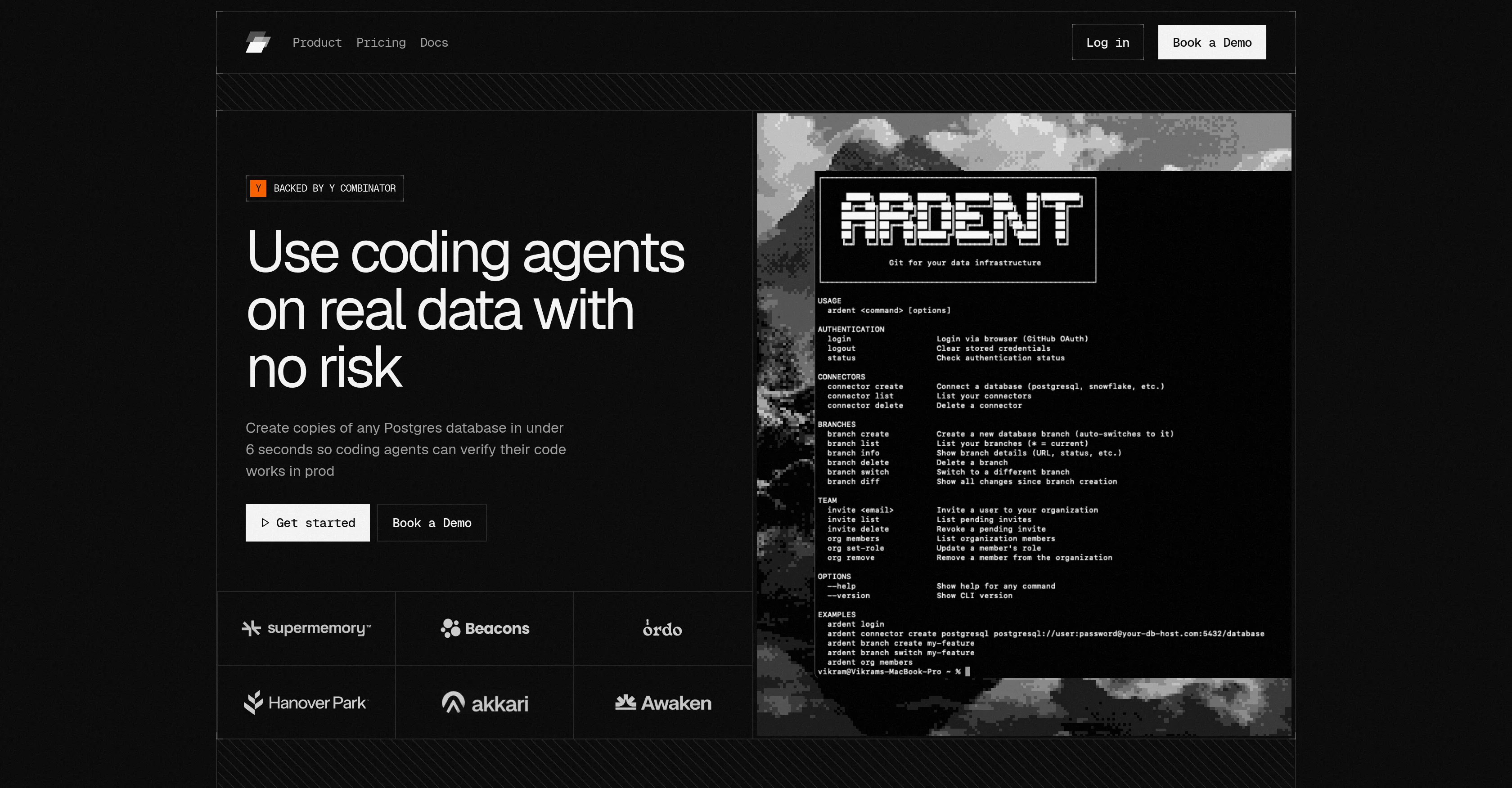
Access & connections
Where you can use Ardent.
Platforms
Capabilities
What this tool accepts, produces, and is strongest at.
Input
- Structured data
Output
- Structured data
Highlights
- Agents
Supported features
- Agents
Pros & cons
Pros
- Effective Postgres database copies
- Database branching capability
- Zero risk to production
- Test and migration isolation
- No operational impact
- Data cleaning
- Data deduplication
- Data standardization
Show 25 more
- Exact production copy usage
- Migration testing
- Backfilling verification
- High scalability
- Consistent speed at terabyte scale
- Storage optimization
- Computing optimization
- Automatic scaling
- Overprovisioning prevention
- Supabase compatibility
- AWS RDS compatibility
- Planetscale compatibility
- Git-style team collaboration
- Database cloning speed
- Clone load in 6 seconds
- Massive storage efficiency
- Zero config changes
- Extensions and configuration compatibility
- Branching without migration
- Infinite clone limit
- Clone management automation
- Agent workloads matching scaling
- Downtime reduction
- Release speed improvement
- Manual resizing avoidance
Cons
- Locked to Postgres databases
- Lacks multi-database support
- Limited provider compatibility
- No mention of security measures
- Might be complex for beginners
- Requires knowledge of Git-style collaboration
- Possibility of high costs with terabyte-scale data
- No explicit support for non-coding agents
Show 2 more
- Assumes familiarity with database management
- No offline functionality mentioned
Compare alternatives
Similar tools in the catalog — with a clear reason to open each one.

HydraDB ✓
FreemiumThe fastest GraphDB built on object storage
Why look Typically cheaper
Full comparison
Stackby AI ✓
FreemiumBuild no-code apps and databases with AI.
Why look Typically cheaper
Full comparison
Releem ✓
FreemiumSupercharge MySQL performance with one-click tuning.
Why look Typically cheaper
Full comparison
MeetingBrief ✓
PaidComprehensive meeting research in under a minute.
Why look Typically cheaper
Full comparison
Jam SQL Studio ✓
FreemiumAI-native SQL IDE for macOS, Windows, and Linux.
Why look Typically cheaper
Full comparisonReleases 1
FAQ 12
What is Ardent?
What are the key features of Ardent?
What is unique about the database branching in Ardent?
What do you mean by zero risk to production in Ardent?
How does Ardent facilitate data cleaning and standardization?
How can backfilling verifications be done using Ardent?
Can Ardent handle large scale data? How efficient is it?
Does Ardent provide automatic scaling? How does it work?
What measures does Ardent take to prevent overprovisioning?
How is Ardent compatible with other providers like Supabase, AWS RDS, Planetscale?
What Git-style team collaboration features does Ardent offer?
How can I create copies of my Postgres databases using Ardent?
Related tools
Recommended

turbopuffer ✓
PaidSearch every byte with 10x cheaper vector search.

Splutter AI ✓
FreemiumWebsite Chatbot & Voicebot w/ Hotswappable Models, Databases, & Tools!

1Scholar Citation Checker ✓
FreemiumVerify every reference against academic databases in seconds.

Routine ✓
FreemiumAll your work in one place, powered by AI.

Modelence ✓
FreemiumBuild production-ready web apps with AI.

88Agents ✓
FreemiumBuild AI chatbots and agents for clients