

Vector databases 2026 Rank: #2580
turbopuffer ✓
Search every byte with 10x cheaper vector search.
Verdict
A quick read before you dig into the full page.
- Best if
- Search every byte with 10x cheaper vector search
- Skip if
- Limited pinned namespaces
- Pick this when
- 10x cheaper vector search
Considering Weaviate instead? Compare side by side
Overview
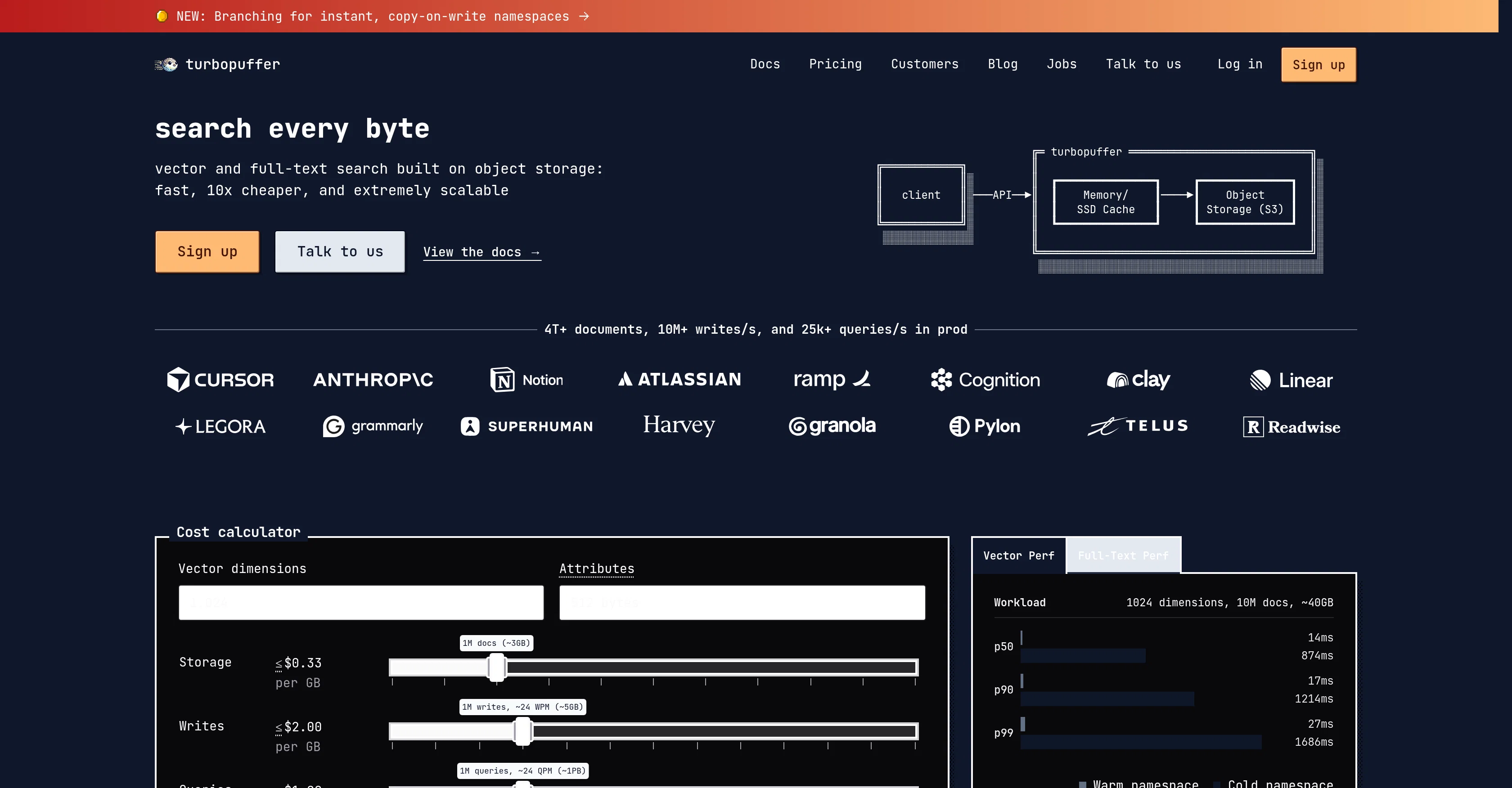
Turbopuffer is a trusted and scalable vector and full-text search database designed around object storage. Its main application lies in areas such as AI, semantic search, recommendation systems, and other use cases that require high-performance similarity search functionality.
It provides faster search capabilities at a lower cost. Turbopuffer's unique features include automated scaling, low latency in responses, the ability to support billions of vectors, hybrid search, metadata filtering, and substantial savings compared to traditional vector databases.
Instant namespace branching is another feature that enhances its flexibility and performance. In addition, Turbopuffer is noted for its scalability and capacity to handle massive amounts of data, reflected in the use by leading companies, underlining its capabilities.
Testimonials highlight its effectiveness in terms of cost savings and decreased complexity. However, the exact numbers regarding its capabilities, such as documents it can handle or queries it can process, may vary and will need to be confirmed by the service provider for current and accurate information.
Access & connections
Where you can use turbopuffer.
Platforms
Capabilities
What this tool accepts, produces, and is strongest at.
Input
- API
Output
- API
Highlights
- API
Supported features
- Search
- API
Pros & cons
Pros
- 10x cheaper vector search
- Faster search capabilities
- Automated scaling
- Low latency responses
- Supports billions of vectors
- Hybrid search capabilities
- Metadata filtering
- Instant namespace branching
Show 27 more
- Scalable database
- Object storage based
- High-performance similarity search
- Cost-effective
- Handles massive data
- 4T+ document handling
- 10M+ writes/s
- 25k+ queries/s
- Sub-10ms p50 latency
- Full-text search capabilities
- Universal API
- Good documentation
- Trusted by leading companies
- Simple integration
- High recall rates
- Unlimited scalability
- Customizable
- Low complexity
- Order of magnitude cost savings
- Easy to use
- Flexible architecture
- Fast performance
- Reliable
- Secure
- Compliance features
- Namespace metadata
- Authentication support
Cons
- Performance varies
- Data handling ambiguity
- Lack of SSL encryption
- Cost savings unclear
- Limited pinned namespaces
- Vague production limits
- Query restrictions per namespace
- Exact capabilities unconfirmed
Show 2 more
- Specific latency unclear
- Queried document limitation
Compare alternatives
Similar tools in the catalog — with a clear reason to open each one.


Supabase Vector ✓
FreemiumThe Postgres Vector database and AI Toolkit
Why look Freemium alternative
Full comparison
Vectorize ✓
FreemiumTurn your unstructured data into optimized vector search indexes.
Why look Freemium alternative
Full comparison

BigIdeasDB ✓
PaidAI-Powered Tools to Help You Find, Validate, and Build a Winning Product
Why look Typically cheaper
Full comparison
Sequel ✓
FreemiumAI SQL Generator: Chat with your database
Why look Freemium alternative
Full comparisonReleases 1
FAQ 12
What is the main application of Turbopuffer?
How does the performance of Turbopuffer compare with traditional vector databases?
What are the key features of Turbopuffer?
What is Turbopuffer's capacity for handling data?
What types of search does Turbopuffer support?
In which areas is Turbopuffer most effectively used?
How does automated scaling in Turbopuffer work?
Can you explain the concept of 'namespace branching' in Turbopuffer?
What is the response latency for Turbopuffer?
What makes Turbopuffer a cost-effective choice?
How does Turbopuffer handle similarity searches?
Who are some notable clients using Turbopuffer?
Related tools
Recommended

Parallel Web Systems ✓
UnknownWeb browsing

MagicSlides.app AI PPT Maker ✓
FreemiumCreate Stunning PPTs in Seconds with the AI PPT Maker

B12 AI Website Builder ✓
FreemiumAI-powered website builder

GetLogit ✓
FreemiumArtificial intelligence, available for everyone.

Thea ✓
FreemiumAI study tools to master material, not just memorize it.

ChatGPT ✓
FreemiumAsk anything, create anything, and move from idea to action.