

Databases 2026 Rank: #1778
HydraDB ✓
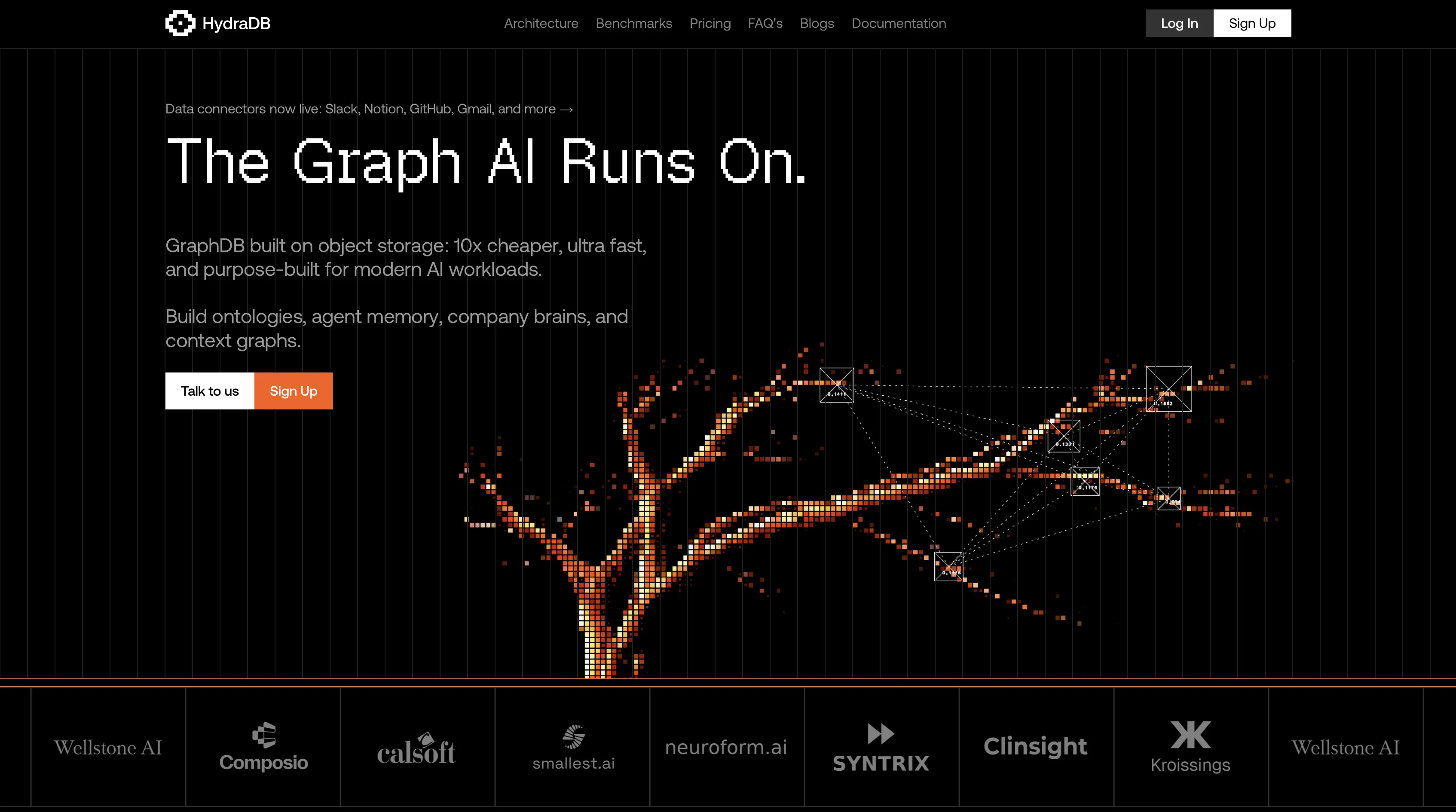
The fastest GraphDB built on object storage
Verdict
A quick read before you dig into the full page.
- Best if
- The fastest GraphDB built on object storage
- Skip if
- No MVCC support
- Pick this when
- Supports both structured and unstructured data
Considering Stackby AI instead? Compare side by side
Overview


Most teams building stateful AI end up stitching together five systems: a vector database, a graph database, a relational store, filesystem primitives, and a cache. You spend months planning, write brittle code, maintain it constantly and everything still fails in production.
Either embeddings miscalculate similarity, results aren’t relevant or personalized, or costs scale exponentially. Ultimately, your agents and evals suffer.
HydraDB solves that by giving you one graph that learns every user preference, retains every agent experience, and delivers personalized context the moment your agent needs it.
We give you primitives so that you can build your own context stores, memory layers, and workflows that require context for your AI. Think of it as a graph-native context delivery mechanism for your agents.
The graph, the memory primitives, the retrieval pipeline, and the ranking knobs are yours to compose. Your context. Your opinions.
What are people building with HydraDB?
In-house memory systems : Graphs work better for storing user preferences, past interactions, and agent traces.
Structures on domain knowledge : An operational "digital twin" of the businesses that bridges the gap between raw data and real-world operations.
Agent orchestration and tool-use : Audit-ready traces for every decision and tool call.
HydraDB designed for AI applications that need persistent, structured, and traceable memory across complex workflows.
The use cases span any domain where agents need to recall past interactions, track evolving relationships, and reason over historical context.
Access & connections
Where you can use HydraDB, and what it plugs into.
Platforms
Integrations
Capabilities
What this tool accepts, produces, and is strongest at.
Input
- API
- Code
- Tabular
- Text
Output
- Code
- Tabular
- API
- Text
Highlights
- API
- MCP
Supported features
- API
- MCP
Pros & cons
Pros
- Supports both structured and unstructured data
- Sub-200ms Latency
- Graph-native and temporal awareness
- Multi-hop reasoning
- Multi-tenant architecture and tenant-isolation
Cons
- No MVCC support
- Ingestion latency
Compare alternatives
Similar tools in the catalog — with a clear reason to open each one.

Stackby AI ✓
FreemiumBuild no-code apps and databases with AI.
Why look Typically cheaper
Full comparison
Releem ✓
FreemiumSupercharge MySQL performance with one-click tuning.
Free + from $59/mo
Full comparison
MeetingBrief ✓
PaidComprehensive meeting research in under a minute.
Why look Typically cheaper
Full comparison

Jam SQL Studio ✓
FreemiumAI-native SQL IDE for macOS, Windows, and Linux.
Why look Typically cheaper
Full comparison
Aiqbee ✓
Free TrialGive any AI tool persistent organizational context.
Why look Typically cheaper
Full comparisonReleases 1
FAQ 12
What is HydraDB designed to do?
What are the key features of HydraDB?
What is the technology platform that HydraDB built on?
What is a 'digital twin' in HydraDB terms?
What types of information does HydraDB ingest?
What sources can HydraDB ingest information from?
What tasks can HydraDB perform with AI agents?
What is the graph traversal feature in HydraDB?
Does HydraDB support AI agents in learning from past mistakes?
Can HydraDB trace agent memory actions?
What do you mean by HydraDB ensures audit-ready traces?
What is the storage optimization in HydraDB?
Related tools
Recommended

SureThing.io - "OpenClaw" for Beginners ✓
FreemiumFirst General AI Agency. Designed for long-horizon tasks.

Intuo – Your AI geospatial analyst ✓
FreeAsk a question about anywhere. Get analyst-grade maps and answers.

HappySeeds ✓
FreemiumTurn ideas into AI-powered apps instantly.

TheFluxTrain ✓
FreemiumCreate AI ads, infographics, and films with agents or reusable workflows

Managed Hermes Agent | Hostinger ✓
PaidHermes Agent with zero setup, maintenance, or infrastructure management.

Neural4D | Image to 3D ✓
Free TrialTurn photos or prompts into 3D models instantly.