
from $20/mo
Verdict
A quick read before you dig into the full page.
- Best if
- The coding agent that never stops working
- Skip if
- Limited to certain file types
- Pick this when
- Advanced coding platform
Considering Cursor instead? Compare side by side
Overview
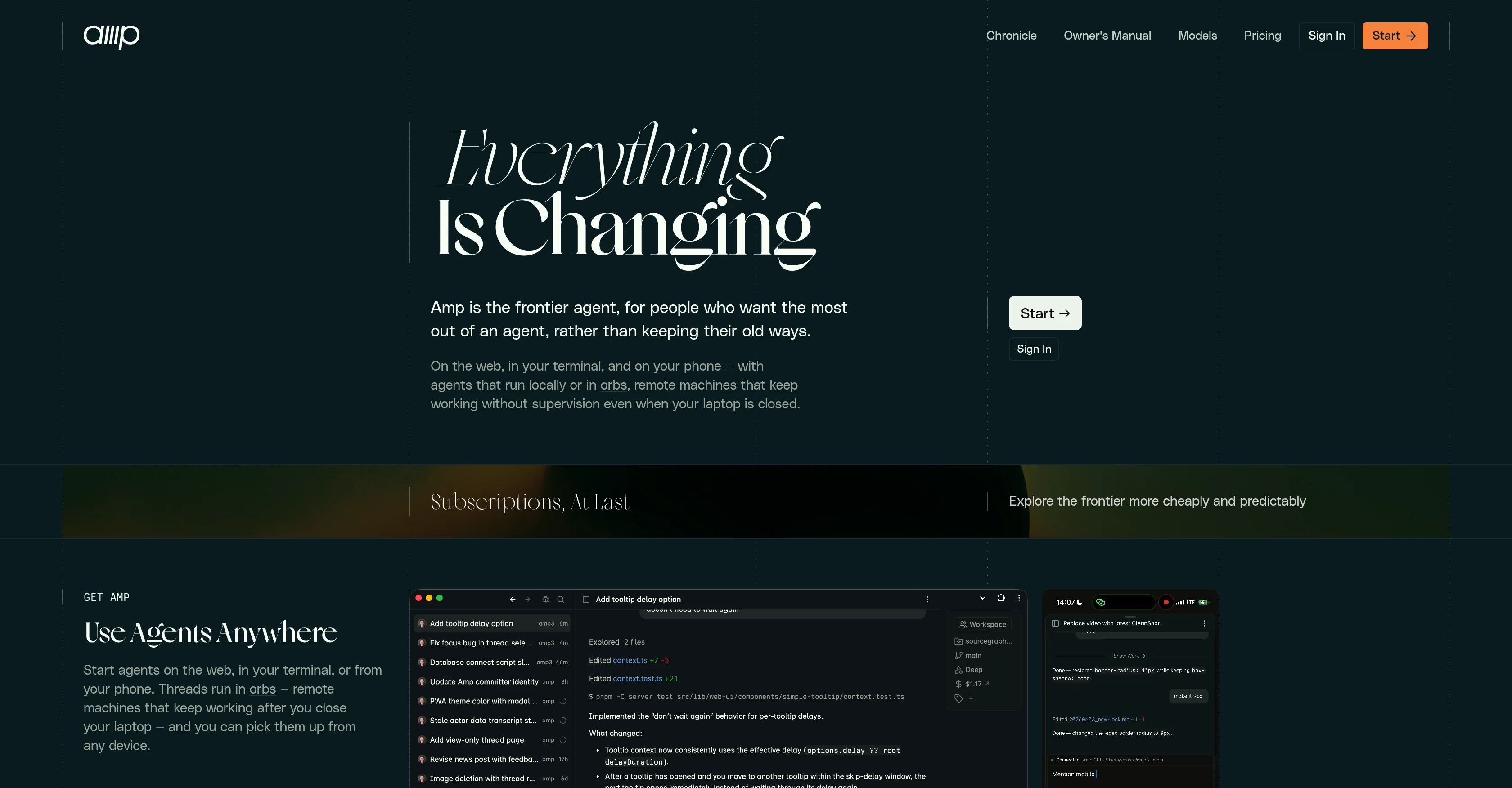
Amp is an innovative advanced coding agent platform, designed to allow users to make full use of cutting-edge models. It's versatile in nature, working on the web, in terminal, and on mobile devices as well.
One of its distinguishing features is the utilization of agents that can run locally or on 'orbs', remote machines capable of operating with little to no supervision even after the controlling device is powered off.
This enables tasks to continue without needing constant monitoring. Enabling ease of use across multiple devices is another key feature of Amp, allowing you to pick up your work from any device.
Amp aims to be innovative and continuously evolving, adapting and moving as the models develop and change, thus effectively eliminating old workflows and stale assumptions.
The tool strongly focuses on beneficial features while also swiftly eliminating features that are not pulling their weight. In terms of functionality and performance, Amp is designed to stay responsive even during long and extensive agent runs, making it suitable for handling large threads that teams are currently dealing with.
Amp also supports plugins for customization and policy standardization among other things, enhancing its extensibility and adaptability to your workspace needs.
Further, it's been developed to work with a wide range of files, aiding effectively in processing and handling videos, logs, PDFs, datasets and more.
Access & connections
Where you can use AMP, and what it plugs into.
Platforms
Integrations
Capabilities
What this tool accepts, produces, and is strongest at.
Input
- Text
Output
- Code
Supported features
- CLI
Pros & cons
Pros
- Advanced coding platform
- Versatile usage
- Web, terminal, mobile compatible
- Autonomous operation on 'orbs'
- Unmonitored task continuation
- Easily switch between devices
- Continuous evolution and adaptation
- Responsive during extensive runs
Show 43 more
- Excellent with large threads
- Plugin support and customization
- Supports policy standardization
- Handles a wide range of files
- Effective video processing
- Effective log processing
- Effective data processing
- Effective PDF processing
- Consistently eliminates unproductive features
- Focus on beneficial features
- Improves old workflows
- Innovation and versatility focus
- Uninterrupted agent runs
- Effective remote operation
- Agents can run locally
- Allows use of latest models
- Highly extensible
- Standardized policy support
- Can effectively process datasets
- Supports workflow optimization
- Supports customization
- Adoptive learning and development
- Performance oriented
- Can handle extensive threads
- Policy standardization support
- Works with diverse file formats
- Supports video, log, PDF and data processing
- Feature elimination for effective performance
- Able to maintain responsiveness
- Supports plugin for extended features
- Event hooking through plugins
- Works with remote machines
- Ability to pick up work anywhere
- ARCH: cross device compatibility
- Remote operating capability
- Standardizes policies among teams
- Supports effective file handling
- Offers plugin adaptability for workspace
- Eliminates stale assumptions
- Processes and handles large files
- Supports banking technology needs
- Scheduled agent operations
- Interactive multi-agent control
Cons
- Eliminates old workflows quickly
- Possible over-reliance on agents
- Can eliminate useful features
- Continuous development might disrupt work
- Requires multiple device setup
- No control over remote 'orbs'
- Potential data security concerns
- Plugin compatibility issues
Show 2 more
- Limited to certain file types
- Unclear customer support options
Compare alternatives
Similar tools in the catalog — with a clear reason to open each one.


OnSpace.AI - No Code App Builder ✓
FreemiumBuild Apps with AI, No Code
Why look Freemium alternative
Full comparison
Kilo Code ✓
Free TrialAI-powered coding assistant for VS Code
Why look Typically cheaper
Full comparison
Github Copilot ✓
FreemiumAI-powered coding assistant for faster development
Why look Freemium alternative
Full comparison
CodingFleet ✓
FreemiumAI wizard transforms instructions into code snippets.
Why look Freemium alternative
Full comparison
Releases 1
FAQ 12
What is the main purpose of Amp?
How does Amp utilize agents to run tasks locally or on orbs?
What kind of devices can I use with Amp?
How does Amp adapt and evolve with changing models?
What features of Amp can I customize using plugins?
Can Amp process different file types like videos and PDFs?
How does Amp optimize workflows?
What is the functionality of Amp in terms of large scale data processing?
How does Amp improve performance optimization?
How does policy standardization work in Amp?
What is the benefit of Amp's cross device compatibility feature?
How does Amp handle tasks when the controlling device is powered off?
Related tools
Recommended

Knowster ✓
FreemiumYour website answers questions while you sleep.

Kiro ✓
Free TrialMove beyond AI coding to agentic engineering.

GetLogit ✓
FreemiumArtificial intelligence, available for everyone.

ChatGPT ✓
FreemiumAsk anything, create anything, and move from idea to action.

Notis ✓
Free TrialThe first WhatsApp assistant that runs on your ChatGPT and Claude subscriptions

freebeat AI ✓
FreemiumTurn Music & Ideas into Viral Videos In One Click