
Elicit
AI research assistant to automate research workflows, find papers, summarize, and extract data.
Free + from $10 per month, billed annually
Verdict
A quick read before you dig into the full page.
- Best if
- You are researchers and need: Speeding up literature reviews
- Skip if
- You need enterprise SLAs or a fully managed team plan right away
- Pick this when
- Freemium · Free + from $10 per month, billed annually
Overview
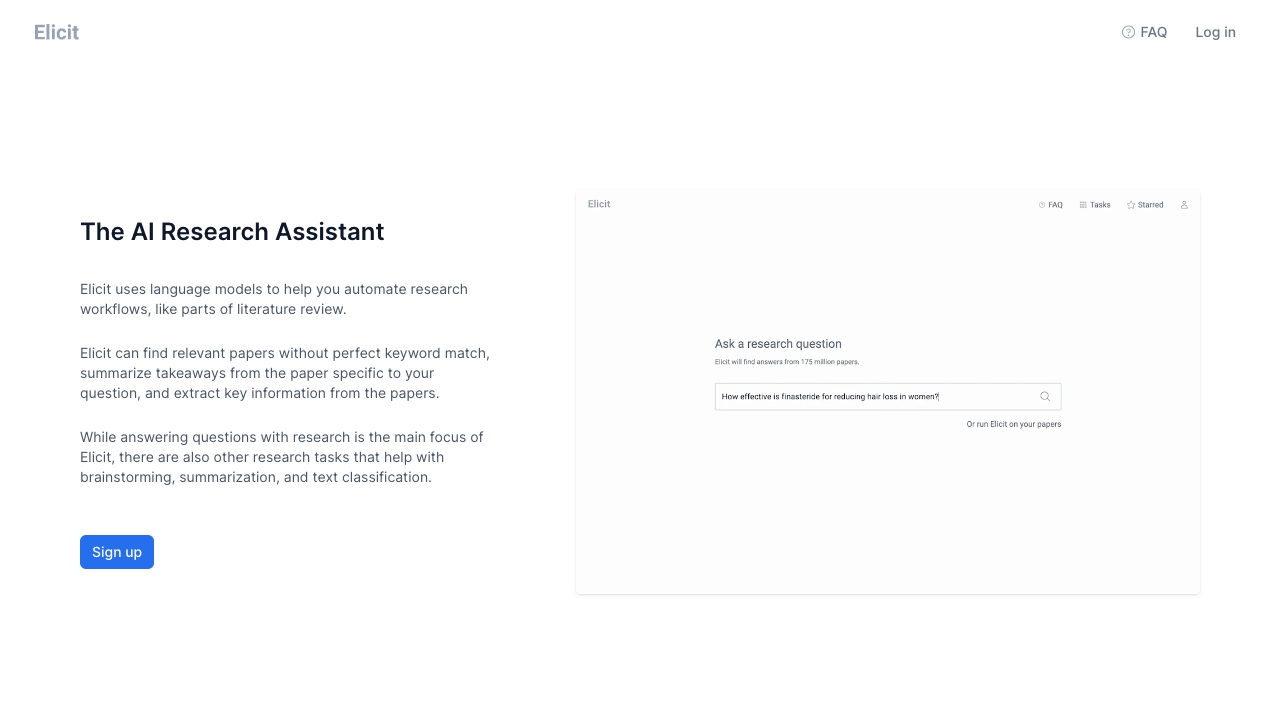
Elicit uses language models to help you automate research workflows, like parts of literature review. Elicit can find relevant papers without perfect keyword match, summarize takeaways from the paper specific to your question, and extract key information from the papers. Elicit can also help with other research tasks like brainstorming, summarization and text classification.
Best for
Short scenarios where Elicit tends to shine.
-
Speeding up literature reviews
Best for Researchers
-
Automating systematic reviews and meta-analyses
Best for Academics
-
Learning about new domains
Best for Consultants
-
Data extraction in rigorous systematic literature reviews
Best for Data analysts
How it works
Example outputs 1
Sample generations and before/after results for Elicit.
Access & connections
Where you can use Elicit.
Platforms
Capabilities
What this tool accepts, produces, and is strongest at.
Highlights
- AI-enabled systematic reviews
- Research reports
- Upload your own PDFs
- Quick summaries
- Source quotes
- Question answering
People also view
Tools that often show up alongside Elicit in collections and comparisons.

Raccoon AI ✓
FreemiumThe AI Coworker for Apps, Research, Docs & Everything Else

Gobii ✓
FreemiumCreate digital workers that automate web tasks 24/7.

Flowith AI ✓
FreemiumUnleash deep work with AI-powered flow.

Articos ✓
PaidRun synthetic user interviews and validate messaging, landing pages, and product ideas
In the news
Launch coverage and community mentions for Elicit.
FAQ 7
What is Elicit?
How to use Elicit?
How do researchers use Elicit?
What is Elicit not a good fit for?
What types of data can Elicit search over?
How accurate are the answers in Elicit?
What happens to papers uploaded to Elicit?
Related tools
Recommended
Flowith AI ✓
FreemiumUnleash deep work with AI-powered flow.
Raccoon AI ✓
FreemiumThe AI Coworker for Apps, Research, Docs & Everything Else
Articos ✓
PaidRun synthetic user interviews and validate messaging, landing pages, and product ideas
Gobii ✓
FreemiumCreate digital workers that automate web tasks 24/7.