

Podcast transcription 2026 Rank: #2581
Spoken ✓
Any podcast episode as clean Markdown in one API call.
Verdict
A quick read before you dig into the full page.
- Best if
- Any podcast episode as clean Markdown in one API call
- Skip if
- Limited to podcast data
- Pick this when
- Single API call
Considering SpotScribe instead? Compare side by side
Overview
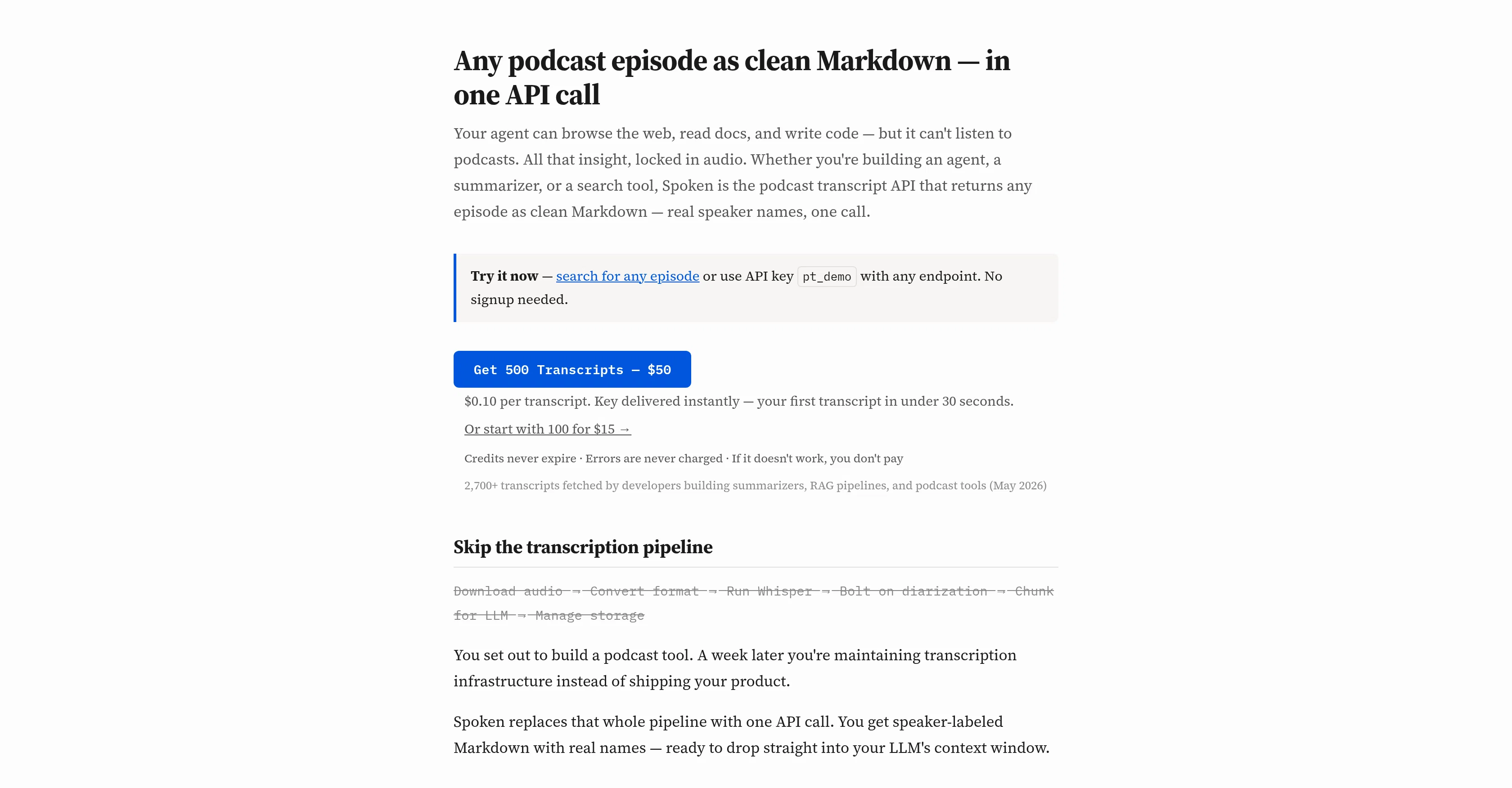
Spoken is an API tool that provides transcripts for any podcast episode in clean Markdown format. This efficient solution replaces manual audio transcribing processes with a single API call, saving time and resources for developers and allowing them to focus on building their products.
Spoken also uniquely distinguishes real speaker names instead of using generic labels such as 'Speaker 1', enhancing the readability and comprehension of the transcripts.One key feature of Spoken is its ability to detect speaker names by analyzing the context of the transcript, thus eliminating manual lookup tables or post-processing requirements.
Additionally, it offers an easy search facility where users can query by text or paste a URL from various podcast platforms, including Spotify, YouTube, and other podcast apps.Designed to be integrated with AI agents, Spoken's transcripts can be used as input data for various applications like summarizers, RAG pipelines, podcast tools, etc.
It provides a straightforward integration process, supporting any agent framework and accepting simple HTTP calls.Despite being a paid service, Spoken allows potential users a trial experience where they can evaluate the transcript's quality and format using a demo API key.
With a commitment to quality assurance, Spoken ensures that credits are never charged for errors, and it maintains a flexible payment model, without subscriptions or expiration of credits.
Access & connections
Where you can use Spoken, and what it plugs into.
Platforms
Capabilities
What this tool accepts, produces, and is strongest at.
Input
- API
- Audio
Output
- API
- Text
Highlights
- API
- MCP
Supported features
- STT
- API
- MCP
- Transcription
- Podcast
Pros & cons
Pros
- Single API call
- Markdown formatted transcripts
- Real speaker name recognition
- Speaker names from context
- Easy text or URL search
- Compatible with various podcast platforms
- Straightforward integration process
- Supports any agent framework
Show 33 more
- Compatibility with HTTP calls
- Trial experience with demo API
- Quality assurance for errors
- Flexible payment model
- No expiration of credits
- No subscription requirement
- Narration summarization feature
- Text search functionality
- No post-processing requirements
- Direct transcript fetch via URL
- Naming fallbacks for ambiguous speakers
- Transcripts fit into LLM context windows
- Metadata included in response headers
- Agent skill URL for direct installation
- OpenAPI spec for agent integration
- Automatic LLM discovery
- Credits top-up feature
- Error denotation in response
- Transcript preview before purchase
- Volume-based pricing discounts
- Full-service transcript retrieval
- Results returned in text/markdown
- Name mention analysis for speaker detection
- Compatibility across various podcast apps
- Supports plain HTTP calls
- No manual lookup table for speakers
- API response includes top-up link
- No timing artifacts in transcript
- Supports podcast search by text
- Extraction of real speaker names
- Search tool integration
- Ready-to-use transcripts without cleanup
- Allows for text-based episode search
Cons
- No realtime transcription
- No multi-language support
- No offline functionality
- Relies heavily on context
- Doesn't support custom formatting
- Probable speaker misidentification
- No error correction options
- Pricing per transcript
Show 2 more
- Limited to podcast data
- No user interface
Compare alternatives
Similar tools in the catalog — with a clear reason to open each one.

SpotScribe ✓
Free TrialTurn any Spotify podcast into text instantly.
Why look Typically cheaper
Full comparison
Tapesearch ✓
FreemiumFind what was said in a podcast instantly.
Why look Freemium alternative
Full comparison
Voscribe ✓
FreemiumInstantly transcribe and perfect your podcast episodes.
Why look Freemium alternative
Full comparison
Podnotes ✓
PaidAI-powered podcast post-production in seconds.
Why look Higher community rating
Full comparison
Pods.ee ✓
FreemiumAI-powered tools for podcast listeners
Why look Freemium alternative
Full comparison
Releases 1
FAQ 12
What is Spoken?
What services does Spoken provide?
How does Spoken work?
How does Spoken distinguish real speaker names?
How can I search for podcast episodes with Spoken?
What platforms is Spoken compatible with?
How can Spoken be integrated with my AI agents?
What format does Spoken provide transcripts in?
Does Spoken provide a trial experience?
What is Spoken's payment model?
How fast can I get a transcript from Spoken?
Can Spoken be used for large volume of transcripts?
Related tools
Recommended

Draw3D ✓
FreemiumTransform sketches and 3D blockout into photorealistic images.

SpeakPal ✓
PaidFun. Fast. Fluent. SpeakPal Makes It Easy!

Meshy ✓
FreemiumTurn text and images into production-ready 3D models with AI in seconds.

ClothesChange.ai ✓
FreemiumTransform your photos into any outfit instantly.

AITWO.CO ✓
FreemiumRemodel your home instantly with AI.

MyColoring.AI ✓
FreemiumTransform photos into printable coloring pages instantly.