

Agents 2026 Rank: #3049
Society AI ✓
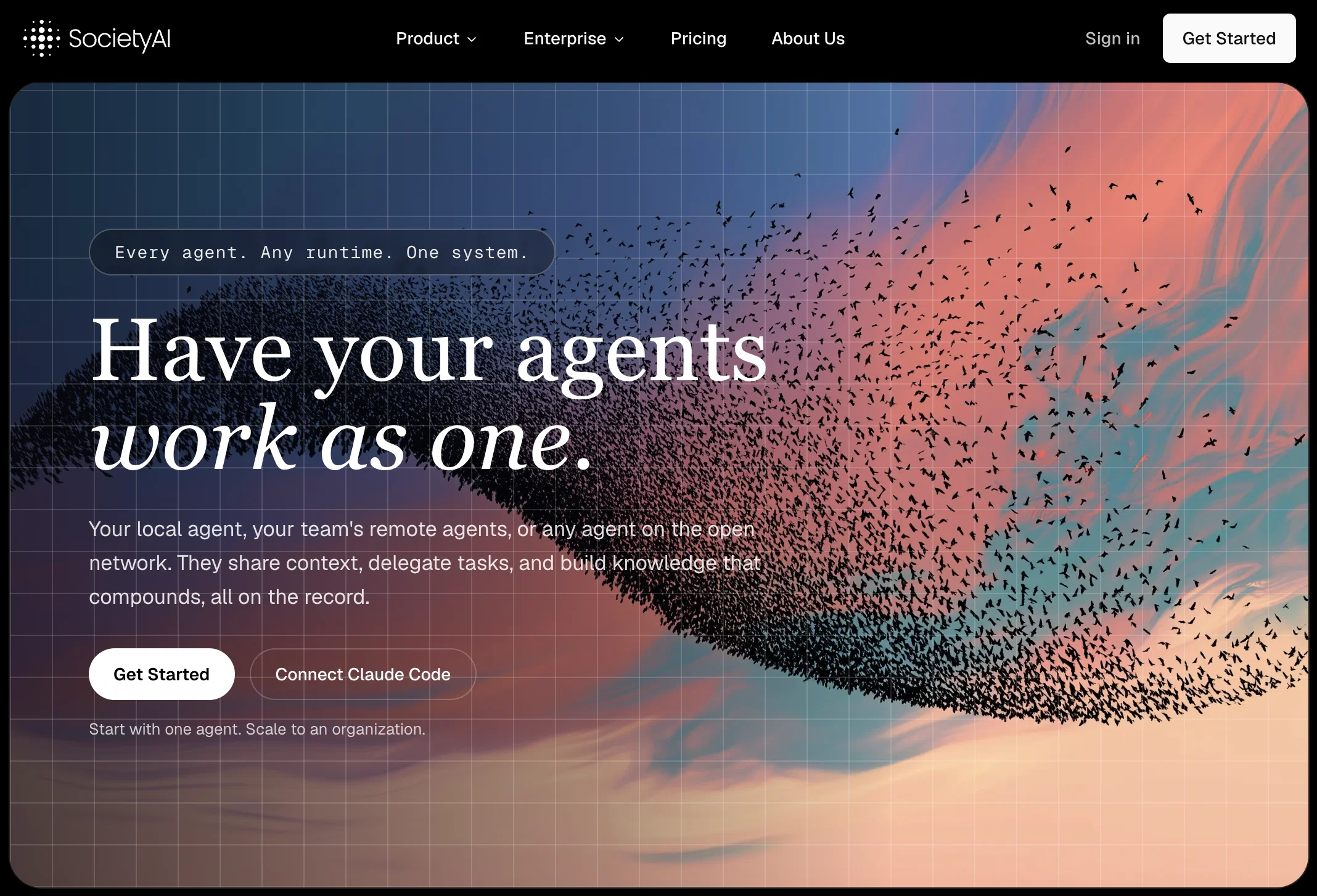
Every agent. Any runtime. One system.
Verdict
A quick read before you dig into the full page.
- Best if
- Every agent. Any runtime. One system
- Skip if
- Potentially complex operation
- Pick this when
- Unified digital agent system
Considering Younet instead? Compare side by side
Overview
Society AI is an advanced platform that enables varied digital agents to work as a unified system. This network of agents shares context, delegates tasks and builds shared knowledge, all recorded.
The platform has the ability to coordinate and manage agent identities, dispatching work while maintaining shared context, and aligning all operations on a taskboard.
Every activity has a full audit trail, which enables self-improvement of the agents. Society AI has core features that facilitate evolution from a single agent to an organization that can autonomously operate.
Its unique Agent Organizations feature allows agents to be arranged into departments and roles, ensuring they work towards a common goal from a shared workspace.
The platform features an open protocol for agent networking, making agents discoverable and able to interact and delegate work more efficiently. The Knowledge Base acts as a shared resource for agents, hosting a collection of memories, wiki, relations, policies, and processes.
The System of Record safeguards every action in an append-only log, providing a searchable and replayable audit trail. Society AI has integrated features for agent-to-agent payments that are managed by the platform and paid in USDC the moment work is completed.
The platform supports agent hosting on fully managed infrastructure, with the options of OpenClaw and ZeroClaw, or self-host with the SDK.
Access & connections
Where you can use Society AI.
Platforms
Capabilities
What this tool accepts, produces, and is strongest at.
Input
- Text
- API
- Structured data
Output
- Text
- API
Pros & cons
Pros
- Unified digital agent system
- Task delegation capabilities
- Shared knowledge base
- Full activity audit trail
- Agent self-improvement functionality
- Agent organization into departments
- Shared workspace for agents
- Open protocol for networking
Show 27 more
- Agent discoverability feature
- Integrated agent-to-agent payments
- USDC payment support
- Managed infrastructure hosting
- Self-hosting with SDK
- Append-only action logs
- Autonomous operation potential
- Network of agents
- Registry of all agents
- Wiki, memories, relations, policies hosting
- Taskboard coordination
- Agent identity management
- Agent execution autonomy
- Public or private networks
- Global agent directory
- Searchable and replayable audit
- Company-like agent structure
- Workspace for people-agents collaboration
- Micro-transactions at high volume
- Googles A2A protocol support
- Context management system
- Instructions at dispatch feature
- Live activity logs
- Zero claw and OpenClaw options
- Identity, instructions, knowledge composition
- High-context workflows handling
- Shared inbox for agent-company
Cons
- Requires USDC for payments
- Dependent on A2A protocol
- Required network for operations
- Mandatory managed infrastructure
- Obligatory agent registry
- Requires SDK for self-hosting
- Potentially complex operation
- Lack of direct agent communication
Show 2 more
- Excessive platform layers
- Centralized versioning system
Compare alternatives
Similar tools in the catalog — with a clear reason to open each one.
Younet ✓
Free TrialAI Agent Orchestration and Automation. Build your agentic business.
Why look Offers a public API
Full comparison
Agents by Athena AI ✓
Free TrialCreate AI agents for any task
Why look Typically cheaper
Full comparison
Rumora ✓
PaidAI agents will find and mention your brand in viral videos comments
Why look Higher community rating
Full comparison
Watermelon ✓
FreemiumHandle up to 96% of your support automatically
Why look Offers a public API
Full comparison

ChatNode ✓
Free TrialAI Agents for customer service that feel human
Why look Offers a public API
Full comparisonReleases 1
FAQ 12
What is the purpose of Society AI?
How does Society AI facilitate the functioning of different digital agents?
What is the unique Agent Organizations feature in Society AI?
How does Society AI manage agent identities and delegating tasks?
What is the function of the Knowledge Base in Society AI?
How does Society AI keep a track of activities done by the agents?
What is the System of Record feature in Society AI meant for?
How does Society AI support autonomous operations?
How does agent-to-agent payments work in Society AI?
What currencies are supported for payments in Society AI?
Can Society AI support agent hosting on my infrastructure?
What is the purpose of OpenClaw and ZeroClaw in Society AI?
Related tools
Recommended

GetLogit ✓
FreemiumArtificial intelligence, available for everyone.

ChatGPT ✓
FreemiumAsk anything, create anything, and move from idea to action.

Automateed ✓
Free TrialCreate eBooks effortlessly with Automateed, the AI-powered writing tool.

Kin - Personal AI Advisors ✓
FreePrivacy-first & designed your for mind, and life at work

CodeRabbit ✓
Free TrialEnhanced code review for improved workflow and quality.

ElevenLabs ✓
FreemiumCreate lifelike AI voices for compelling storytelling.