

Semantic Scholar ✓
AI-powered research tool for scientific literature
Verdict
A quick read before you dig into the full page.
- Best if
- You are researchers and need: Discovering relevant research papers
- Skip if
- Limited to scientific literature
- Pick this when
- Aggregates scientific literature
Considering Scholarcy instead? Compare side by side
Overview
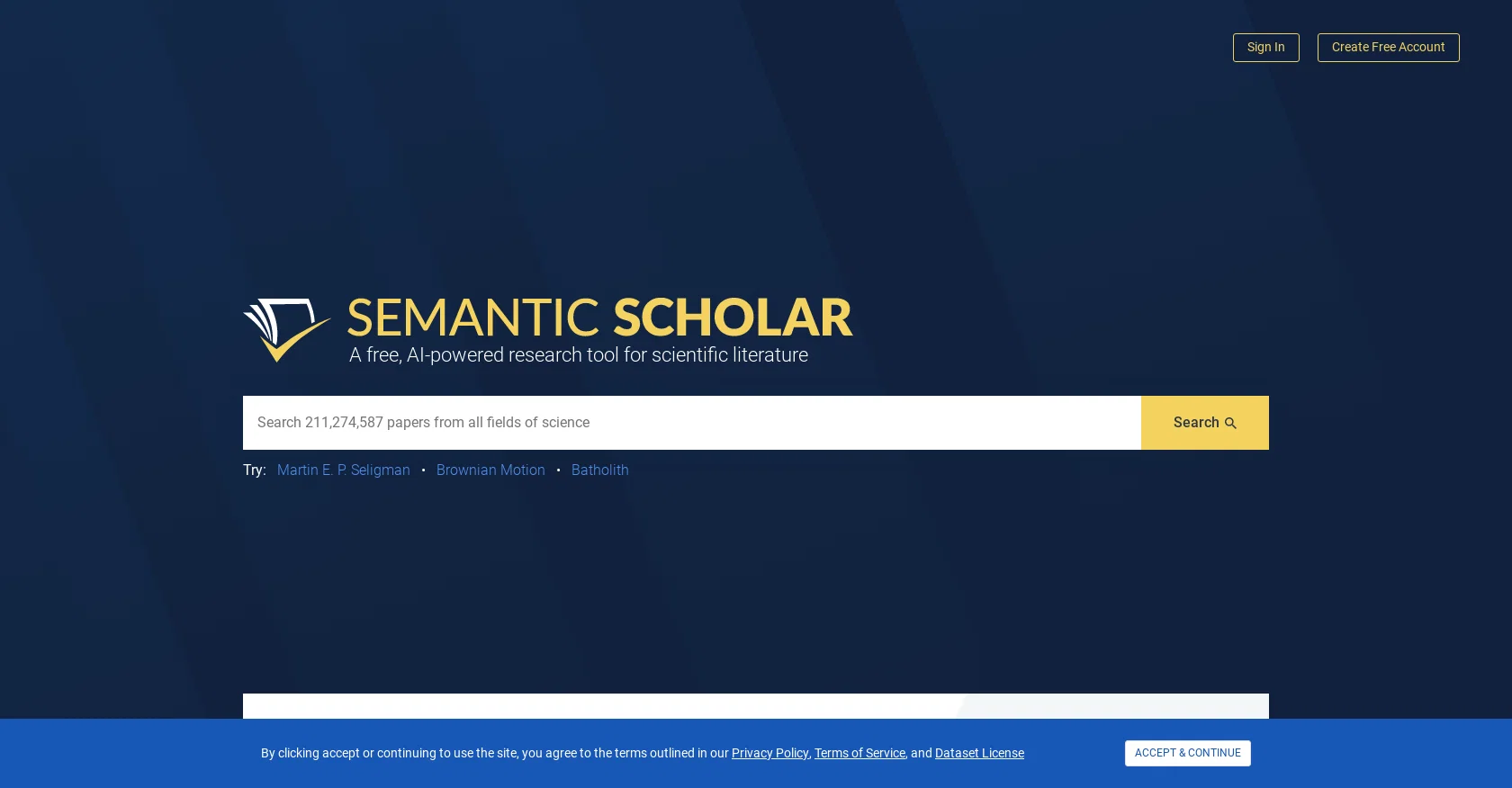
Semantic Scholar is a free AI-powered research tool that aggregates scientific literature from various fields of science, including nanotechnology and moral reasoning, and uses AI and engineering to understand the semantics of the research to help scholars discover relevant publications.
The platform currently archives over 211 million papers. Also, the tool has a beta program, Semantic Reader, that provides an augmented reading experience to help increase accessibility and richness to scientific literature.
Besides, Semantic Scholar has a newly improved API for developers, which allows searching for papers on the platform, better documentation, and improved stability.
Semantic Scholar was developed by the Allen Institute for AI, which focuses on creating efficiency in AI research to decrease carbon footprint and increase inclusivity.
Researchers who use Semantic Scholar can sign up and stay connected to receive alerts about relevant papers, as well as receive updates about new features and releases.
The platform is open to publishers who want to contribute their research, and a team of expert researchers composes the Semantic Scholar team. The platform also offers a detailed FAQ section and tutorials to help users understand the tool's full range of capabilities.
Overall, Semantic Scholar is a highly useful research tool for scholars, allowing them to discover relevant scientific publications with the power of AI.
Best for
Short scenarios where Semantic Scholar tends to shine.
-
Discovering relevant research papers
Best for Researchers
-
Augmenting the reading experience with Semantic Reader
Best for Scientists
-
Building scholarly apps using the API
Best for Academics
Example outputs 1
Sample generations and before/after results for Semantic Scholar.
Access & connections
Where you can use Semantic Scholar.
Platforms
Capabilities
What this tool accepts, produces, and is strongest at.
Input
- API
- Text
Output
- API
- Text
Pros & cons
Pros
- Aggregates scientific literature
- Covers various science fields
- Archives over 211 million papers
- Includes Semantic Reader for augmented reading
- Improved API for developers
- Better documentation
- Increased stability
- Promotes decreased carbon footprint
Show 6 more
- Encourages increased inclusivity
- Offers new feature and release updates
- Allows publisher contribution
- Team made of expert researchers
- Detailed FAQ section
- Tutorials available
Cons
- Limited to scientific literature
- No offline access
- No language translation options
- Requires sign up for alerts
- Specific API requirements
- Beta features might be unstable
- Not suitable for non-academic use
- Might not cover all fields
Show 1 more
- No mobile application
Compare alternatives
Similar tools in the catalog — with a clear reason to open each one.

Scholarcy ✓
FreemiumConvert long articles into summary flashcards.
Free + from $9.99/mo
Full comparison
Scispace ✓
FreemiumPlatform for exploring and publishing research papers.
Why look Higher community rating
Full comparison
OpenRead ✓
FreemiumAI-powered interactive papers for faster, intuitive research
Free + from $5/mo
Full comparisonPeople also view
Tools that often show up alongside Semantic Scholar in collections and comparisons.
OpenRead ✓
FreemiumAI-powered interactive papers for faster, intuitive research

Scite ✓
Free TrialAI research partner with insight and control
Scispace ✓
FreemiumPlatform for exploring and publishing research papers.

Papers ✓
Free TrialDiscover, Organize, and Analyze Research with AI-Powered Precision

Elicit ✓
Free TrialAI-powered research assistant for literature reviews and analysis.

Sourcely ✓
FreemiumAI-powered academic research assistant.

SciPub ✓
FreemiumAI-powered academic writing assistants for researchers
Scholarcy ✓
FreemiumConvert long articles into summary flashcards.
Releases 1
In the news
Launch coverage and community mentions for Semantic Scholar.
FAQ 12
What is Semantic Scholar?
What type of research can Semantic Scholar analyze?
How does Semantic Scholar's AI technology enhance the research experience?
How many papers does Semantic Scholar currently archive?
What is the Semantic Reader beta program?
Who developed Semantic Scholar?
How can researchers receive updates about new features in Semantic Scholar?
How can publishers contribute their research to Semantic Scholar?
What resources does Semantic Scholar offer to help users understand its features?
What is the purpose of the improved API in Semantic Scholar?
How can I sign up for Semantic Scholar?
What fields of science does Semantic Scholar specialize in?
Related tools
Recommended

Scisummary ✓
Free TrialCutting-edge scientific articles summarization.

AcademicGPT ✓
FreemiumAI-powered academic writing assistant.

TutorAI ✓
FreemiumInstant knowledge on any topic

GPTExcel ✓
FreemiumGenerate spreadsheet formulas with AI

LearningStudioAI ✓
Free TrialAI-powered authoring tool for effortless online course creation.

Vicena ✓
FreemiumAI for real scientific research (Vibe Research)
