

Business operations 2026 Rank: #938
Pit ✓
AI that learns workflows and builds business systems.
Verdict
A quick read before you dig into the full page.
- Best if
- AI that learns workflows and builds business systems
- Skip if
- Limited existing software compatibility
- Pick this when
- Customizes operational systems
Considering Bika.ai instead? Compare side by side
Overview
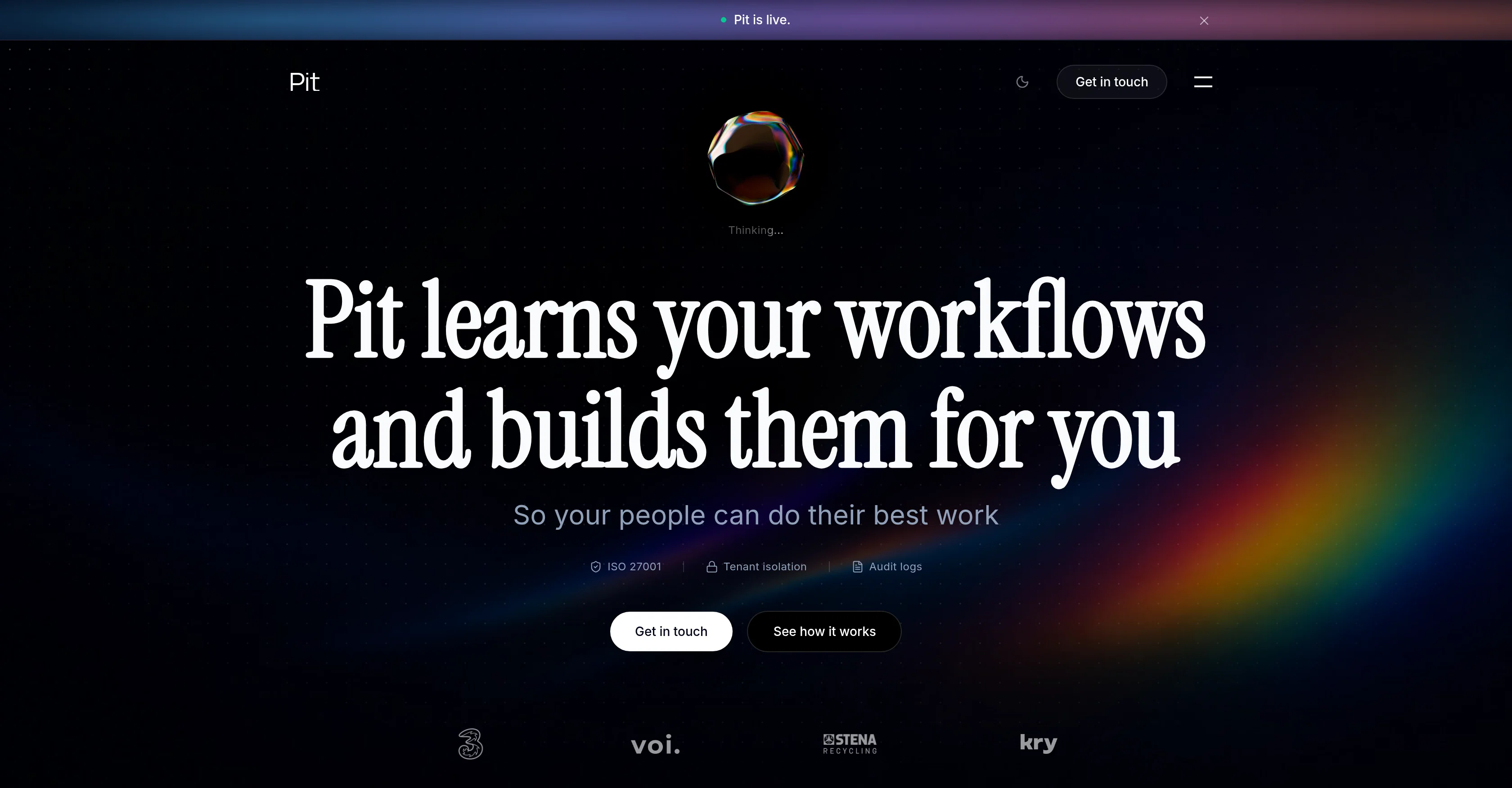
Pit is an AI platform designed to automate and simplify business operations. By learning how a business operates, Pit then creates customized systems to manage those operations, thereby saving time and resources.
Users can describe the issues they're facing, and the Pit system can build and refine tailored solutions to address those challenges. Pit blends the benefits of custom-built solutions with a 'buy' convenience - solving the problem of internal resource drain as seen with projects that require in-house development.
Pit is suitable for mid-to-large operations with manual processes prone to inefficiency and errors, like transferring data across systems or streamlining approval chains.
The goal is to automate operational work and allow teams to focus on tasks that genuinely move the business forward. The systems created by Pit integrate seamlessly with existing business tools, eliminating the need for manual workload between systems, which ensures the workflows remain cohesive while increasing efficiency.
Pit's systems are structured, monitored, and rolled back, ensuring unremitting reliability beyond an initial demonstration phase. Such processes undergo automatic documentation for better manageability and to allow for system evolution as business requirements change.
Pit provides a compliant and secure platform with its necessities like Single Sign-On (SSO), role-based access, complete audit trails, tenant isolation, and conformance to ISO 27001.
It helps ensure data protection and meets procurement checklist requirements. Technical expertise is not essential to use Pit; the system handles the complexities, leaving users to define their requirements.
Best for
Short scenarios where Pit tends to shine.
-
AI that learns workflows and builds business systems.
Example outputs 1
Sample generations and before/after results for Pit.
Access & connections
Where you can use Pit.
Platforms
Capabilities
What this tool accepts, produces, and is strongest at.
Input
- Text
Output
- Code
Supported features
- App Builder
- Automation
- Integrations
Pros & cons
Pros
- Customizes operational systems
- Adapts to business processes
- Reduces internal resource drain
- Mid-to-large operations suitability
- Improves manual processes
- Automates data transfer
- Constructs approval-chain solutions
- Integrates with pre-existing tools
Show 41 more
- Increases workflow cohesion
- Eliminates manual inter-system workload
- Structured system creation
- Ensures business reliability
- Auto-generates process documentation
- Compliant & secure platform
- Includes Single Sign-On (SSO)
- Role-based access feature
- Complete audit trails
- ISO 27001 conformity
- Ensures data protection
- Non-technical usability
- Reflects evolving business needs
- Tenant isolation for security
- Communicates user issues
- Refines operational solutions
- Suitable for critical tasks
- Supports system evolution management
- Streamlines approval chain
- Reduces operational work
- Increases focus on strategic work
- Automatic system documentation
- Adheres to procurement checklist
- Monitored operational processes
- Retrievable rollback ability
- Customized internal tool building
- Automates Cross-system data reconciliation
- Removes manual busywork
- Production-grade tools
- Harnessed code generation
- Futureproofs system changes
- GDPR compliant
- Reduces technical debt
- Ready for production software
- Automated operational work
- Automates approval workflows
- Pit cloud for security
- Versatile model options
- Regulated sector suitability
- Rapid system production
- No migration project necessary
Cons
- Only for mid-to-large businesses
- May not support small-scale automation
- Customization process potentially time-consuming
- Dependant on accurate user descriptions
- Limited existing software compatibility
- Requires initial manual setup
- Highly specific use-cases
- No mention of multi-language support
Show 2 more
- Focus on business operations only
- Possible long system integration
Compare alternatives
Similar tools in the catalog — with a clear reason to open each one.

Bika.ai ✓
FreemiumChat, build, manage one-person AI company like a messenger app.
Why look Higher community rating
Full comparison
Hugo AI ✓
Free TrialAI support agent that resolves tickets faster.
Free + from $45/mo
Full comparison
Parallel AI ✓
FreemiumBuild AI employees trained on your business.
Why look Higher community rating
Full comparisonPeople also view
Tools that often show up alongside Pit in collections and comparisons.
Parallel AI ✓
FreemiumBuild AI employees trained on your business.

Jungle AI ✓
PaidAI solutions for peak machine performance

Jude ✓
FreemiumTalking AI-Native CRM | Jude
Hugo AI ✓
Free TrialAI support agent that resolves tickets faster.

GestionFlow ✓
FreemiumComplete business management made simple and intuitive.
Bika.ai ✓
FreemiumChat, build, manage one-person AI company like a messenger app.

Orbecta ✓
FreemiumSupply chain intelligence for business impact.

Geekflare Chat ✓
FreemiumAll-in-One AI Platform for Modern Teams
Releases 1
FAQ 12
What is Pit?
How does Pit learn business operations?
What kinds of business operations can Pit automate?
In what ways does Pit increase operational efficiency?
How does Pit integrate with existing business tools?
How does Pit manage and adapt to changing business requirements?
What security measures does Pit have in place?
How does Pit ensure data protection?
Who is the ideal user for Pit?
Do I need any technical expertise to use Pit?
How does the 'buy' convenience option in Pit work?
Can Pit bring improvements to approval chain management?
Related tools
Recommended

Mythx.AI ✓
Free TrialCreate immersive AI-powered roleplay adventures with instant image generation.

Automateed ✓
Free TrialCreate eBooks effortlessly with Automateed, the AI-powered writing tool.

remio: Your Personal ChatGPT ✓
FreemiumGet Tailored Answer with Your Personal ChatGPT

AgentSwarms ✓
FreeLearn, Build and Run Agentic AI on your Browser!

Guideless ✓
FreemiumTurn any browser workflow into a polished, AI-narrated video guide in minutes.

Betula Assistant ✓
Free TrialStop juggling calls, tasks, reminders and notes. I've got them.