
Website monitoring 2026 Rank: #2156
Parallel Monitor API ✓
Track web changes continuously with scheduled queries.
from $0.10
Verdict
A quick read before you dig into the full page.
- Best if
- Track web changes continuously with scheduled queries
- Skip if
- Limited update frequency options
- Pick this when
- Scheduled updates
Considering Let Me Know When instead? Compare side by side
Overview
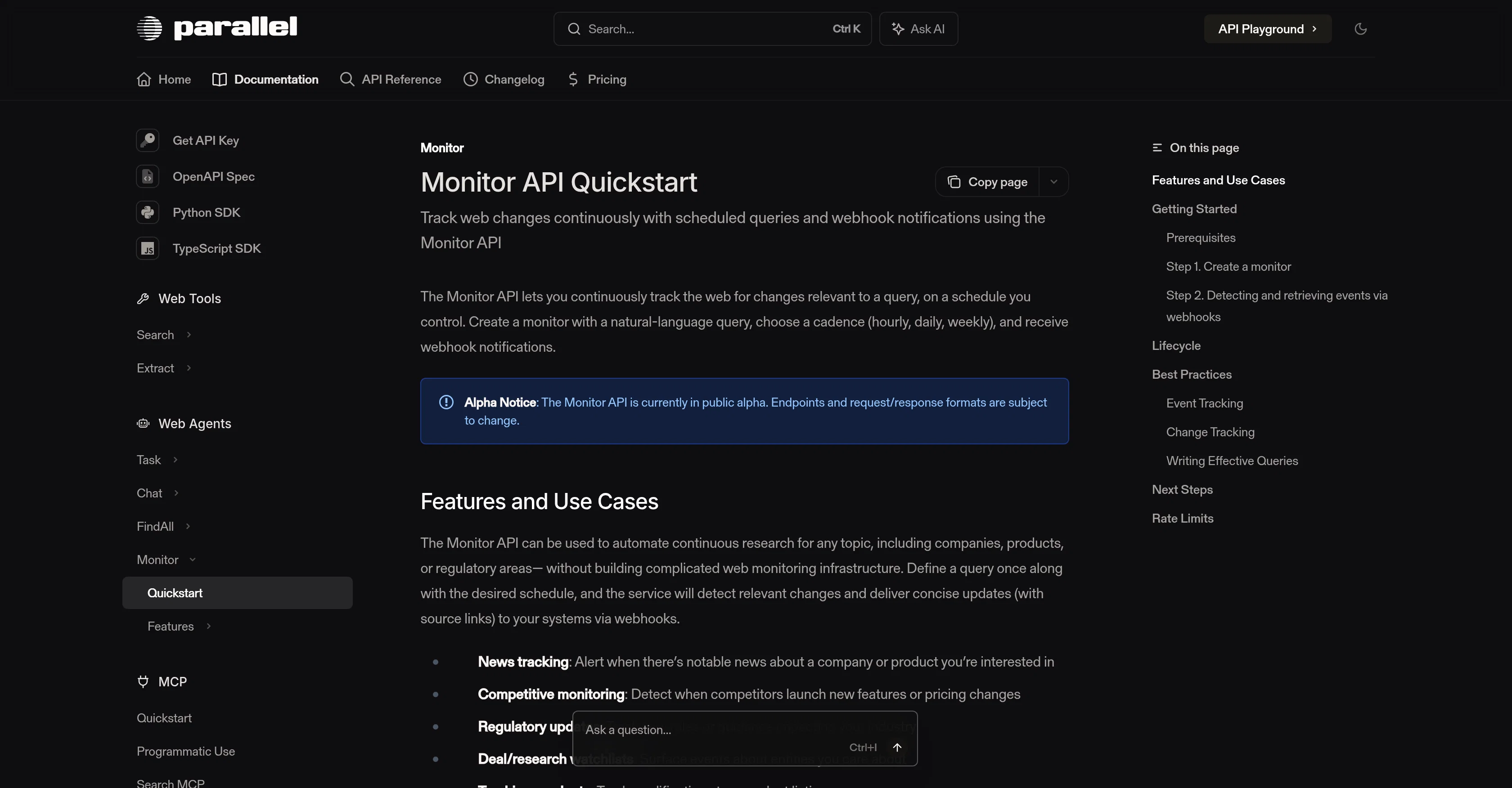
The Monitor API is a tool designed for continuous tracking of web changes relevant to a user-defined query, providing scheduled updates via webhook notifications.
Users can generate a monitor with a natural-language query and choose an update cadence (hourly, daily, or weekly). The tool is made for automating ongoing research without building complicated web monitoring infrastructure.
By defining a query and setting a desired schedule, users can expect relevant web change alerts and concise updates with source links delivered to their systems.
Suitable use-cases include news tracking, competitive monitoring, regulatory updates, deal or research watchlists, and product modifications tracking.
Notable features include scheduling of updates, receiving notifications upon event detection or monitor completion, retrieval of event history, and lifecycle management abilities, which include updating cadence, webhook, or metadata and deletion for stopping future runs.
Instead of using polling, users are advised to use webhooks in order to reduce latency to updates. The tool is currently in its public alpha, implying that endpoints and request/response formats may mutate as development continues.
Access & connections
Where you can use Parallel Monitor API, and what it plugs into.
Platforms
Integrations
Capabilities
What this tool accepts, produces, and is strongest at.
Input
- API
- Tabular
- Text
Output
- API
- Text
Highlights
- API
Supported features
- API
- Search
- Automation
- SOC 2 Compliance
Pros & cons
Pros
- Scheduled updates
- Webhook notifications
- Natural-language queries
- News tracking
- Competitive monitoring
- Regulatory updates
- Research watchlists
- Product tracking
Show 38 more
- Event detection
- Lifecycle management
- Reduced latency
- Event history retrieval
- Metadata management
- Alpha version
- Deal tracking
- User-defined queries
- Automated research
- Web change tracking
- Event completion notification
- Suitable for industry updates
- Adaptable cadence
- Hourly, daily, or weekly updates
- Endpoints mutation for development
- Supports Python and TypeScript SDK
- Efficient webhook setup
- Reminder for version migration
- Flexible to user needs
- Write queries in natural language
- Effective for fast-moving topics
- Slack thread routing
- Cancellation feature reduces bills
- Structured outputs
- Brand mentions tracking
- Product announcements alerts
- Regulatory updates notifications
- Price monitoring
- Stock availability alert
- Content updates tracking
- Policy changes tracking
- Crawler status page
- On-page extensive documentation
- Web Agents Task Chat
- API Playground feature
- Monitor API Quickstart
- MCP Integrations
- Supports AWS Marketplace
Cons
- Alpha version instability
- Requires natural-language query proficiency
- No support for polling
- Limited update frequency options
- Webhook dependency for notifications
- Metadata management complexity
- Potential latency in notifications
- No guaranteed event detection
Show 2 more
- Requires manual monitor lifecycle management
- End-user webhook setup requirement
Compare alternatives
Similar tools in the catalog — with a clear reason to open each one.
Let Me Know When ✓
FreemiumAI-powered alerts for website changes
Why look Freemium alternative
Full comparison
Fluxguard ✓
Free TrialAI-powered web surveillance for critical changes.
Free + from $99/mo
Full comparison
Firecrawl Monitor ✓
FreemiumMonitor the web. Get only what changed.
Why look Freemium alternative
Full comparison
Releases 1
FAQ 12
What is the purpose of the Monitor API?
How can I track web changes using Monitor API?
What types of update cadence does Monitor API support?
What are the use-cases of Monitor API?
What are the key features of Monitor API?
How can I use webhooks with Monitor API?
What is the alpha version of Monitor API?
Can I customize the metadata in Monitor API?
How does Monitor API reduce latency to updates?
What does 'monitor lifecycle management' mean in the context of Monitor API?
What do webhook notifications from Monitor API contain?
How to write effective natural-language queries for Monitor API?
Related tools
Recommended

Automateed ✓
Free TrialCreate eBooks effortlessly with Automateed, the AI-powered writing tool.

Recall ✓
FreemiumSummarize Anything, Forget Nothing!

Kin - Personal AI Advisors ✓
FreePrivacy-first & designed your for mind, and life at work

Notis ✓
Free TrialThe first WhatsApp assistant that runs on your ChatGPT and Claude subscriptions

freebeat AI ✓
FreemiumTurn Music & Ideas into Viral Videos In One Click

Marketing Assistant (Elsa AI) ✓
FreemiumDefine your ideal customers and craft a winning marketing strategy with Elsa.