

Benchmarks 2026 Rank: #2977
Optima by Artificial Analysis
Benchmark AI models on your own tasks, not someone else's.
Verdict
A quick read before you dig into the full page.
- Best if
- Benchmark AI models on your own tasks, not someone else's
- Skip if
- HS code speciality limited
- Pick this when
- Custom benchmark creation
Overview
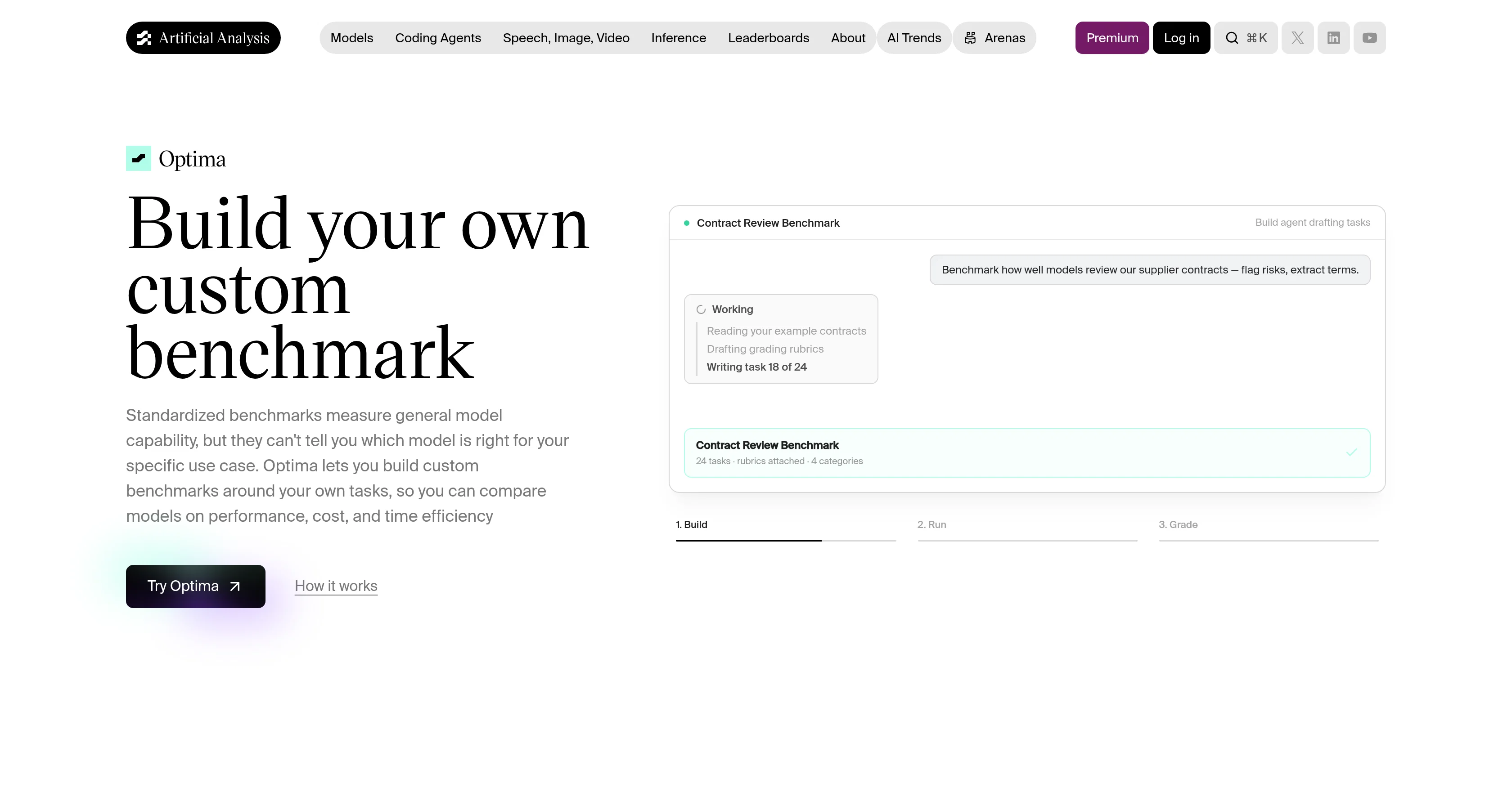
Optima, part of the Artificial Analysis suite, is designed to help users evaluate AI models based on custom benchmarks around specific tasks, providing insights about model performance, cost, and time efficiency.
Instead of relying on generalized benchmarks, Optima facilitates creating benchmarks from ones own data and tasks, and provides results for the latest models as soon as they are released.
It allows users to import their traces and use their coding agents, providing ample flexibility for various use cases. Optima's approach also enables a detailed evaluation based on specific criteria, by employing a panel of judges from major evaluations for a head-to-head ranking of models.
Users can also bring their own AI agent, which can compete in the benchmarking process. Additionally, Optima provides evaluative metrics including cost and time per task efficiency, across different models, aiding users significantly in decision-making.
The pricing model of Optima is based on token usage and grading costs, thus enabling a clear and predictable cost structure for running evaluations. The key takeaway about Optima is its ability to provide customized, objective, and precise model evaluation, which is highly cost and time efficient.
Access & connections
Where you can use Optima by Artificial Analysis.
Platforms
Capabilities
What this tool accepts, produces, and is strongest at.
Input
- Tabular
- Text
Output
- Tabular
- Text
Pros & cons
Pros
- Custom benchmark creation
- Task-focused model evaluation
- In-depth performance insights
- Grades latest models
- Flexible trace imports
- Supports coding agents
- Model head-to-head ranking
- Comparative analysis feature
Show 35 more
- Cost and time metrics
- Predictable cost structure
- Model-specific efficiency reports
- Interactive task setup
- Option for objective grading
- Includes benchmark competition
- User-tailored rubric options
- Pass-through grading costs
- Importance for decision-making
- Cost-per-task analysis
- Supports various agent types
- Task efficiency comparison
- Panel of expert judges
- Real-time model updates
- Latest model access
- Built on grading expertise
- Deterministic scoring system
- Cost and time optimization
- Detailed evaluation criteria
- Supports multiple evaluation-types
- Offers pairwise grading
- Facilitates task interaction simulation
- Charges based on usage
- Control over grading costs
- Offers token-based pricing
- Supports user-specific contexts
- Allows user-defined agents
- Multiple model processing
- Detailed grading breakdown
- Custom rubric grading
- Selective evaluation type
- Attachment of examples
- Facilitates context description
- Task creation assistance
- Individual grading per model
Cons
- Token-based pricing model
- Requires own data import
- Dependent on user-defined benchmarks
- No standard benchmarks available
- Only provides latest model results
- Requires agent handling expertise
- Grading cost is extra
- Real-time interaction feature pending
Show 2 more
- HS code speciality limited
- Task drafting and rubrics creation required
Releases 1
FAQ 12
What is Optima from Artificial Analysis?
How can Optima help users evaluate AI models?
What are the benefits of using custom benchmarks in Optima?
Can I import my own data and tasks into Optima?
Does Optima provide results for new AI models once released?
Can Optima assist with detailed evaluation of AI models?
Is it possible to bring my own AI agent to compete in Optima's benchmarking process?
What sort of evaluative metrics does Optima provide?
What is the pricing model of Optima?
How beneficial is Optima in decision-making regarding AI models?
Can Optima handle task-specific model evaluation?
What kind of flexibility does Optima offer for different use cases?
Related tools
Recommended

GetLogit ✓
FreemiumArtificial intelligence, available for everyone.

ChatGPT ✓
FreemiumAsk anything, create anything, and move from idea to action.

Notis ✓
Free TrialThe first WhatsApp assistant that runs on your ChatGPT and Claude subscriptions

freebeat AI ✓
FreemiumTurn Music & Ideas into Viral Videos In One Click

Jason AI ✓
PaidAI-powered assistant for B2B sales outreach

DeepSeek ✓
FreeUnravel the mystery of AGI with curiosity