

OmniTrust ✓
ML fraud detection that sees everything.
Verdict
A quick read before you dig into the full page.
- Best if
- ML fraud detection that sees everything
- Skip if
- Lacks multi-language support
- Pick this when
- Holistic user behavior understanding
Considering Ambient AI instead? Compare side by side
Overview
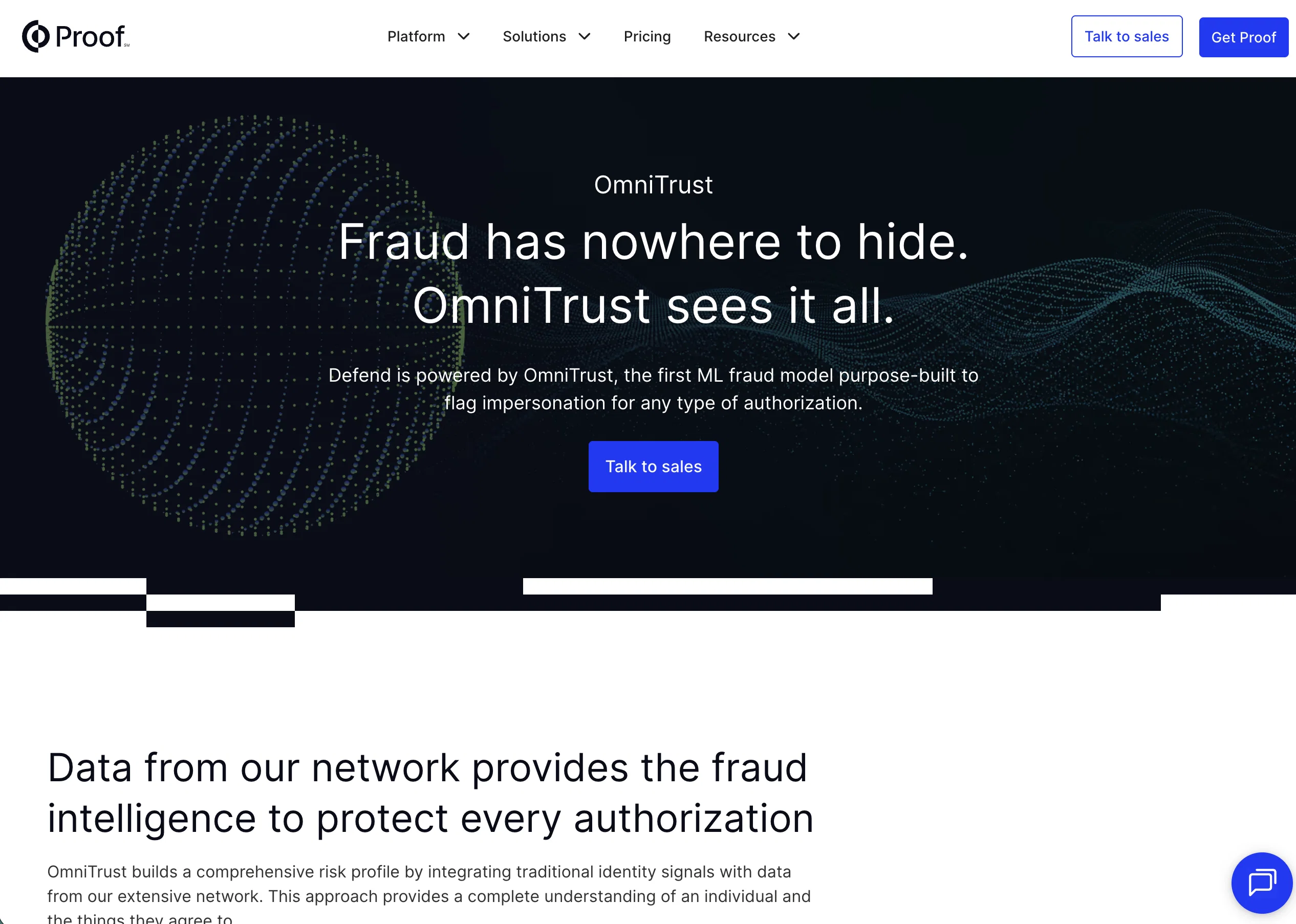
OmniTrust is an advanced fraud detection tool powered by machine learning, designed to enhance transaction security. Developed by Proof, it's specifically built to flag potential impersonation attempts during authorizations across a range of sectors including Real Estate, Financial Services, and Energy.
OmniTrust builds a comprehensive risk profile of individuals by integrating traditional identity signals with data from an extensive network, ensuring a holistic understanding of user behavior.
Key features include deepfake detection capabilities, credential and biometric matching, and liveliness detection to protect against AI impersonation.
Its ability to incorporate signals from payment networks helps identify credit card associated fraud risk, while synthetic identity detection enables it to flag bogus identities.
This tool also utilizes feedback from human agents to continually improve its learning model. Additionally, it employs IP and location data signals to detect suspicious activities like the usage of VPNs, adopts device fingerprinting to catch coordinated fraud patterns, and uses transactional data to comprehend the transaction nature, enabling a nuanced risk assessment.
OmniTrust is ideal for businesses seeking a robust, comprehensive solution to guard their customer interactions and transactions against fraud.
Access & connections
Where you can use OmniTrust.
Platforms
Capabilities
What this tool accepts, produces, and is strongest at.
Input
- Tabular
Output
- Text
Supported features
- Cybersecurity
- Data Analysis
- Image Understanding
Pros & cons
Pros
- Holistic user behavior understanding
- Deepfake detection capabilities
- Credential matching
- Biometric matching
- Liveliness detection
- Payment network signal incorporation
- Credit card fraud identification
- Synthetic identity detection
Show 16 more
- Human feedback integration
- IP and location data utilization
- VPN detection
- Device fingerprinting
- Transactional data analysis
- Nuanced risk assessment
- Customer interaction protection
- Impersonation protection
- Sector-specific utility
- Risk profiling
- Identity verification
- Optimised for multiple sectors
- Protection against replay attacks
- Coordinated fraud pattern detection
- Incorporates human-agent reports
- Inconsistency flagging
Cons
- Lacks multi-language support
- No explicit regulatory compliance
- May raise privacy concerns
- No clear accountability features
- No custom integrations mentioned
- Lacks offline capabilities
- Biometrics may create accessibility issues
- Doesn't mention mobile compatibility
Show 2 more
- No real-time support specified
- No open API
Compare alternatives
Similar tools in the catalog — with a clear reason to open each one.

Ambient AI ✓
UnknownTransform physical security with AI-powered threat detection.
No pricing
Full comparison

RiskOS AI Suite ✓
UnknownEmbedded AI assistants and agents for risk teams.
No pricing
Full comparison
Charley | Charlemagne Labs ✓
FreemiumDefending Against Cyber Threats with Agentic AI
Free + from $29/mo
Full comparison
AI Security Gateway ✓
FreemiumAI Firewall & LLM Proxy — PII Redaction, Smart Routing, Budget Enforcement
Why look Offers a public API
Full comparison
Releases 1
FAQ 12
What is OmniTrust?
How does OmniTrust use machine learning?
What sectors can OmniTrust be used in?
What is the role of deepfake detection in OmniTrust?
How does OmniTrust implement credential and biometric matching?
What is liveliness detection in OmniTrust?
How does OmniTrust detect credit card fraud?
Does OmniTrust detect synthetic identities?
How does OmniTrust improve its learning model?
How does OmniTrust use IP and location data for fraud detection?
Does OmniTrust detect the usage of VPNs?
What is meant by device fingerprinting in the context of OmniTrust?
Related tools
Recommended

Polymer Runtime Data Security ✓
Free TrialPrevent AI data breaches with real-time risk management.
AI QA Monkey ✓
FreemiumInstant AI Security Score: Scan Free, Fix with AI, Monitor 24/7.

ApiPosture ✓
FreemiumFind API security flaws in seconds.

ZeroPath ✓
FreemiumAI-native SAST finding 2x more vulnerabilities with fewer false positives.

LangWatch ✓
PaidSimulation-based AI agent testing and evaluation that turns unpredictable agents into reliable