

Ai infrastructure 2026 Rank: #3213
Modal ✓
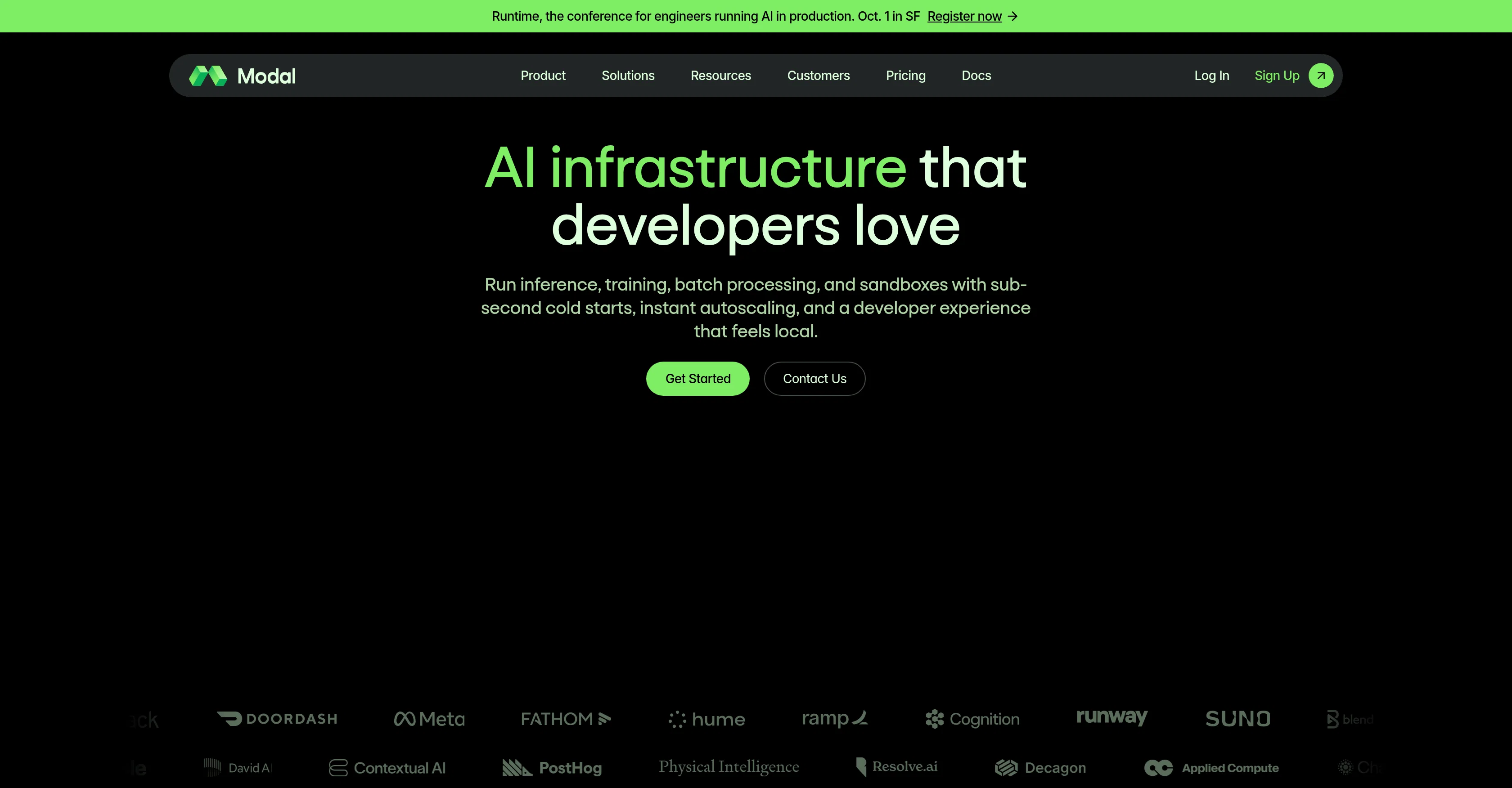
AI infrastructure that developers love.
Verdict
A quick read before you dig into the full page.
- Best if
- AI infrastructure that developers love
- Skip if
- Limited to Python
- Pick this when
- Serverless platform
Considering Mel by Skymel- Persistent Open-Web intelligence Infr... instead? Compare side by side
Overview
Modal provides a high-performance AI infrastructure, serving as a serverless platform for AI and data teams. It allows users to run data-intensive compute with their own code.
The tool is designed specifically to handle intensive AI workloads and offers features such as sub-second cold starts and instant autoscaling, providing an experience that feels local to developers.
It includes the Modal SDK, which allows everything from logic to hardware to be specified in one place in Python. The system includes a unique AI-native runtime, offering super-fast autoscaling and container booting.
The platform's elasticity allows it to autoscale from zero to 1,000+ GPUs instantly, routing workloads across clouds and regions in real time. For transparency and control, it provides robust observability tools.
Modal caters to various workloads, including inference, training, and batch processing. Due to its flexible design, it suits everything from single-GPU fine-tuning to parallel hyperparameter sweeps to multi-node runs.
With its 'sandbox' feature, it can also securely scale ephemeral environments for executing untrusted code. Additionally, the tool guarantees security, governance, and isolation with its unique measures, supporting SO2 & HIPAA specifications.
Access & connections
Where you can use Modal.
Platforms
Capabilities
What this tool accepts, produces, and is strongest at.
Input
- Code
Output
- API
Pros & cons
Pros
- Serverless platform
- Run user's own code
- Sub-second cold starts
- Instant autoscaling
- Local-like developer experience
- Modal SDK included
- Logic and hardware unity
- Super-fast container booting
Show 31 more
- Highly elastic platform
- Instant GPU autoscaling
- Workloads routing in real-time
- Supports various workloads
- Allows parallel hyperparameter sweeps
- Enables multi-node runs
- Sandboxing feature for security
- Isolation for untrusted code
- SO2 & HIPAA compliance
- Unified observability
- Flexible design
- Robust security and governance
- Single-GPU fine-tuning
- Supports inference, training
- Supports batch processing
- Data residency controls
- Team control features
- Battle-tested isolation
- Real-time code collaboration
- First-party integrations
- Multi-cloud capacity pool
- Intelligent scheduling of resources
- Unified logs and visibility
- Ephemeral environment scaling
- Globally distributed storage system
- Fast model loading
- High throughput architecture
- Low latency design
- Developer community accessibility
- Shareable notebooks feature
- Coverage across clouds and regions
Cons
- Limited to Python
- Not open-source
- No multi-language support
- No YAML or config files
- Unsuitable for non-GPU intensive workloads
- Potentially high cost at scale
- Dependency on third-party cloud providers
- Lack of data retention capabilities
Compare alternatives
Similar tools in the catalog — with a clear reason to open each one.

Mel by Skymel- Persistent Open-Web intelligence Infr... ✓
Free TrialOpen-source intelligence infrastructure for teams and agents
Why look Typically cheaper
Full comparison
Connector | Hostinger ✓
PaidDeploy and manage websites directly from your IDE.
Why look Typically cheaper
Full comparison
Agentic Mail | Hostinger ✓
PaidEmail infrastructure built for AI agents.
Why look Typically cheaper
Full comparison
Clocsy ✓
Free TrialFinds your customers, fills your roles, and tracks your competitors — autonomously.
Why look Typically cheaper
Full comparison
Mnemom ✓
FreemiumTrust scores, cryptographic proof, and risk assessment for AI agents.
Why look Typically cheaper
Full comparison
Releases 1
FAQ 12
What is Modal?
How does Modal handle intensive AI workloads?
What features does Modal offer for faster compute?
How can I use my own code with Modal?
Can you explain how the Modal SDK works with Python?
How does Modal handle autoscaling and container booting?
What features does Modal offer for transparency and control?
What types of workloads can Modal handle?
How is Modal designed to handle different GPU tasks?
Can Modal instantly autoscale from zero to 1000+ GPUs?
What is Modal's 'sandbox' feature for?
How does Modal deal with security, governance, and isolation?
Related tools
Recommended

AppDeploy ✓
FreeDeploy real apps directly from ChatGPT or Claude

Waveloom ✓
PaidBuild and deploy AI workflows visually

Octopoda ✓
FreemiumPersistent memory infrastructure for AI agents with Real Time Analytics

Sketch To ✓
Free TrialAI Image to Sketch Converter

FastRouter ✓
Free TrialLightning Fast LLM Gateway

Another Wrapper ✓
PaidBuild AI apps faster with 10 ready-to-use demo apps and powerful integrations