
MiR Autonomous Mobile Robots ✓
Autonomous mobile robots that optimize logistics productivity.
Verdict
A quick read before you dig into the full page.
- Best if
- Autonomous mobile robots that optimize logistics productivity
- Skip if
- Limited speed
- Pick this when
- Optimizes logistics productivity
Considering olixBot G1 instead? Compare side by side
Overview
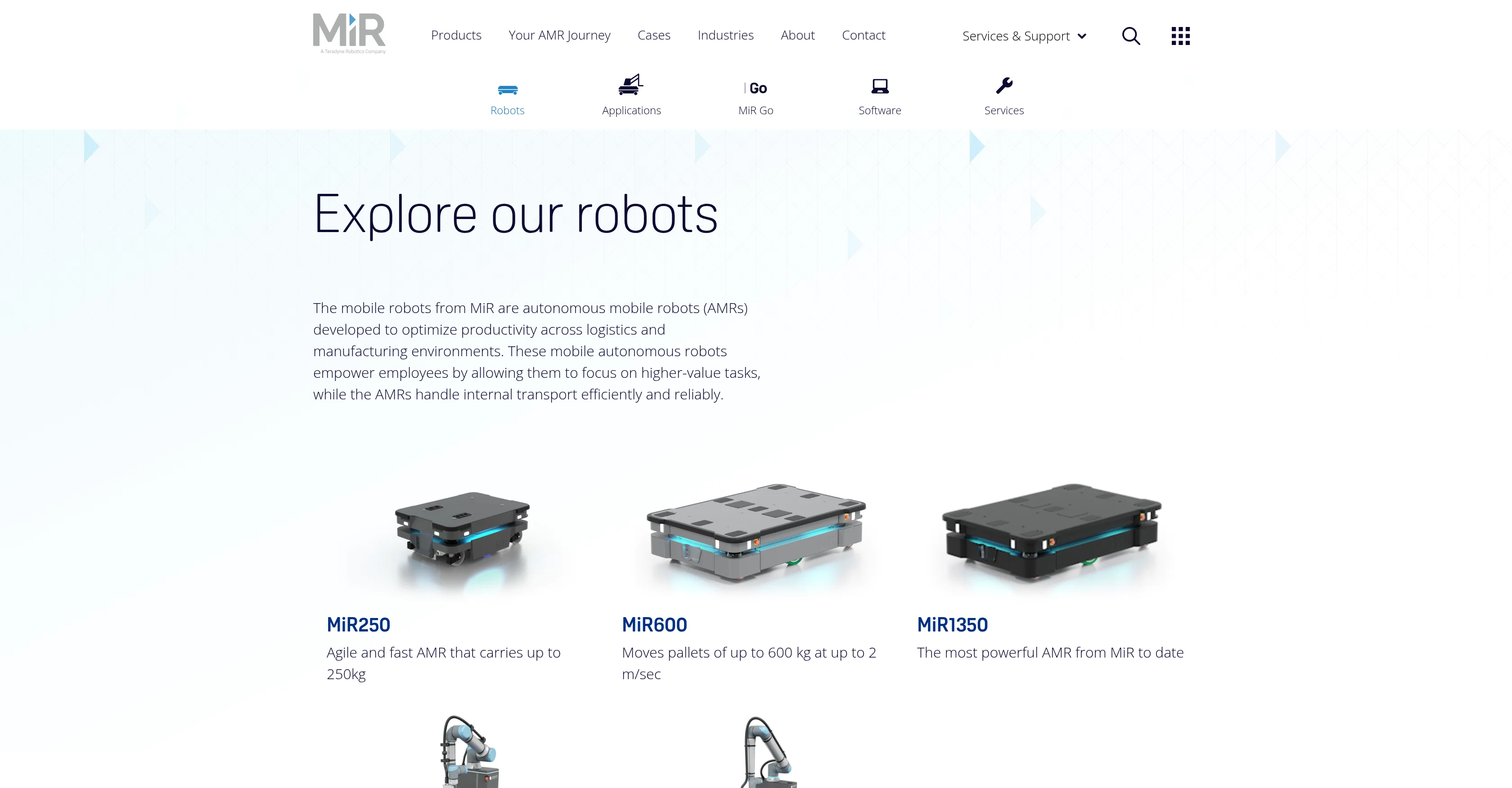
MiR Autonomous Mobile Robots (AMRs) are designed to optimize productivity in logistics and manufacturing operations. These mobile robots are autonomous, aimed to improve efficiency while delegating lower-value tasks such as internal transport to the machines, hence freeing up employees for higher-value tasks.
Each robot can be easily customized according to the specific requirements of a job, resulting in a flexible and adaptable solution. The AMRs have been developed with optimal safety measures, complying with international safety standards and incorporating advanced obstacle avoidance technologies.
These robots can also navigate complex environments reliably. They are designed with scalability, thereby suitable for operations of different sizes. Another remarkable feature of MiR AMRs is their ability to integrate into existing workflows without any disruption and requiring no advanced technical skills.
They are quick to deploy, cost-effective, and easy to program using intuitive interfaces. Moreover, in terms of accommodating to space constraints, their compact design enables efficient operation in tight spaces, narrow aisles, and elevators.
Unique to MiR is the centralized fleet management feature which allows for smooth coordination across multiple robot units. Altogether, MiR Autonomous Mobile Robots offer an innovative solution for increased productivity, flexibility, and safety in logistics and manufacturing operations, particularly for businesses looking to enhance their intralogistics processes.
Access & connections
Where you can use MiR Autonomous Mobile Robots.
Platforms
Pros & cons
Pros
- Optimizes logistics productivity
- Improves manufacturing efficiency
- Automates lower-value tasks
- Customizable per job requirements
- Flexible solution
- Advanced safety measures
- Complies with international safety
- Advanced obstacle avoidance
Show 37 more
- Navigates complex environments reliably
- Scalable for varying operations
- Seamless workflow integration
- Compact design for tight spaces
- Centralized fleet management
- Quick to deploy
- Cost-effective
- Easy programming with intuitive interfaces
- Integration without workflow disruption
- Handles internal transport tasks
- Requires no advanced technical skills
- Efficient operation in narrow aisles
- Smooth coordination across multiple units
- Enhances intralogistics processes
- Employee safety
- NO advanced technical skills required
- Reduction in space constraints
- Provides multiple pick-up/drop-off points
- Effective in small and narrow spaces
- Caters to operations of different sizes
- No disruption to existing processes
- Suitable for dynamic environments
- Real-time route adaptations
- Open platform for customization
- Integrates with existing workflows
- User-friendly software interface
- Communicates via visual indicators
- Multiple safety layers inbuilt
- Ideal for human-robot collaboration
- Handles multiple pickup/delivery points
- Equipped with 360 laser scanners
- Incorporates personnel detection systems
- Inbuilt emergency stop buttons
- Installed with signal lights for safety
- Tailored to specific applications
- Scalable through centralized fleet software
- Enhances material flow efficiency
Cons
- Not suitable for rough terrains
- Dependant on facility layout
- Limited weight carrying capacity
- Potential technical glitches
- Limited speed
- Requires training for employees
- Not for highly specialized tasks
- Not built for outdoor navigation
Show 2 more
- Constrained to customized tasks
- Reliable power source required
Compare alternatives
Similar tools in the catalog.

olixBot G1 ✓
UnknownROS-native omnidirectional robot for advanced development.
No pricing
Full comparison
KUKA Autonomous Mobile Robotics (AMR) ✓
UnknownAutonomous robots for flexible material transport and assembly.
No pricing
Full comparison
ABB Autonomous Mobile Robots ✓
UnknownSmart robots that move loads autonomously.
No pricing
Full comparison