

Test automation 2026 Rank: #1467
Autonoma ✓
Agentic testing with real browsers and devices.
Free + from $499/mo
Verdict
A quick read before you dig into the full page.
- Best if
- You are qA teams and need: Automated regression testing on every release
- Skip if
- Limited to web, mobile testing
- Pick this when
- Open-source testing platform
Considering Alumnium instead? Compare side by side
Overview
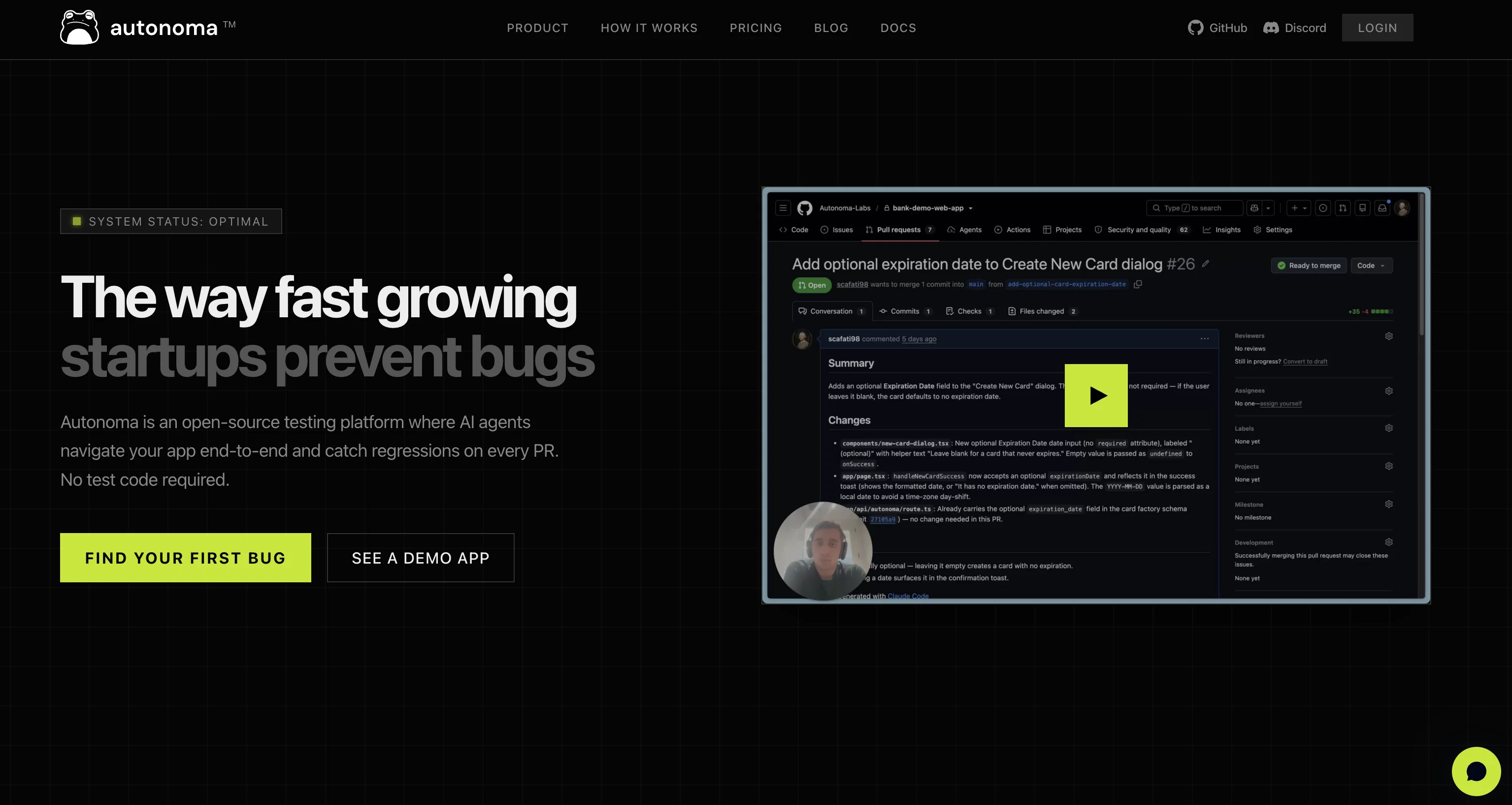
Autonoma is an open-source testing platform powered by artificial intelligence. It provides testing capabilities for web and mobile applications in real browsers and devices, enabling detection of regressions on every update.
One of the distinguishing features of Autonoma is its AI agents that navigate and test an application end-to-end, without the need for any test code. Autonoma connects directly to the user's GitHub repository to analyze and map the codebase, covering every page, user flow, and edge case to generate a comprehensive test plan.
The AI agents of Autonoma interact with the application in the same way a real user would, performing actions like clicking through flows, filling forms, and testing the user interface.
Each code push triggers Autonoma to run tests on the preview deploy, with results showing up directly in the pull request. Autonoma is also built to integrate seamlessly into the existing stack of tools without disrupting workflow.
It supports a wide range of frameworks and languages, making it a versatile choice for any development stack. Despite its comprehensive testing capabilities, Autonoma aims not to replace QA teams but to enhance their efficiency by catching regressions and providing instant feedback.
Best for
Short scenarios where Autonoma tends to shine.
-
Automated regression testing on every release
Best for QA teams
-
End-to-end testing for web and mobile applications
Best for Business teams
-
Understanding and documenting legacy codebases
Best for Software developers
-
UI testing without engineers
Best for CTOs
Example outputs 1
Sample generations and before/after results for Autonoma.
Access & connections
Where you can use Autonoma, and what it plugs into.
Platforms
Integrations
Capabilities
What this tool accepts, produces, and is strongest at.
Input
- Code
Output
- Code
Highlights
- Agents
- Open Source
Supported features
- Agents
- Automation
- Code Review
- Computer Use
- Integrations
- Open Source
- QA Automation
Pros & cons
Pros
- Open-source testing platform
- End-to-End Testing
- Code Analysis
- GitHub Integration
- User Flow Testing
- Edge Case Testing
- UI Testing
- Automatic Test Generation
Show 38 more
- Deployment Testing
- Stack Integration
- Framework Support
- Language Support
- Enhances QA efficiency
- Provides instant feedback
- Tests in real browsers
- Tests on real devices
- No test code required
- Catches regressions on updates
- Enhances efficiency of QA teams
- Clicks through flows
- Fills forms in testing
- Test results in PR
- Test on preview deploy
- Wide framework compatibility
- Wide language compatibility
- Mapped coverage of codebase
- Zero trust architecture
- SOC 2 Type II Certified
- End-to-End Encryption
- SSO & RBAC integration
- VPC Peering (Enterprise)
- Data Encryption at Rest
- Browses app like a user
- Integrates with existing tools
- Supports various development stacks
- Automatically Analyzes GitHub repo
- Supports Web and Mobile testing
- Sandboxed test environment
- Parallel test execution
- Dashboard and team collaboration
- Scalable parallel execution
- Supports Autonoma cloud and self-hosted
- Enforces role-based access controls
- Tests accessibility of URLs and devices
- Web, iOS & Android testing
- Slack channel integration
Cons
- Requires GitHub integration
- Relies on real devices
- Not a stand-alone tool
- Repository access necessary
- May miss human insensitivity
- Payment for additional credits
- Unclear handling of framework-specific issues
- Not bound to specific frameworks/languages
Show 2 more
- Limited to web, mobile testing
- No feature limits for self-hosted version
Compare alternatives
Similar tools in the catalog — with a clear reason to open each one.

Alumnium ✓
FreeAI-powered test automation from human instructions
Why look Fully free option
Full comparison
Keak ✓
PaidAI-powered A/B testing for continuous website improvement
Why look Typically cheaper
Full comparison
Kane AI ✓
FreemiumWorld’s first end to end software testing agent built on modern LLMs
Why look Typically cheaper
Full comparison
Bugzy AI ✓
Free TrialRelease faster with QA that keeps up
Why look Typically cheaper
Full comparison
QA.tech ✓
PaidOur AI tests your web apps and creates bug reports loved by developers.
Why look Typically cheaper
Full comparison
Quell ✓
Free TrialAI agents that supercharge UAT and catch critical bugs faster.
Why look Typically cheaper
Full comparisonPeople also view
Tools that often show up alongside Autonoma in collections and comparisons.
Quell ✓
Free TrialAI agents that supercharge UAT and catch critical bugs faster.
QA.tech ✓
PaidOur AI tests your web apps and creates bug reports loved by developers.
Kane AI ✓
FreemiumWorld’s first end to end software testing agent built on modern LLMs
Bugzy AI ✓
Free TrialRelease faster with QA that keeps up
Keak ✓
PaidAI-powered A/B testing for continuous website improvement
Alumnium ✓
FreeAI-powered test automation from human instructions

TestDriver ✓
FreemiumAI code reviewer that actually runs your app.

Quash ✓
Free TrialMobile QA testing your team will actually adopt.
Releases 1
Imported reviews 1
100% agentic.
FAQ 12
What is Autonoma?
How does Autonoma use AI agents to test my application?
How does Autonoma interact with GitHub?
Does Autonoma support mobile applications testing?
How can Autonoma detect regressions with each GitHub update?
How does Autonoma generate a comprehensive test plan for my application?
Can Autonoma run tests on real devices and browsers?
How does Autonoma handle user interface testing?
What happens when I push code while using Autonoma?
Will Autonoma disrupt my existing stack of tools?
What frameworks and languages does Autonoma support?
Is Autonoma intended to replace my QA team?
Related tools
Recommended

Observe Earth ✓
FreeSee the world and share what's really happening.

Claude ✓
FreemiumBuilding reliable, interpretable AI systems

DeepSeek ✓
FreeUnravel the mystery of AGI with curiosity

Serno ✓
FreemiumCustom AI experts that map what one AI can't

biela.dev ✓
Free TrialIf you can imagine it, Biela can code it!

Rocket ✓
FreemiumThink It. Type It. Launch It.