

Knowledge bases 2026 Rank: #1272
MemoryBase ✓
Unified Memory for Every AI Tool
Verdict
A quick read before you dig into the full page.
- Best if
- Unified Memory for Every AI Tool
- Skip if
- Limited browsing options of memory
- Pick this when
- Unified memory capture
Considering remio: Your Personal ChatGPT instead? Compare side by side
Overview
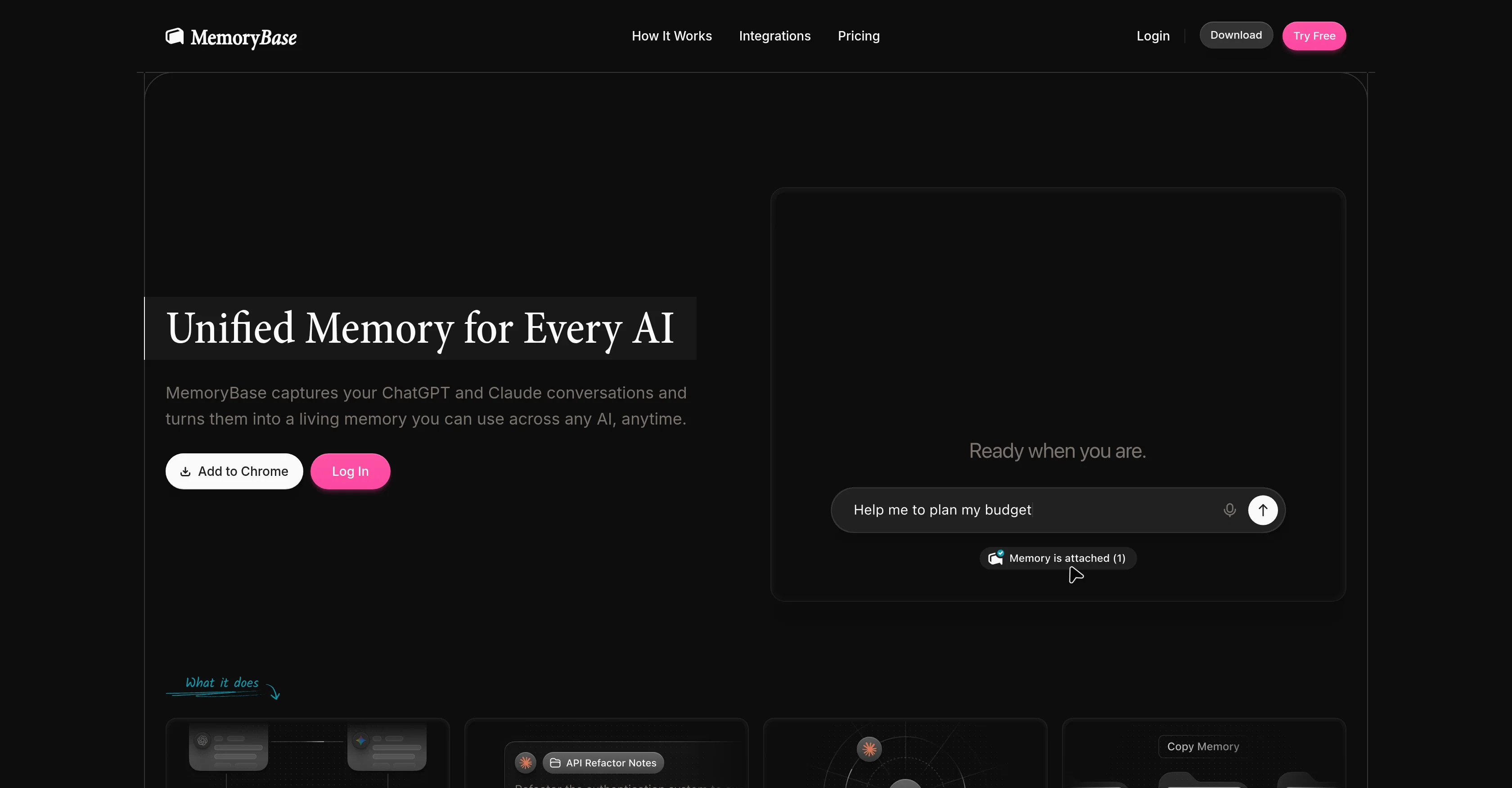
MemoryBase is an AI tool that provides a unified, cross-model memory for AI applications. Its main function is to capture and store conversations from different AI tools such as ChatGPT and Claude.
By doing so, it creates a 'living memory' that can be used to inform and enhance interactions across various AI applications. In essence, it unifies the separate 'memories' of different AI tools into a central hub, enabling effective, seamless transfers of conversation context and user history among AI models.
Each AI agent connected with MemoryBase gets the necessary context from previous interactions without the need to reiterate information. This tool also allows users to push any conversation into their Integrated Development Environment (IDE), benefiting from a continuous thread of discussions from platforms like ChatGPT, Claude, and Gemini.
MemoryBase also has features for organizing the captured conversations automatically, allowing users to browse their memory chronologically or by project.
Users have complete control over their collected data as they can prune, export, and decide what each AI assistant should know. It supports a variety of AI tools and plans to expand its integration capabilities.
Security and privacy are key considerations, with features designed to ensure user data stays secure, with sensitive information staying on the user's device and the data encrypted end-to-end.
Access & connections
Where you can use MemoryBase.
Platforms
Capabilities
What this tool accepts, produces, and is strongest at.
Input
- Text
Output
- Text
Highlights
- Agents
Supported features
- Memory
- Integrations
- IDE
- Agents
- Cybersecurity
Pros & cons
Pros
- Unified memory capture
- Cross-model memory functionality
- Seamless context transfer
- User history management
- IDE integration benefit
- Automatic conversation organizing
- User-friendly memory browsing
- Complete data control
Show 31 more
- End-to-end data encryption
- Sensitive information kept local
- Project memory access
- Chronological memory browsing
- Project-level memory browsing
- User-defined context packs
- Enhances personalized communication
- Expandable integration capabilities
- Priority support for Pro
- Conversation labelling and organization
- Unlimited chat history (Pro)
- Unlimited context packs (Pro)
- Data pruning availability
- Data export option
- Automated background updates
- Move chats instantly
- Individual agent context adapting
- ChatGPT compatible
- Claude compatible
- Gemini compatible
- Security focused design
- Privacy prioritizing
- User-ran context building
- Context aware agents
- Easy memory export
- Data deletion option
- Free version available
- Pro version for advanced users
- Memory recall for each tool
- One-click full data export
- No lock-in policy
Cons
- Focused on Text-Only Conversations
- Limited integration capabilities
- Data pruning could lead to data loss
- Might be difficult to navigate large volumes of data
- Security concerns with sensitive information
- End-to-end encryption may slow performance
- Limited browsing options of memory
- Potential privacy breaches
Compare alternatives
Similar tools in the catalog — with a clear reason to open each one.

remio: Your Personal ChatGPT ✓
FreemiumGet Tailored Answer with Your Personal ChatGPT
Why look Offers a public API
Full comparison
Sensay ✓
Free TrialAI Offboarding that keeps knowledge inside your company.
Free + from $500/yr
Full comparison
Nouswise ✓
FreemiumYour personal search engine for trusted information.
Free + from $9.98/mo
Full comparison
Saner.ai ✓
FreemiumOrganized knowledge for business and info management.
Free + from $16 / month
Full comparison
Releases 1
FAQ 12
How does MemoryBase capture dialogue from different AI tools like ChatGPT and Claude?
What does it mean when MemoryBase is described as a 'living memory'?
Can MemoryBase be accessed and used at any time and place?
How does MemoryBase help in reducing repetition of information to AI?
What is the advanced retrieval system of MemoryBase?
How useful is MemoryBase for users who engage with multiple AI tools concurrently?
What does 'tool-agnostic' mean in the context of MemoryBase?
How does MemoryBase improve the quality of interaction with AI tools?
How does MemoryBase enhance the understanding of user's preferences and context?
Can MemoryBase enable a more personalized interaction experience with AI?
How does MemoryBase enhance efficiency in communication with AI?
Can MemoryBase be used across different AI applications?
Related tools
Recommended

AppDeploy ✓
FreeDeploy real apps directly from ChatGPT or Claude

AvatarCraft AI ✓
Free TrialGenerate professional AI avatar videos from text or audio in seconds.

Jason AI ✓
PaidAI-powered assistant for B2B sales outreach

AI Website Builder | Hostinger ✓
FreemiumCreate stunning websites instantly with AI.

Floot ✓
FreemiumBuild AI apps with the subscription you're already paying for.

AI Builder | Hostinger Horizons ✓
Free TrialBuild web apps and websites without writing any code.