

Music vv3 Pro 2026 Rank: #135
Lyria ✓
Generate high fidelity music and audio
Verdict
A quick read before you dig into the full page.
- Best if
- Generate high fidelity music and audio
- Skip if
- High learning curve
- Pick this when
- High fidelity music generation
Considering Suno instead? Compare side by side
Overview
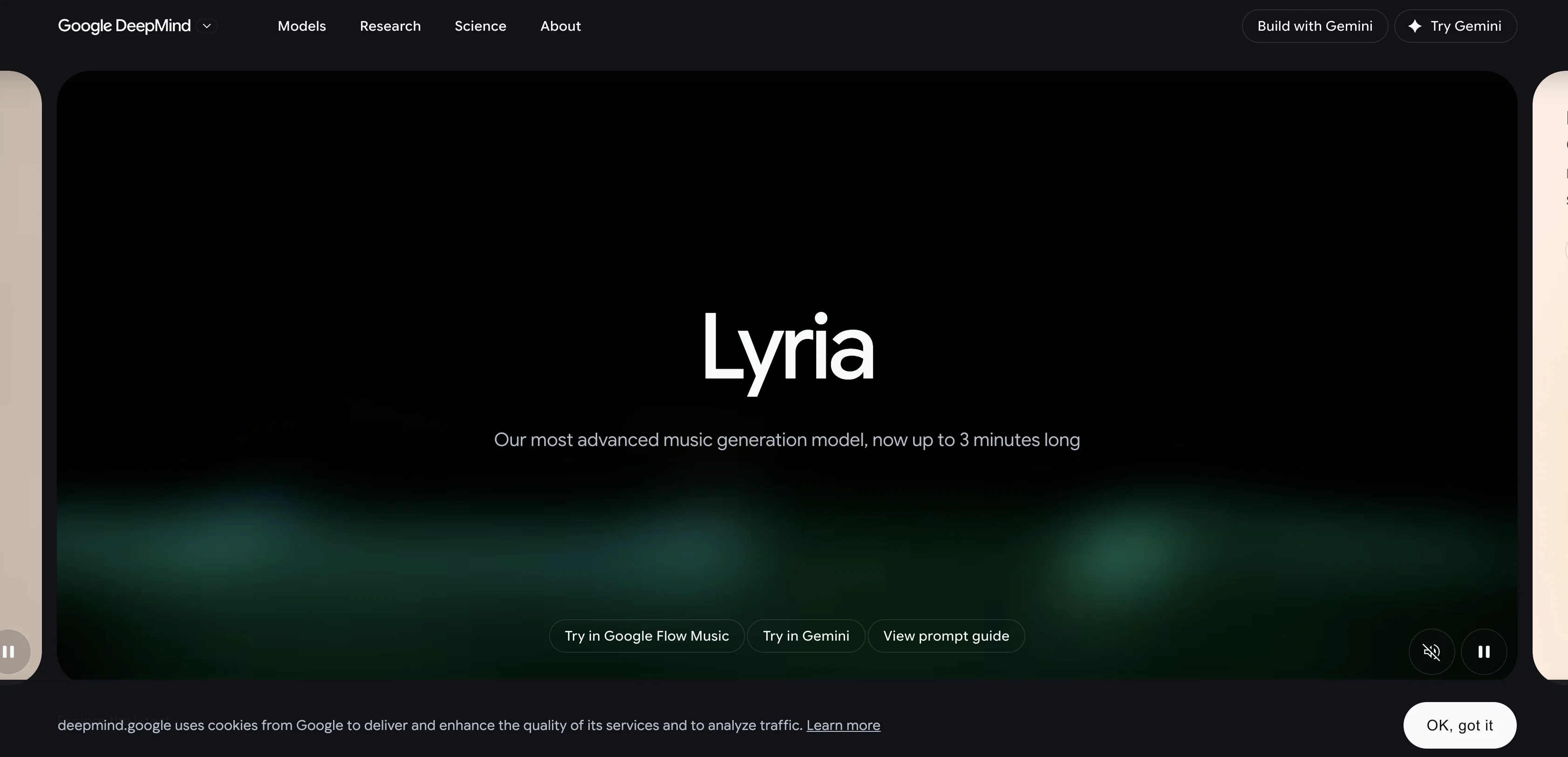
Developed by Google DeepMind, Lyria 3 is a highly sophisticated AI model specifically designed for music generation. This model offers a creative platform for users to explore, experiment with new ideas, and create their desired sound.
Users can upload an image and Lyria 3 has the ability to transform it into a custom high-fidelity track. Lyria 3 allows for unique customization, as it provides the ability to define realistic vocal styles and acoustic preferences, thereby enabling users to produce music that aligns perfectly with their creative vision.
The output can range from background ambience to mainstage anthems, designed to produce crisp and clear tracks ready for various projects. Additionally, Lyria 3 fits into Google's mission of building AI responsibly to benefit humanity, and prioritizes AI safety through proactive security, untouched by evolving threats.
Best for
Short scenarios where Lyria tends to shine.
-
Generate high fidelity music and audio
Example outputs 1
Sample generations and before/after results for Lyria.
Access & connections
Where you can use Lyria.
Platforms
Capabilities
What this tool accepts, produces, and is strongest at.
Input
- Text
Output
- Audio
- API
Supported features
- Sound Creation
- Music Generation
- Image Understanding
- Text Generation
- Styling
- Voice Cloning
- SynthID
Pros & cons
Pros
- High fidelity music generation
- Image-to-audio conversion
- Unique sound customization
- Defined vocal styles
- Acoustic preference setting
- Range of output types
- Crisp clear track production
- Realtime interactive music generation
Show 11 more
- Produces cohesive tracks
- Supports global languages
- Multi-genre music creation
- Professional-grade audio export
- Fine-scale details control
- Produces natural flowing music
- Prompts for creative tracks
- Music-watermarking with SynthID
- Extensive filtering of data
- Reduces harmful lyric likelihood
- Data privacy-assured
Cons
- No offline capability
- Limited voice styles
- Image-to-audio results vary
- High learning curve
- Specific to music
- Export quality inconsistency
- No batch processing
- Limited acoustic preferences
Show 2 more
- Potential privacy concerns
- Limited genre capabilities
Compare alternatives
Similar tools in the catalog — with a clear reason to open each one.

Tunee ✓
FreemiumChat with AI to create music and music video in minutes.
Why look Offers a public API
Full comparison
AirMusic ✓
Free TrialAI music generator and music video creator in one platform.
Free + from $11.9/mo
Full comparisonPeople also view
Tools that often show up alongside Lyria in collections and comparisons.
Tunee ✓
FreemiumChat with AI to create music and music video in minutes.
Suno ✓
FreemiumMake music at the speed of your ideas.

Singify ✓
PaidSingify Your World – Create, Cover, Inspire

MusicStar.ai ✓
Free TrialPersonalized music with automated genre and lyrics.

MakeBestMusic-Al Song Generator ✓
Free TrialTurn Ideas into Original Music – Your AI Songmaker
AirMusic ✓
Free TrialAI music generator and music video creator in one platform.

RaoMusic ✓
FreemiumAI Music Generator with Pay-as-you-go Credits

MeloLetter ✓
PaidTurn real memories into personalised song gifts.
Releases 3
Longer track generation, expanding from shorter creations to tracks up to 3 minutes.
Better structural awareness, with explicit control over sections like intros, verses, choruses, and bridges.
Stronger customization and creative control for more complex song builds and transitions.
Broader rollout across Google products, including Vertex AI, AI Studio, Gemini app, Google Vids, and ProducerAI.
More production-oriented use, pushing it beyond creative sketching into scalable soundtrack, video, and song-making workflows.
Cohesive track generation with smoother musical flow from start to finish.
Supports vocals and can generate songs with lyrics from prompts.
Multimodal prompting that can turn an uploaded image into a matching track.
Broader genre and language coverage for vocals and styles.
Ships inside Gemini as a music-making feature, not just a developer-only or lab-only demo.
In the news
Launch coverage and community mentions for Lyria.
FAQ 12
What is Lyria 3?
How does Lyria 3 generate music?
What is the image-to-audio conversion feature in Lyria 3?
How can I customize the sound in Lyria 3?
What is the output quality of the music generated by Lyria 3?
Can Lyria 3 help me to create a unique vocal style?
How does Lyria 3 ensure AI safety?
What is the AI Ethical Use in Lyria 3?
Can Lyria 3 be used for automatic music composition?
How does Lyria 3 assist in creativity?
How can Lyria 3 aid in track production?
What is the role of Google DeepMind in Lyria 3?
Related tools
Recommended

AppDeploy ✓
FreeDeploy real apps directly from ChatGPT or Claude

Promtist AI ✓
FreeGenerate optimized prompts for better AI results.

Lyric Remix Studio ✓
FreeAI-powered music generation, transcription, and album art

Thea ✓
FreemiumAI study tools to master material, not just memorize it.

Claude ✓
FreemiumBuilding reliable, interpretable AI systems

DeepSeek ✓
FreeUnravel the mystery of AGI with curiosity
More from this creator
Gemini ✓
FreemiumGemini: Google's most capable AI model yet

Google Imagen ✓
Free TrialTransform images with AI-powered creativity

Veo ✓
PaidGenerate high-quality, cinematic videos with AI.

Nano Banana ✓
FreemiumAI-powered image editing, faster than ever with Nano Banana.

AlphaGenome ✓
UnknownDecipher DNA function with DeepMind's genomics model.

Gemini Robotics ✓
UnknownMultimodal AI for next-generation helpful robots.